

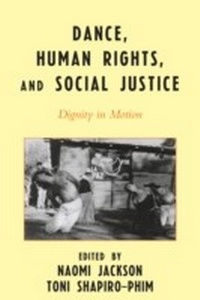
Dance, Human Rights, and Social Justice
Dignity in Motion
Scarecrow Press
1st Edition
Published on 6. November 2008
398 pages
978-0-8108-6218-0 (ISBN)
Description

Dance, Human Rights, and Social Justice: Dignity in Motion presents a wide-ranging compilation of essays, spanning more than 15 countries. Organized in four parts, the articles examine the regulation and exploitation of dancers and dance activity by government and authoritative groups, including abusive treatment of dancers within the dance profession; choreography involving human rights as a central theme; the engagement of dance as a means of healing victims of human rights abuses; and national and local social/political movements in which dance plays a powerful role in helping people fight oppression.
These groundbreaking papers-both detailed scholarship and riveting personal accounts-encompass a broad spectrum of issues, from slavery and the Holocaust to the Bosnian and Rwandan genocides to the Israeli-Palestinian conflict; from First Amendment cases and the AIDS epidemic to discrimination resulting from age, gender, race, and disability. A range of academics, choreographers, dancers, and dance/movement therapists draw connections between refugee camp, courtroom, theater, rehearsal studio, and university classroom.
These groundbreaking papers-both detailed scholarship and riveting personal accounts-encompass a broad spectrum of issues, from slavery and the Holocaust to the Bosnian and Rwandan genocides to the Israeli-Palestinian conflict; from First Amendment cases and the AIDS epidemic to discrimination resulting from age, gender, race, and disability. A range of academics, choreographers, dancers, and dance/movement therapists draw connections between refugee camp, courtroom, theater, rehearsal studio, and university classroom.
More details
Edition
1. Auflage
Language
English
Place of publication
Lanham
United States
Target group
Professional and scholarly
ISBN-13
978-0-8108-6218-0 (9780810862180)
Copyright in bibliographic data and cover images is held by Nielsen Book Services Limited or by the publishers or by their respective licensors: all rights reserved.
Schweitzer Classification
Other editions
Additional editions
Book
11/2008
Scarecrow Press
€138.50
Shipment within 10-20 days
Persons
Naomi Jackson, Ph.D. in performance studies, is associate professor in the Department of Dance at Arizona State University. She is the author of Converging Movements: Modern Dance and Jewish Culture at the 92nd Street Y (2002).
Toni Shapiro-Phim, Ph.D. in cultural anthropology, is director of research and archiving at the Khmer Arts Academy in Takhmao, Cambodia. She is the co-author of Dance in Cambodia (1999).
Toni Shapiro-Phim, Ph.D. in cultural anthropology, is director of research and archiving at the Khmer Arts Academy in Takhmao, Cambodia. She is the co-author of Dance in Cambodia (1999).
Content
- Intro
- Contents
- Preface
- Acknowledgments
- Introduction
- Part One. Regulatory Moves
- Chapter 1. Roadblock: Journal Excerpt, November 26, 2001
- Chapter 2. Practical Imperative: German Dance, Dancers, and Nazi Politics
- Chapter 3. Plunge Not into the Mire of Worldly Folly: Nineteenth-Century and Early Twentieth-Century Religious Objections to Social Dance in the United States
- Chapter 4. Dancing Chinese Nationalism and Anticommunism: The Minzu Wudao Movement in 1950s Taiwan
- Chapter 5. Animation Politique: The Embodiment of Nationalism in Zaire
- Chapter 6. Dance and Human Rights in the Middle East, North Africa, and Central Asia
- Chapter 7. Right to Dance: Exotic Dancing in the United States
- Chapter 8. The Hidden Authoritarian Roots in Western Concert Dance
- Chapter 9. Human Rights and Dance through an Artist's Eyes
- Part Two. Choreographing Human Rights
- Chapter 10. Fagaala
- Chapter 11. Your Fight Is Our Fight: Protest Ballets in Sweden
- Chapter 12. Dancing in Paradise with Liz Lerman on 9/11
- Chapter 13. What Was Always There
- Chapter 14. Cambodian Dance and the Individual Artist
- Chapter 15. Dancing against Burning Grounds: Notes on From Site: Lament, Fury, and a Plea for Peace
- Chapter 16. Human Rights Issues in the Work of Barro Rojo Arte Escénico
- Chapter 17. Requiem
- Chapter 18. Sardono: Dialogues with Humankind and Nature
- Chapter 19. Adib's Dance
- Part Three. Healing, Access, and the Experience of Youth
- Chapter 20. Japanese Butoh and My Right to Heal
- Chapter 21. Dancing in our Blood: Dance/Movement Therapy with Street Children and Victims of Organized Violence in Haiti
- Chapter 22. Interactions between Movement and Dance, Visual Images, Etno, and Physical Environments: Psychosocial Work with War-Affected Refugee and Internally Displaced Children and Adults (Serbia 2001-2002)
- Chapter 23. Sudanese Youth: Dance as Mobilization in the Aftermath of War
- Chapter 24. Community Dance: Dance Arizona Repertory Theatre as a Vehicle for Cultural Emancipation
- Chapter 25. Doing Time: Dance in Prison
- Chapter 26. Balance and Freedom: Dancing in from the Margins of Disability
- Part Four. Kinetic Transgressions
- Chapter 27. Exposure and Concealment
- Chapter 28. The Dance of Life: Women and Human Rights in Chile
- Chapter 29. Mediating Cambodian History, the Sacred, and the Earth
- Chapter 30. No More Starving in the Attic: Senior Dance Artists Advocate a Canadian Artists' Heritage Resource Centre
- Chapter 31. Dance and Disability
- Chapter 32. Monuments and Insurgencies in the Age of AIDS
- Chapter 33. If I Survive: Yehudit Arnon's Story
- Index
- About the Editors and Contributors
