

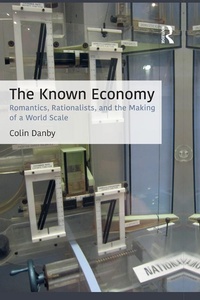
The Known Economy
Romantics, Rationalists, and the Making of a World Scale
Published on 26. June 2017
218 pages
978-1-317-30213-1 (ISBN)
Description

Why do critics and celebrants of globalization concur that international trade and finance represent an inexorable globe-bestriding force with a single logic? The Known Economy shows that both camps rest on the same ideas about how the world is scaled. Two centuries ago romantic and rationalist theorists concurred that the world was divided into discrete nations, moving at different rates toward a "modernity", split between love and money. Though differing over whether this history is tragedy or triumph, they united in projecting an empty "international" space in which a Moloch-like global capitalism could lurk.
The Known Economy tracks the colonial development of national accounting and re-examines the ways gender and heteronormativity are built in to economic representation. It re-interprets the post-WWII spread of standardized economic statistics as the project of international organizations looking over the shoulders of national governments, rather than the expanding power of national governments over populations.
The Known Economy tracks the colonial development of national accounting and re-examines the ways gender and heteronormativity are built in to economic representation. It re-interprets the post-WWII spread of standardized economic statistics as the project of international organizations looking over the shoulders of national governments, rather than the expanding power of national governments over populations.
Reviews / Votes
"Incisive, illuminating, and strikingly original, The Known Economy is a lucid and erudite account of how modernist knowledge practices (especially those of economists) came together with the post-war international system to create what the author terms "the modern world scale". Danby's engaging and eye-opening tale should dispel once and for all the idea that national accounting is dull!" - James Ferguson, Susan S. and William H. Hindle Professor in the School of Humanities and Sciences, Stanford University"An incisive genealogical critique of Modernist economics, The Known Economy adds a fresh dimension to postcolonial studies. Colin Danby's analysis of the origination in economics of the category known as "world scale" demonstrates the complicity of the international in the national and challenges postcolonial theory to rethink its perspective on nationalism and the nation state. For far too long, economics has been no more than a concept metaphor in postcolonial studies, and Danby's work remedies this situation and demonstrates the infrastructural imperatives of economics and economic accounting at work in the worlding of the postcolonial imaginary" - R. Radhakrishnan, Chancellor's Professor of English and Comparative Literature, University of California, Irvine
The Known Economy offers an innovative account of the conceptions and forms of calculation with which mainstream economics came to represent and measure the economy. Equally, the book argues that some of the major cultural critics of modern economic thought share the same conceptual genealogy, reproducing in their criticisms some of the unexplored assumptions on which the contemporary global economy depends. Economic calculation and its critics, Danby tells us, jointly shape our world. - Timothy Mitchell, Professor of Middle Eastern, South Asian, and African Studies, Columbia University
The Known Economy provides a fascinating and insightful account of the contested representations that have shaped 20th century economic practice. Through a set of imaginative and carefully researched case studies, Colin Danby disrupts the binaries of household/market, national/global, modernity/tradition and love/money that animate economic thinking, while exposing the gendered, heteronormative and colonial power dynamics at work in even the most "technical" accounts of national and global economic activity. This book is crucial reading for anyone interested in critically rewriting economics outside of its current disempowering logics. - Suzanne Bergeron, Professor of Social Sciences, University of Michigan-Dearborn
More details
Series
Language
English
Place of publication
London
United Kingdom
Publishing group
Taylor & Francis Ltd
Target group
College/higher education
Product notice
Reflowable
Illustrations
9 s/w Abbildungen, 1 s/w Tabelle, 2 s/w Photographien bzw. Rasterbilder, 7 s/w Zeichnungen
1 Tables, black and white; 7 Line drawings, black and white; 2 Halftones, black and white; 9 Illustrations, black and white
File size
1,30 MB
ISBN-13
978-1-317-30213-1 (9781317302131)
Copyright in bibliographic data and cover images is held by Nielsen Book Services Limited or by the publishers or by their respective licensors: all rights reserved.
Schweitzer Classification
Other editions
Additional editions
Book
08/2018
1st Edition
Routledge
€77.03
Shipment within 10-20 days
Book
05/2017
1st Edition
Routledge
€215.77
Shipment within 10-20 days
Person
Colin Danby received a Ph.D. in Economics from the University of Massachusetts Amherst in 1997 and is currently Professor of Interdisciplinary Arts and Sciences at the University of Washington, Bothell. He has published articles in Post Keynesian theory, Feminist Economics, and Economic Anthropology.
Content
Preface and acknowledgments
Introduction: Sarkozy versus GDP
Part 1: The Voice of Economy
Introduction to Part I
1. Love or Money
2. A Jewish Economy in Palestine
3. Body of the Nation
4. Shape of the World
5. Discovering Economies in British Africa
6. The IMF Makes the World
Part 2: Romantic Responses
Introduction to Part Two
7. Romantic Political Economy
8. Shock of the Modern
9. Jameson's Postmodern
10. Spirit of Finance
Part 3: Opening Up
11. Time and Finance
12. Numbered Things
Introduction: Sarkozy versus GDP
Part 1: The Voice of Economy
Introduction to Part I
1. Love or Money
2. A Jewish Economy in Palestine
3. Body of the Nation
4. Shape of the World
5. Discovering Economies in British Africa
6. The IMF Makes the World
Part 2: Romantic Responses
Introduction to Part Two
7. Romantic Political Economy
8. Shock of the Modern
9. Jameson's Postmodern
10. Spirit of Finance
Part 3: Opening Up
11. Time and Finance
12. Numbered Things
