

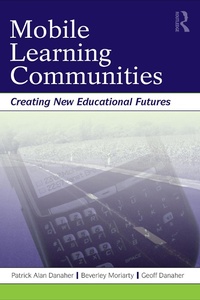
Mobile Learning Communities
Creating New Educational Futures
Published on 1. June 2009
224 pages
978-1-135-85241-2 (ISBN)
Description

Mobile Learning Communities explores the diverse ways in which traveling groups experience learning 'on the run'. This book provides empirical evidence that draws on the authors' 17 years of continuing research with international occupational Travelers. It engages with themes such as workplace learning, globalization, multiliteracies, and emerging technologies which impinge on the ways mobile groups make sense of themselves as learning communities. International in focus, this book deals with an issue of increasing global significance and shows the complexities of the lives and learning experiences of such mobile cultures and their strategies for earning, learning, and living, thus challenging simplistic and stereotypical images of traveling groups still found in mainstream media and popular culture.
Mobile Learning Communities brings together for the first time mobilities and learning communities into a single and comprehensive focus. It provides a detailed analysis of how mobile groups position themselves and how they are positioned by others. This text will appeal to scholars in the field of distance education and educational technology and to researchers in education, cultural studies, and sociology. It will also be of interest to educational instructors, policy-makers, and administrators, as well as teacher educators and pre-service teachers. It paints a vivid picture of the experience of mobility through the words of the mobile learners themselves, but also critiques existing notions of learning and suggests ways of creating new educational futures for all learners and educators.
Mobile Learning Communities brings together for the first time mobilities and learning communities into a single and comprehensive focus. It provides a detailed analysis of how mobile groups position themselves and how they are positioned by others. This text will appeal to scholars in the field of distance education and educational technology and to researchers in education, cultural studies, and sociology. It will also be of interest to educational instructors, policy-makers, and administrators, as well as teacher educators and pre-service teachers. It paints a vivid picture of the experience of mobility through the words of the mobile learners themselves, but also critiques existing notions of learning and suggests ways of creating new educational futures for all learners and educators.
Reviews / Votes
'most importantly it puts learning in its place by stressing the current conceptual bases for applying technologies' -- British Journal of Educational Technology, Vol 41, No 2, 2010More details
Language
English
Place of publication
London
United Kingdom
Publishing group
Taylor & Francis Ltd
Target group
College/higher education
Illustrations
10 s/w Abbildungen, 2 s/w Tabellen
2 Tables, black and white; 10 Illustrations, black and white
File size
7,46 MB
ISBN-13
978-1-135-85241-2 (9781135852412)
Copyright in bibliographic data and cover images is held by Nielsen Book Services Limited or by the publishers or by their respective licensors: all rights reserved.
Schweitzer Classification
Other editions
Additional editions
Patrick Alan Danaher | Beverley Moriarty | Geoff Danaher
Mobile Learning Communities
Creating New Educational Futures
Book
06/2009
1st Edition
Routledge
€241.70
Shipment within 15-20 days
Patrick Alan Danaher | Beverley Moriarty | Geoff Danaher
Mobile Learning Communities
Creating New Educational Futures
Book
06/2009
1st Edition
Routledge
€82.40
Shipment within 15-20 days
Persons
Patrick Alan Danaher (BEd, BA, BA(Hons), GradDipTertiaryEd, MLitt, PhD) is Associate Professor in Education (Education Research) at the Toowoomba campus of the University of Southern Queensland, Australia.
Beverley Moriarty (DipTeach, BEd, MEd, PhD, AMusA) is Senior Lecturer in the School of Teacher Education at the Dubbo campus of Charles Sturt University, Australia.
Geoff Danaher (BA(Hons), DipEd, PhD) is a Lecturer in Learning Support and the Skills for Tertiary Education Preparatory Studies program in the Division of Teaching and Learning Services at the Rockhampton campus of Central Queensland University, Australia.
Beverley Moriarty (DipTeach, BEd, MEd, PhD, AMusA) is Senior Lecturer in the School of Teacher Education at the Dubbo campus of Charles Sturt University, Australia.
Geoff Danaher (BA(Hons), DipEd, PhD) is a Lecturer in Learning Support and the Skills for Tertiary Education Preparatory Studies program in the Division of Teaching and Learning Services at the Rockhampton campus of Central Queensland University, Australia.
Content
List of Illustrations
Acknowledgments
List of Acronyms
Introduction: Mobile Learning Communities
1. Networks and Partnerships
2. Lifelong Learning: From the Cradle to the Grave
3. Technologies and Their Users
4. Globalization and Interactions with the Outside World
5. The Knowledge Economy and Workplace Learning
6. Multiliteracies and Meaning-Making
7. Communities at Risk: Building Capacities for Sustainability
8. Marginalization and Transformation
Conclusion: Creating New Educational Futures
Glossary of Terms
References
Index
Acknowledgments
List of Acronyms
Introduction: Mobile Learning Communities
1. Networks and Partnerships
2. Lifelong Learning: From the Cradle to the Grave
3. Technologies and Their Users
4. Globalization and Interactions with the Outside World
5. The Knowledge Economy and Workplace Learning
6. Multiliteracies and Meaning-Making
7. Communities at Risk: Building Capacities for Sustainability
8. Marginalization and Transformation
Conclusion: Creating New Educational Futures
Glossary of Terms
References
Index
