

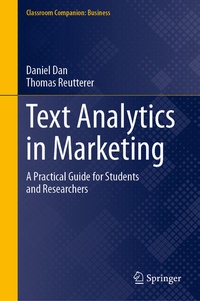
Text Analytics in Marketing
Description

This book offers a comprehensive introduction to text mining and text analytics tailored for marketers. It presents key techniques for analyzing, compressing, classifying, and visualizing textual data and user-generated content (UGC), with a particular emphasis on using R software. These methods enable readers to effectively prepare and manipulate textual data to uncover actionable marketing insights.
In today's digital landscape, analyzing online chatter, sentiment, preferences, and other forms of electronic word-of-mouth has become an essential skill for marketing researchers and professionals. Through a rich collection of examples, program code, and hands-on exercises, this book equips both students and marketing managers with the theoretical foundation and practical skills needed to apply text-based data analysis to contemporary marketing challenges.
More details
Other editions
Additional editions
Persons
Daniel Dan is Assistant Professor and founder of the School of Applied Data Science at Modul University Vienna (MU Vienna), Austria. His expertise focuses on natural language processing, information retrieval, and data-driven marketing analytics in text-rich environments. His primary research, teaching, and collaboration interests include generative AI, sentiment and opinion mining, data visualization, and decision support. He teaches data science and AI courses at MU Vienna and AI at the WU (Vienna University of Economics and Business) Executive Academy. His work features in peer-reviewed journals and international conferences, and he contributes to EU-funded projects on information overload and digital well-being.
Thomas Reutterer is Professor of Marketing at the Vienna University of Economics and Business (WU Vienna), Austria. His expertise focuses on analyzing, modeling and forecasting customer behavior in data-rich environments. His primary research, teaching and business consulting interests are focused in areas of retail and digital services, customer value and relationship management, and marketing models for customer-base analysis and decision support. His prior research has appeared in leading marketing and operations management journals.
Content
Introduction to Text Analytics in Marketing: A Practical Guide for Students and Researchers.- Textual Data, String Handling, Regular Expressions, and Data Structures.- Obtaining Textual Data for Marketing Analytics, Web Scraping, APIs, and Structured Sources.- Basic Text Analysis, Preprocessing, Bag of Words, TF-IDF, and Exploratory Statistics.- Clustering Text for Marketing Segmentation, Similarity Measures and Grouping.- Text Classification, LDA, KNN, SVM, Neural Networks, and Fast Text.- Topic Modeling for Marketing Insights, Latent Dirichlet Allocation and Structural Topic Models.- Sentiment and Emotion Analysis in Marketing, Lexicons, Machine Learning, and Aspect Based Methods.- Named Entity Recognition and Extractive Summarization.- Word Embeddings and Transformers for Marketing Text Analytics.
