

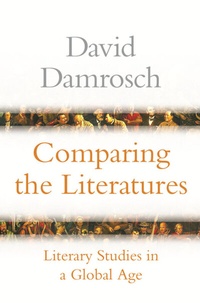
Comparing the Literatures
Literary Studies in a Global Age
1st Edition
Published on 6. April 2020
392 pages
978-0-691-20128-3 (ISBN)
Description

From a leading figure in comparative literature, a major new survey of the field that points the way forward for a discipline undergoing rapid changes
Literary studies are being transformed today by the expansive and disruptive forces of globalization. More works than ever circulate worldwide in English and in translation, and even national traditions are increasingly seen in transnational terms. To encompass this expanding literary universe, scholars and teachers need to increase their linguistic and cultural resources, rethink their methods and training, and reconceive the place of literature and criticism in the world. In Comparing the Literatures, David Damrosch integrates comparative, postcolonial, and world-literary perspectives to offer a comprehensive overview of comparative studies and its prospects in a time of great upheaval and great opportunity.
Comparing the Literatures looks both at institutional forces and at key episodes in the life and work of comparatists who have struggled to define and redefine the terms of literary analysis over the past two centuries, from Johann Gottfried Herder and Germaine de Staël to Edward Said, Gayatri Spivak, Franco Moretti, and Emily Apter. With literary examples ranging from Ovid and Kalidasa to James Joyce, Yoko Tawada, and the internet artists Young-Hae Chang Heavy Industries, Damrosch shows how the main strands of comparison-philology, literary theory, colonial and postcolonial studies, and the study of world literature-have long been intertwined. A deeper understanding of comparative literature's achievements, persistent contradictions, and even failures can help comparatists in literature and other fields develop creative responses to today's most important questions and debates.
Amid a multitude of challenges and new possibilities for comparative literature, Comparing the Literatures provides an important road map for the discipline's revitalization.
Literary studies are being transformed today by the expansive and disruptive forces of globalization. More works than ever circulate worldwide in English and in translation, and even national traditions are increasingly seen in transnational terms. To encompass this expanding literary universe, scholars and teachers need to increase their linguistic and cultural resources, rethink their methods and training, and reconceive the place of literature and criticism in the world. In Comparing the Literatures, David Damrosch integrates comparative, postcolonial, and world-literary perspectives to offer a comprehensive overview of comparative studies and its prospects in a time of great upheaval and great opportunity.
Comparing the Literatures looks both at institutional forces and at key episodes in the life and work of comparatists who have struggled to define and redefine the terms of literary analysis over the past two centuries, from Johann Gottfried Herder and Germaine de Staël to Edward Said, Gayatri Spivak, Franco Moretti, and Emily Apter. With literary examples ranging from Ovid and Kalidasa to James Joyce, Yoko Tawada, and the internet artists Young-Hae Chang Heavy Industries, Damrosch shows how the main strands of comparison-philology, literary theory, colonial and postcolonial studies, and the study of world literature-have long been intertwined. A deeper understanding of comparative literature's achievements, persistent contradictions, and even failures can help comparatists in literature and other fields develop creative responses to today's most important questions and debates.
Amid a multitude of challenges and new possibilities for comparative literature, Comparing the Literatures provides an important road map for the discipline's revitalization.
More details
Other editions
Additional editions
Book
02/2022
Princeton University Press
€26.50
Shipment within 10-20 days
Book
04/2020
Princeton University Press
€55.71
Shipment within 10-20 days
Person
David Damrosch is the Ernest Bernbaum Professor of Comparative Literature and director of the Institute for World Literature at Harvard University, and a past president of the American Comparative Literature Association. His many books include What Is World Literature? (Princeton), the coedited Princeton Sourcebook in Comparative Literature, The Buried Book: The Loss and Rediscovery of the Great Epic of Gilgamesh, and We Scholars: Changing the Culture of the University.
Content
- Cover
- Contents
- List of Illustrations
- Acknowledgments
- Introduction
- 1. Origins
- 2. Emigrations
- 3. Politics
- 4. Theories
- 5. Languages
- 6. Literatures
- 7. Worlds
- 8. Comparisons
- Conclusion: Rebirth of a Discipline
- Bibliography
- Index
