

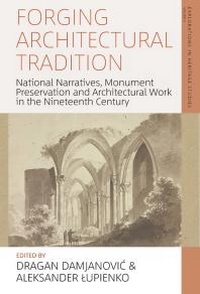
Forging Architectural Tradition
National Narratives, Monument Preservation and Architectural Work in the Nineteenth Century
1st Edition
Published on 11. March 2022
366 pages
978-1-80073-338-1 (ISBN)
Description

During the nineteenth century, a change developed in the way architectural objects from the distant past were viewed by contemporaries. Such edifices, be they churches, castles, chapels or various other buildings, were not only admired for their aesthetic values, but also for the role they played in ancient times, and their role as reminders of important events from the national past. Architectural heritage often was (and still is) an important element of nation building. Authors address the process of building national myths around certain architectural objects. National narratives are questioned, as is the position architectural heritage played in the nineteenth and the early twentieth centuries.
Reviews / Votes
"The book Forging Architectural Tradition is an excellent contribution for anyone interested in the creation of national narratives around architectural buildings. It is suitable for architects, art historians, historians, sociologists, cultural researchers, and the general cultural public, as well as anyone interested in the national narratives of 'small' nations. The topics explored in the book should not be viewed as a part of the distant past but as still current as the historical processes described in the book can help us deal with problems related to the politicization of heritage that is still evident today." * Prostor"The scholarly essays in this book present a sweeping panorama of this fascinating development based on new research, otherwise virtually inaccessible in English." * Jozsef Sisa, Institute of Art History, ELKH Research Centre for the Humanities, Budapest, Hungary
More details
Series
Edition
1. Auflage
Language
English
Place of publication
Oxford
United Kingdom
Target group
Professional and scholarly
Illustrations
Bibliography; Index; 27 Illustrations
ISBN-13
978-1-80073-338-1 (9781800733381)
DOI
10.3167/9781800733374
Copyright in bibliographic data and cover images is held by Nielsen Book Services Limited or by the publishers or by their respective licensors: all rights reserved.
Schweitzer Classification
Other editions
Additional editions
Dragan Damjanovic | Aleksander Lupienko
Forging Architectural Tradition
National Narratives, Monument Preservation and Architectural Work in the Nineteenth Century
Book
03/2022
Berghahn Books
€161.90
Shipment within 3-4 weeks
Persons
Dragan Damjanovic works as a full professor at the Art History Department, Faculty of Humanities and Social Sciences, University of Zagreb, Croatia, teaching and researching history of nineteenth- and twentieth-century Croatian and European art and architecture.
Content
List of Figures and Tables
Introduction: Forging Architectural Tradition
Aleksander Lupienko?
Part I: Architectural Conservation and National Narratives??
Chapter 1. The Cathedral of Citizenship: Race and National Identity in Eugene Viollet-le-Duc's Work and Discourse
Berenice Gaussuin??
Chapter 2. Identity Written in Stone?: Gothicising Renovation of Estonian Churches at a Second Glance
Kristina Joekalda??
Chapter 3. Architecture as a Weapon: The Gothic and the National Ideal in Nineteenth-Century Polish Discourse
Aleksander Lupienko??
Chapter 4. Before and After Emile-Andre Lecomte du Nouy or the Birth of National Style in Romanian Architecture
Anda-Lucia Spanu
Chapter 5. On the Articulation and Popularization of Christian Built Heritage: Representing National Continuity in Nineteenth-Century Athens
Georgios Karatzas
Part II: Styles for the Nation and State
??Chapter 6. Creating a Monument to Kaiser Wilhelm I in Berlin: Tensions between National, Prussian and Dynastic Identities
Douglas Klahr
Chapter 7. History, National Identity and Architecture in the Last Royal Palaces in Europe (1861-1930): Turin, Budapest, Bucharest
Paolo Cornaglia?
Chapter 8?. Renaissance Architecture and the Search for the Hungarian National Style in the Late Nineteenth and Early Twentieth Centuries?
Gabor Gyoergy Papp
Chapter 9. Vernacular Versus Historical: National Style(s) in the Architecture of Austro-Hungarian Croatia
Dragan Damjanovic??
Part III: Appropriation of Heritage(s)??
Chapter 10. Architectural Heritage in the National Discourse of the Nineteenth Century Russia: Kazan Antiquities
Gulchachak Nugmanova
??Chapter 11. Hungarian Nation-Building and the Use of Medieval Archaeology: Interpreting the Szekesfehervar Excavations in the Nineteenth Century
Andrea Kocsis
Chapter 12. Architectural Heritage of Silesia in the Purview of Prussian History (1740-1918)
Monika Ewa Adamska??
Chapter 13. Madonna del Pascolo: Ruthenian Heritage in the Baroque Rome and the Development of the National Church of the Ukrainians, 1640s-1960s
Anatole Upart
Afterword: For the Glory of Nation: Architectural Heritage in Nineteenth-Century Europe
Dragan Damjanovic
Index
Introduction: Forging Architectural Tradition
Aleksander Lupienko?
Part I: Architectural Conservation and National Narratives??
Chapter 1. The Cathedral of Citizenship: Race and National Identity in Eugene Viollet-le-Duc's Work and Discourse
Berenice Gaussuin??
Chapter 2. Identity Written in Stone?: Gothicising Renovation of Estonian Churches at a Second Glance
Kristina Joekalda??
Chapter 3. Architecture as a Weapon: The Gothic and the National Ideal in Nineteenth-Century Polish Discourse
Aleksander Lupienko??
Chapter 4. Before and After Emile-Andre Lecomte du Nouy or the Birth of National Style in Romanian Architecture
Anda-Lucia Spanu
Chapter 5. On the Articulation and Popularization of Christian Built Heritage: Representing National Continuity in Nineteenth-Century Athens
Georgios Karatzas
Part II: Styles for the Nation and State
??Chapter 6. Creating a Monument to Kaiser Wilhelm I in Berlin: Tensions between National, Prussian and Dynastic Identities
Douglas Klahr
Chapter 7. History, National Identity and Architecture in the Last Royal Palaces in Europe (1861-1930): Turin, Budapest, Bucharest
Paolo Cornaglia?
Chapter 8?. Renaissance Architecture and the Search for the Hungarian National Style in the Late Nineteenth and Early Twentieth Centuries?
Gabor Gyoergy Papp
Chapter 9. Vernacular Versus Historical: National Style(s) in the Architecture of Austro-Hungarian Croatia
Dragan Damjanovic??
Part III: Appropriation of Heritage(s)??
Chapter 10. Architectural Heritage in the National Discourse of the Nineteenth Century Russia: Kazan Antiquities
Gulchachak Nugmanova
??Chapter 11. Hungarian Nation-Building and the Use of Medieval Archaeology: Interpreting the Szekesfehervar Excavations in the Nineteenth Century
Andrea Kocsis
Chapter 12. Architectural Heritage of Silesia in the Purview of Prussian History (1740-1918)
Monika Ewa Adamska??
Chapter 13. Madonna del Pascolo: Ruthenian Heritage in the Baroque Rome and the Development of the National Church of the Ukrainians, 1640s-1960s
Anatole Upart
Afterword: For the Glory of Nation: Architectural Heritage in Nineteenth-Century Europe
Dragan Damjanovic
Index
