

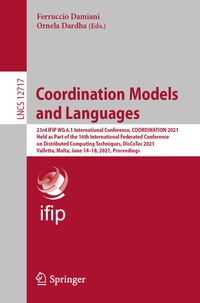
Coordination Models and Languages
Description

The 15 regular papers, 2 short papers, and 1 tutorial paper presented in this book were carefully reviewed and selected from 31 submissions. COORDINATION provides a well-established forum for the growing community of researchers interested in coordination models and languages, architectures, verification and implementation techniques necessary to cope with the complexity induced by the demands of today's software development.
The tool papers describe experience reports, technological artefacts, and innovative prototypes, as well as educational tools in the scope of the research topics of the conference.
Due to the Corona pandemic this event was held virtually.More details
Other editions
Additional editions
Content
Modeling and analyzing resource-sensitive actors: A tutorial introduction.- Manifestly Phased Communication via Shared Session Types.- Deconfined Global Types for Asynchronous Sessions.- Relating Functional and Imperative Session Types.- Safe Session-Based Asynchronous Coordination in Rust.- A Session Subtyping Tool.- Towards Probabilistic Session-Type Monitoring.- Java Typestate Checker.- Asynchronous Global Types in co-logic Programming.- Tuple-Based Coordination in Large-Scale Situated Systems.- A Theory of Automated Market Makers in DeFi.- ReGraDa: Reactive Graph Data.- The Structure of Concurrent Process Histories.- A Clean and Efficient Implementation of Choreography Synthesis for Behavioural Contracts.- A Practical Tool-Chain for the Development of Coordination Scenarios: Graphical Modeler, DSL, Code Generators and Automaton-Based Simulator.- Microservice Dynamic Architecture-Level Deployment Orchestration.- Jolie & LEMMA: Model-Driven Engineering and Programming Languages Meet on Microservices.- ScaFi-Web: a Web-Based Application for Field-Based Coordination Programming.
