

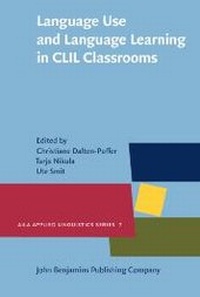
Language Use and Language Learning in CLIL Classrooms
1st Edition
Published on 15. December 2010
X, 295 pages
978-90-272-8751-9 (ISBN)
Description

This volume explores a highly topical issue in second and foreign language education: the spreading practice in mainstream education to teach content subjects through a foreign language. CLIL has been enthusiastically embraced as a language enrichment measure in many contexts and finally research can offer principled insights into its dynamics and potentials. The editors' introductory and concluding chapters offer a synthesis of current CLIL research as well as a critical discussion of unresolved issues relating both to theoretical concerns and research practice. The individual contributions by authors from a range of European contexts report on current empirical research in this dynamic field. The focus of these chapters ranges from theoretical to empirical, from learning outcomes to classroom talk, examining both the written and spoken mode across secondary and tertiary educational contexts. This volume is a valuable resource not only for researchers and teachers but also for policy makers.
More details
Other editions
Additional editions
Christiane Dalton-Puffer | Tarja Nikula | Ute Smit
Language Use and Language Learning in CLIL Classrooms
Book
12/2010
John Benjamins Publishing Co
€100.70
Shipment within 10-15 days
Persons
Content
- Language Use and Language Learning in CLIL Classrooms
- Editorial page
- Title page
- LCC data
- Table of contents
- Acknowledgements
- Preface
- References
- Charting policies, premises and research on content and language integrated learning
- 1. Defining CLIL
- 2. CLIL in Europe: Policy and implementation
- 3. Underlying assumptions
- 4. Overview of research on CLIL
- 5. On theoretical and methodological trends
- 6. Introducing the volume
- References
- Websites mentioned
- Part I. General and theoretical issues
- On the natural emergence of language structures in CLIL
- 1. Introduction
- 2. Methodology
- 3. Results and discussion
- 3.1 Samples from the corpus
- 3.2 The alignment of grammar and content in CLIL learner discourse
- 3.3 The transfer of L1 academic knowledge into an L2
- 3.4 The growth of L2 interlanguage in CLIL
- 4. Conclusion
- References
- The pragmatics of L2 in CLIL
- 1. Introduction
- 2. Which pragmatics of SLA?
- 3. Pragmatic effects in CLIL
- 3.1 Data
- 3.2 Spoken production or classroom activity?
- 3.3 Through the bottleneck: The pragmatics of CLIL
- 3.4 Further evidence for the mask effect
- 4. Conclusion: Cognitive echo
- References
- Part II. CLIL at the secondary level
- A cross-sectional analysis of oral narratives by children with CLIL and non-CLIL instruction
- 1. Introduction
- 2. Theoretical background
- 2.1 Narratives
- 2.2 Communicative strategies
- 3. Setting and participants
- 3.1 CLIL in Austria
- 3.2 Participants and data collection
- 4. Findings
- 4.1 Macro-level (creating coherent narratives)
- 4.2 Micro-level (mastering the language system)
- 4.3 Communicative strategies
- 5. Conclusion
- References
- Using a genre-based approach to integrating content and language in CLIL
- 1. Introduction
- 2. Genre and subject-specific literacy
- 3. Genre-based pedagogy
- 4. Genres in secondary school history
- 5. Three examples of classroom practice in secondary CLIL history
- 5.1 Classroom Examples 1 and 2: building field knowledge together
- 5.2 Classroom Example 3: Student presentations
- 6. Genre and the 4 Cs approach to CLIL
- 7. Genre and CLIL teacher education
- 8. Conclusion
- References
- Effects of CLIL on a teacher's classroom language use
- 1. Introduction
- 2. Theoretical approach, data and methods of analysis
- 3. Findings
- 3.1 Different patterns of interaction
- 3.2 Subtle means of meaning making used differently
- 4. Concluding remarks
- References
- Appendix
- Transcription conventions
- Writing and speaking in the history class
- 1. Introduction
- 2. Theoretical background: Genre and register
- 3. The study
- 4. Analysis of the data
- 4.1 Process types
- 4.1.1 Circumstances
- 4.1.2 Clause complexes
- 4.1.3 Modality
- 5. Discussion
- 6. Conclusions and pedagogic implications
- References
- Language as a meaning making resource in learning and teaching content
- 1. Introduction
- 2. Systemic functional theory
- 2.1 Grammatical metaphor
- 2.1.1 Syntactic intricacy
- 2.2.2 Thematic organization
- 3. The study
- 4. Methodology
- 5. Results
- 5.1 Grammatical metaphor: Syntactic perspective
- 5.2 Grammatical metaphor: Thematic perspective
- 6. Discussion
- References
- The CLIL differential
- 1. Introduction
- 2. Literature review on CLIL writing
- 3. The case study: Sample and method
- 3.1 A model for rating writing ability
- 4. Findings
- 4.1 Task fulfilment
- 4.2 Organisation
- 4.3 Grammar
- 4.4 Vocabulary
- 5. Conclusion
- References
- Appendix
- 1. Rating scale used for assessment (adapted from Friedl/Auer 2007):
- 2. Sample texts
- Written production and CLIL
- 1. Introduction
- 2. The Basque Country and CLIL
- 3. Hypotheses
- 4. The study
- 4.1 Participants
- 4.2 Instruments and procedure
- 5. Results
- 6. Discussion
- 7. Conclusions
- Acknowledgement
- References
- Part III. CLIL at the tertiary level
- Metadiscursive devices in university lectures
- 1. Introduction
- 1.1 Aims and scope
- 1.2 The data: Collection and description
- 2. Lectures from the perspective of systemic functional linguistics and genre theory
- 2.1 Lectures as an educational genre: A functional view
- 2.2 A metadiscourse taxonomy for lecture analysis
- 3. Findings and discussion: Lecture performance in Spanish (L1) and English (L2)
- 3.1 Discourse Structure markers
- 3.2 Interaction markers
- 3.3 Conclusion markers
- 4. Conclusions and implications
- References
- Language Matters
- 1. Introduction
- 2. Method
- 2.1 Dependent variables
- 3. Results and analysis
- 3.1 Lecture comprehension issues
- 3.2 Background variables
- 4. Discussion
- 4.1 Validity
- 4.2 Improving EM instruction
- 5. Conclusion
- References
- Appendix
- SOME QUESTIONS ABOUT YOUR BACKGROUND
- Have you received any other forms of English instruction in high school? (You may give several answers)
- QUESTIONS ABOUT YOUR UNIVERSITY LEVEL STUDIES
- QUESTIONS ABOUT YOUR ATTENDING AN ENGLISH-MEDIUM COURSE OR PROGRAM
- Indicate your reasons for attending an English-Medium course:
- QUESTIONS ABOUT YOUR UNDERSTANDING OF LECTURES IN YOUR FIRST LANGUAGE (SUCH AS NORWEGIAN). YOU MAY ANSWER ON THE BASIS OF COURSES YOU HAVE HAD EARLIER.
- QUESTIONS ABOUT YOUR UNDERSTANDING OF LECTURES IN ENGLISH
- IF YOU HAVE TIME TO ANSWER:
- CLIL in an English as a lingua franca (ELF) classroom
- 1. Introduction
- 2. The study: Setting and methodology
- 3. On conceptualising 'interactive explaining'
- 4. Analysing intex on lexical items
- 4.1 Explaining subject-specific terms
- 4.2 Explaining general language terms.
- 5. Conclusions
- References
- Appendix
- Transcription conventions
- Language use and language learning in CLIL
- 1. Summary of findings
- 2. Contentious issues
- 2.1 Dilemmas of comparison and implications of research for practice
- 2.2 Policy and reality: tensions and pretensions
- 2.3 CLIL or CEIL (Content and English Integrated Learning)?
- 2.4 Integrating language and content - from duality to fusion?
- References
- Subject index
- The AILA Applied Linguistics Series
