

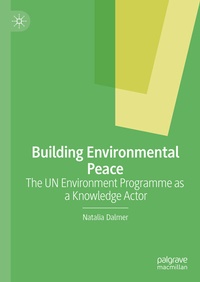
Building Environmental Peace
Description

By analyzing the UN Environment Programme's (UNEP's) contribution to peacebuilding, this book aims to show how international bureaucracies develop knowledge and thereby come to matter on the world stage. Portraying UNEP as an open system, it explores how a growing understanding within the Programme of how environmental degradation shapes insecurities and vice versa has motivated its work on peacebuilding. The theoretical part of this book addresses knowledge, open systems, and knowledge creation. It then presents a historical discussion of UNEP's development in an open system context. Finally, it investigates how knowledge emergence on the linkage between the environment, conflicts, and insecurities influenced UNEP's interests and its work on environmental peacebuilding.
Reviews / Votes
"In this era of misinformation, disinformation and fake news, international organizations have an increasingly important role to play as generators, custodians and disseminators of knowledge. Dalmer shows how the United Nations Environment Programme (UNEP) is uniquely situated to make a positive global contribution in this regard. She illustrates in well-researched detail exactly how international bureaucracies become 'knowledge actors' and presents the UNEP as an open system that is crucial to the development of environmental peacebuilding. This book is an essential reference for anyone interested in UN knowledge and how this kind of knowledge may help us all save the planet." (Nanette Archer Svenson, Centro de Investigación Educativa (CIEDU), República de Panamá, USA)
"Conceiving of international bureaucracies as actors in their own right and drawing from organizational theory and international relations literature, Dalmer illustrates their role as producers of new knowledge. With a focus on UNEP and the different environments from which the organization has obtained new insights regarding environmental peacebuilding, the book not only makes a timely contribution, but readers interested in international institutions and environmental studies will find it of great value." (Jutta M. Joachim, Radboud University, Nijmegen, Netherlands)
More details
Other editions
Additional editions
Person
Natalia Dalmer is a researcher at the Institute of Political Science at Leibniz University Hannover, Germany. She works on international bureaucracies, knowledge, and environmental politics.
