

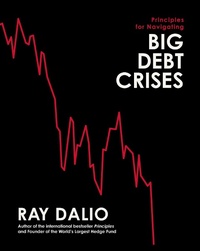
Principles for Navigating Big Debt Crises
Published on 6. December 2022
480 pages
978-1-3985-2091-2 (ISBN)
Description

Ray Dalio, the legendary investor and international bestselling author of Principles - whose books have sold more than five million copies worldwide - shares his unique template for how debt crises work and principles for dealing with them well. This template allowed his firm, Bridgewater Associates, to anticipate 2008's events and navigate them well while others struggled badly.
As he explained in his international bestseller Principles, Ray Dalio believes that almost everything happens over and over again through time, so that by studying patterns one can understand the cause-effect relationships behind events and develop principles for dealing with them well. In this three-part research series, he does just that for big debt crises and shares his template in the hopes of reducing the chances of big debt crises happening and helping them be better managed in the future.
The template comes in three parts:
1. The Archetypal Big Debt Cycle (which explains the template)
2. Three Detailed Cases (which examines in depth the 2008 financial crisis, the 1930s Great Depression and the 1920s inflationary depression of Germany's Weimar Republic)
3. Compendium of 48 Cases (which is a compendium of charts and brief descriptions of the worst debt crises of the last 100 years)
Whether you're an investor, a policy maker, or are simply interested in debt, this unconventional perspective from one of the few people who navigated the crisis successfully, Principles for Navigating Big Debt Crises will help you understand the economy and markets in revealing new ways.
As he explained in his international bestseller Principles, Ray Dalio believes that almost everything happens over and over again through time, so that by studying patterns one can understand the cause-effect relationships behind events and develop principles for dealing with them well. In this three-part research series, he does just that for big debt crises and shares his template in the hopes of reducing the chances of big debt crises happening and helping them be better managed in the future.
The template comes in three parts:
1. The Archetypal Big Debt Cycle (which explains the template)
2. Three Detailed Cases (which examines in depth the 2008 financial crisis, the 1930s Great Depression and the 1920s inflationary depression of Germany's Weimar Republic)
3. Compendium of 48 Cases (which is a compendium of charts and brief descriptions of the worst debt crises of the last 100 years)
Whether you're an investor, a policy maker, or are simply interested in debt, this unconventional perspective from one of the few people who navigated the crisis successfully, Principles for Navigating Big Debt Crises will help you understand the economy and markets in revealing new ways.
More details
Other editions
Additional editions
Book
12/2022
Simon & Schuster Ltd
€56.00
Shipment within 10-20 days
Person
Ray Dalio is the founder and co-chairman of Bridgewater Associates, which, over the last forty years, has become the largest and best performing hedge fund in the world. Dalio has appeared on the Time 100 list of the most influential people in the world as well as the Bloomberg Markets list of the 50 most influential people. He is the author of Principles, Principles for Navigating Big Debt Crises and Principles for Dealing with the Changing World Order. He lives with his family in Connecticut, USA.
Content
- Intro
- Title Page
- Acknowledgments
- Part 1: The Archetypal Big Debt Cycle
- Introduction
- Part 1: The Archetypal Big Debt Cycle
- How I Think about Credit and Debt
- The Template for the Archetypal Long-Term/Big Debt Cycle
- Our Examination of the Cycle
- The Phases of the Classic Deflationary Debt Cycle
- The Early Part of the Cycle
- The Bubble
- The Top
- The "Depression"
- The "Beautiful Deleveraging"
- "Pushing on a String"
- Normalization
- Inflationary Depressions and Currency Crises
- The Phases of the Classic Inflationary Debt Cycle
- The Early Part of the Cycle
- The Bubble
- The Top and Currency Defense
- The Depression (Often When the Currency Is Let Go)
- Normalization
- The Spiral from a More Transitory Inflationary Depression to Hyperinflation
- War Economies
- In Summary
- Part 2: Detailed Case Studies
- German Debt Crisis and Hyperinflation (1918-1924)
- US Debt Crisis and Adjustment (1928-1937)
- US Debt Crisis and Adjustment (2007-2011)
- Part 3: Compendium of 48 Case Studies
- 48 Debt Crises
- United States 1929
- UK 1929
- Japan 1929
- France 1929
- UK 1943
- United States 1945
- Norway 1990
- Finland 1991
- Sweden 1991
- Japan 1991
- United States 2007
- Austria 2008
- Germany 2008
- Greece 2008
- Hungary 2008
- Ireland 2008
- Italy 2008
- Netherlands 2008
- Portugal 2008
- Spain 2008
- UK 2008
- Germany 1918
- Argentina 1980
- Brazil 1980
- Chile 1981
- Mexico 1981
- Peru 1982
- Philippines 1983
- Malaysia 1984
- Peru 1987
- Argentina 1989
- Brazil 1990
- Turkey 1993
- Mexico 1994
- Bulgaria 1995
- Thailand 1996
- Indonesia 1997
- Korea 1997
- Malaysia 1997
- Philippines 1997
- Russia 1997
- Colombia 1998
- Ecuador 1998
- Turkey 2000
- Argentina 2001
- Iceland 2008
- Russia 2008
- Russia 2014
- Appendix: Macroprudential Policies
- About the Author
- Glossary of Key Economic Terms
- Copyright
