

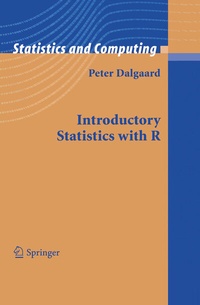
Introductory Statistics with R
Description

Reviews / Votes
From reviews of the first edition:
TECHNOMETRICS
".extensive, well organized, and well documented.The book is an elegant R companion, suitable for the statistically initiated who want to program their own analyses. For experienced statisticians and data analysts, the book provides a good overview of the basic statistical analysis capabilities of R and presumably prepares readers for later migration to S.The format of this compact book is attractive.The book makes excellent use of fonts and intersperses graphics near the codes that produced them. Output from each procedure is dissected line by line to link R code with the computed result.I can recommend [this book] to its target audience. The author provides an excellent overview of R. I found the wealth of clear examples educational and a practical way to preview both R and S."
"The scope of the book, introductory statistics, is a very useful set of methods in parametric and non-parametric statistics up to logistic regression and survival analysis. . Where many constructs in R are very attractive for mathematical oriented users, e.g. matrices, Dalgaard succeeded in convincing me that with little extra effort they can be made very useful to less mathematically oriented people, e.g. by specifying row and column names, and proposing quite attractive ways to specify for example 'subsets' of rows and columns." (Dr. H. W. M. Hendriks, Kwantitatieve Methoden, Vol. 72B8, 2003)
"R is an Open Source implementation of the well-known S language. It works on multiple computing platforms and can be freely downloaded. R is thus ideally suited for teaching at many levels as well as for practical data analysis and methodological development. This book provides an elementary-level introduction to R, targeting both non-statistician scientists in various fields and students of statistics. . Brief sections introduce the statistical methods before they are used. A supplementary Rpackage can be downloaded and contains the data sets." (Zentralblatt für Didaktik der Mathematik, August, 2004)
"This is a nice book on statistical methods and statistical computing in R, a language and environment for statistical computing and graphs: this dialect of the S language is available as free software through internet. . Explanation of statistical methods, together with an interpretation of statistical concepts, is the prevailing style of the text. They are illustrated by plenty of practical examples, all computed using R. This book will be useful for novices in applied statistics or in computing in R." (European Mathematical Society Newsletter, September, 2003)
"The book is an elegant R companion, suitable for the statistically initiated who want to program their own analyses. For experienced statisticians and data analysts, the book provides a good overview of the basic statistical analysis capabilities of R . prepares readers for later migration to S. . I can recommend Introductory Statistics With R to its target audience. The author provides an excellent overview of R. I found the wealth of clear examples educational and a practical way to preview both R and S." (Thomas D. Sandry, Technometrics, Vol. 45 (3), 2003)
"R is both a statistical computer environment and a programming language designed to perform statistical analysis and to produce adequate corresponding graphics. . The present book is . a very useful guide for introducing a number of basic concepts and techniques necessary to practical statistics, covering both elementary statistics and actual programming in the R language. The book is organized in 12 chapters and three appendices, each chapter ending with a beneficial section of proposed exercises." (Silvia Curteanu, Zentralblatt MATH, Vol. 1006, 2003)
More details
Other editions
New editions
Additional editions

Person
Peter Dalgaard is associate professor at the Biostatistical Department at the University of Copenhagen and has extensive experience in teaching within the PhD curriculum at the Faculty of Health Sciences. He was chairman of the Danish Society for Theoretical Statistics from 1996 to 2000. Peter Dalgaard has been a key member of the R Core Team since August 1997 and is well known among R users for his activity on
