

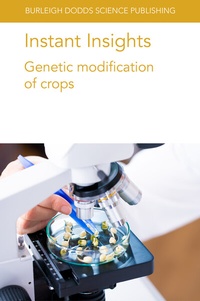
Instant Insights: Genetic Modification of Crops
Published on 15. June 2021
152 pages
978-1-80146-162-7 (ISBN)
Description

This specially curated collection features six reviews of current and key research on genetic modification of crops.
The first chapter reviews key challenges facing banana production, primarily the risk of species decimation by diseases such as Fusarium wilt, and considers how genetic modification may be a solution to this.
The second chapter discusses the development and establishment of 'Golden Rice' - a biofortified variety designed as a health intervention to help alleviate the problem of vitamin A deficiency.
The third chapter details recent advances in the genetic modification of important agronomic traits of soybean crops, such as herbicide tolerance and insect resistance. The fourth chapter addresses progress in and prospects for transgenic interventions in the improvement of grain legumes, concentrating on chickpea, pigeonpea, cowpea and more.
The fifth chapter reviews recent research efforts in the production of genetically modified (GM) oil palm plants and looks towards establishing stable lines of commercially viable GM varieties.
The final chapter describes recent progress relating to transgenic modification of cassava and how future research can strengthen food security and commercialization of the crop.
The first chapter reviews key challenges facing banana production, primarily the risk of species decimation by diseases such as Fusarium wilt, and considers how genetic modification may be a solution to this.
The second chapter discusses the development and establishment of 'Golden Rice' - a biofortified variety designed as a health intervention to help alleviate the problem of vitamin A deficiency.
The third chapter details recent advances in the genetic modification of important agronomic traits of soybean crops, such as herbicide tolerance and insect resistance. The fourth chapter addresses progress in and prospects for transgenic interventions in the improvement of grain legumes, concentrating on chickpea, pigeonpea, cowpea and more.
The fifth chapter reviews recent research efforts in the production of genetically modified (GM) oil palm plants and looks towards establishing stable lines of commercially viable GM varieties.
The final chapter describes recent progress relating to transgenic modification of cassava and how future research can strengthen food security and commercialization of the crop.
More details
Series
Language
English
Place of publication
Cambridge
United Kingdom
Target group
College/higher education
Professional and scholarly
Illustrations
Color tables, photos and figures
File size
7,95 MB
ISBN-13
978-1-80146-162-7 (9781801461627)
DOI
10.19103/9781801461627
Copyright in bibliographic data and cover images is held by Nielsen Book Services Limited or by the publishers or by their respective licensors: all rights reserved.
Schweitzer Classification
Other editions
Additional editions
James Dale | W. K. Tushemereirwe | Robert Harding
Instant Insights: Genetic Modification of Crops
Genetic modification of crops
Book
06/2021
Burleigh Dodds Science Publishing Limited
€67.80
Shipment within 3-4 weeks
Persons
Content
Chapter 1 - Genetic modification of bananas: the long road to farmers' fields: James Dale, Queensland University of Technology, Australia; Wilberforce Tushemereirwe, National Agricultural Research Organisation, Uganda; and Robert Harding, Queensland University of Technology, Australia; 1 Introduction 2 Banana improvement by genetic modification and gene editing 3 Case study: biofortified East African Highland bananas 4 Future trends and conclusion 5 References
Chapter taken from: Kema, G. H. J. and Drenth, A. (eds.), Achieving sustainable cultivation of bananas - Volume 2: Germplasm and genetic improvement, Burleigh Dodds Science Publishing, Cambridge, UK, 2020, (ISBN 978 1 78676 344 0)
Chapter 2 - Biofortified Golden Rice: an additional intervention for vitamin A deficiency: Adrian Dubock, Golden Rice Humanitarian Board, Switzerland; 1 Introduction
2 The problem of vitamin A deficiency (VAD) 3 The origins of Golden Rice 4 Developing Golden Rice as a product 5 Current challenges to establishing Golden Rice as an additional VAD intervention 6 Conclusions 7 Acknowledgements 8 Where to look for further information References
Chapter taken from: Sasaki, T. (ed.), Achieving sustainable cultivation of rice - Volume 1: Breeding for higher yield and quality, Burleigh Dodds Science Publishing, Cambridge, UK, 2017, (ISBN 978 1 78676 024 1)
Chapter 3 - Advances in the genetic modification of soybeans: Wensheng Hou, Chinese Academy of Agricultural Sciences, China; 1 Introduction 2 Genetic modification of agronomic traits: herbicide tolerance and insect resistance 3 Genetic modification of other agronomic traits 4 Genome editing technology 5 Case studies 6 Summary 7 Future trends in research 8 Where to look for further information 9 References
Chapter taken from: Nguyen, H. T. (ed.), Achieving sustainable cultivation of soybeans - Volume 1: Breeding and cultivation techniques, Burleigh Dodds Science Publishing, Cambridge, UK, 2018, (ISBN 978 1 78676 112 5)
Chapter 4 - Genetic modification of grain legumes: Pooja Bhatnagar-Mathur and Kiran Kumar Sharma, International Crops Research Institute for the Semi-Arid Tropics (ICRISAT), India; 1 Introduction 2 Genetic engineering of grain legumes 3 Genetic engineering of chickpea 4 Genetic engineering of pigeonpea 5 Genetic engineering of cowpea 6 Genetic engineering of lentil 7 Genetic engineering of pea (Pisum sativum) 8 Genetic engineering of peanut 9 Genetic engineering of other grain legumes: tepary bean, Vigna species and faba bean 10 Challenges in the commercialization of genetically engineered grain legumes 11 Conclusion 12 Future trends 13 Where to look for further information 14 References
Chapter taken from: Sivasankar, S., Bergvinson, D., Gaur, P., Kumar, S., Beebe, S. and Tamo, M. (eds.), Achieving sustainable cultivation of grain legumes - Volume 1: Advances in breeding and cultivation techniques, Burleigh Dodds Science Publishing, Cambridge, UK, 2018, (ISBN 978 1 78676 136 1)
Chapter 5 - Advances in the genetic modification of oil palm: Denis J. Murphy, Head of Genomics and Computational Biology Research Group, University of South Wales, United Kingdom; 1 Introduction 2 Early and current genetically modified (GM) crop varieties 3 GM oil palm in Malaysia 4 Improving the fatty acid composition of palm oil 5 Progress to date in oil palm transformation 6 New technologies for genome editing - an alternative to 'classical GM' 7 Conclusions and future prospects 8 Where to look for further information 9 References
Chapter taken from: Rival, A. (ed.), Achieving sustainable cultivation of oil palm - Volume 1: Introduction, breeding and cultivation techniques, Burleigh Dodds Science Publishing, Cambridge, UK, 2018, (ISBN 978 1 78676 104 0)
Chapter 6 - Advances in genetic modification of cassava: P. Zhang, Q. Ma, M. Naconsie, X. Wu, W. Zhou, National Key Laboratory of Plant Molecular Genetics, CAS Center for Excellence in Molecular Plant Sciences, Chinese Academy of Sciences, China and J. Yang, Shanghai Chenshan Plant Science Research Center, Shanghai Chenshan Botanical Garden, China; 1 Introduction 2 Transition from model cultivars to farmer-preferred cultivars 3 Tools of gene expression regulation 4 Production of virus-resistant cassava 5 Cassava biofortifi cation for better nutrition 6 Starch modifi cation of cassava for industrial applications 7 Improving storage, root production and post-harvest storage 8 Future trends and conclusion 9 Where to look for further information 10 Acknowledgements 11 References
Chapter taken from: Hershey, C. (ed.) Achieving sustainable cultivation of cassava - Volume 2: Genetics, breeding, pests and diseases, Burleigh Dodds Science Publishing, Cambridge, UK, 2017, (ISBN 978 1 78676 004 3)
Chapter taken from: Kema, G. H. J. and Drenth, A. (eds.), Achieving sustainable cultivation of bananas - Volume 2: Germplasm and genetic improvement, Burleigh Dodds Science Publishing, Cambridge, UK, 2020, (ISBN 978 1 78676 344 0)
Chapter 2 - Biofortified Golden Rice: an additional intervention for vitamin A deficiency: Adrian Dubock, Golden Rice Humanitarian Board, Switzerland; 1 Introduction
2 The problem of vitamin A deficiency (VAD) 3 The origins of Golden Rice 4 Developing Golden Rice as a product 5 Current challenges to establishing Golden Rice as an additional VAD intervention 6 Conclusions 7 Acknowledgements 8 Where to look for further information References
Chapter taken from: Sasaki, T. (ed.), Achieving sustainable cultivation of rice - Volume 1: Breeding for higher yield and quality, Burleigh Dodds Science Publishing, Cambridge, UK, 2017, (ISBN 978 1 78676 024 1)
Chapter 3 - Advances in the genetic modification of soybeans: Wensheng Hou, Chinese Academy of Agricultural Sciences, China; 1 Introduction 2 Genetic modification of agronomic traits: herbicide tolerance and insect resistance 3 Genetic modification of other agronomic traits 4 Genome editing technology 5 Case studies 6 Summary 7 Future trends in research 8 Where to look for further information 9 References
Chapter taken from: Nguyen, H. T. (ed.), Achieving sustainable cultivation of soybeans - Volume 1: Breeding and cultivation techniques, Burleigh Dodds Science Publishing, Cambridge, UK, 2018, (ISBN 978 1 78676 112 5)
Chapter 4 - Genetic modification of grain legumes: Pooja Bhatnagar-Mathur and Kiran Kumar Sharma, International Crops Research Institute for the Semi-Arid Tropics (ICRISAT), India; 1 Introduction 2 Genetic engineering of grain legumes 3 Genetic engineering of chickpea 4 Genetic engineering of pigeonpea 5 Genetic engineering of cowpea 6 Genetic engineering of lentil 7 Genetic engineering of pea (Pisum sativum) 8 Genetic engineering of peanut 9 Genetic engineering of other grain legumes: tepary bean, Vigna species and faba bean 10 Challenges in the commercialization of genetically engineered grain legumes 11 Conclusion 12 Future trends 13 Where to look for further information 14 References
Chapter taken from: Sivasankar, S., Bergvinson, D., Gaur, P., Kumar, S., Beebe, S. and Tamo, M. (eds.), Achieving sustainable cultivation of grain legumes - Volume 1: Advances in breeding and cultivation techniques, Burleigh Dodds Science Publishing, Cambridge, UK, 2018, (ISBN 978 1 78676 136 1)
Chapter 5 - Advances in the genetic modification of oil palm: Denis J. Murphy, Head of Genomics and Computational Biology Research Group, University of South Wales, United Kingdom; 1 Introduction 2 Early and current genetically modified (GM) crop varieties 3 GM oil palm in Malaysia 4 Improving the fatty acid composition of palm oil 5 Progress to date in oil palm transformation 6 New technologies for genome editing - an alternative to 'classical GM' 7 Conclusions and future prospects 8 Where to look for further information 9 References
Chapter taken from: Rival, A. (ed.), Achieving sustainable cultivation of oil palm - Volume 1: Introduction, breeding and cultivation techniques, Burleigh Dodds Science Publishing, Cambridge, UK, 2018, (ISBN 978 1 78676 104 0)
Chapter 6 - Advances in genetic modification of cassava: P. Zhang, Q. Ma, M. Naconsie, X. Wu, W. Zhou, National Key Laboratory of Plant Molecular Genetics, CAS Center for Excellence in Molecular Plant Sciences, Chinese Academy of Sciences, China and J. Yang, Shanghai Chenshan Plant Science Research Center, Shanghai Chenshan Botanical Garden, China; 1 Introduction 2 Transition from model cultivars to farmer-preferred cultivars 3 Tools of gene expression regulation 4 Production of virus-resistant cassava 5 Cassava biofortifi cation for better nutrition 6 Starch modifi cation of cassava for industrial applications 7 Improving storage, root production and post-harvest storage 8 Future trends and conclusion 9 Where to look for further information 10 Acknowledgements 11 References
Chapter taken from: Hershey, C. (ed.) Achieving sustainable cultivation of cassava - Volume 2: Genetics, breeding, pests and diseases, Burleigh Dodds Science Publishing, Cambridge, UK, 2017, (ISBN 978 1 78676 004 3)
