

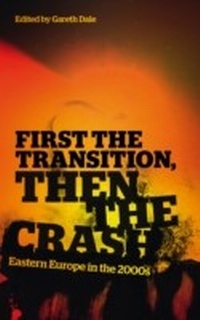
First the Transition, then the Crash
Eastern Europe in the 2000s
1st Edition
Published on 12. September 2011
288 pages
978-1-84964-612-3 (ISBN)
Description

The 1989-91 upheavals in Eastern Europe sparked a turbulent process of social and economic transition. Two decades on, with the global economic crisis of 2008-10, a new phase has begun.
This book explores the scale and trajectory of the crisis through case studies of the Czech Republic, Hungary, Latvia, Poland, Russia, Ukraine and the former Yugoslavia. The contributors focus upon the relationships between geopolitics, the world economy and class restructuring.
The book covers the changing relationship between business and states; foreign capital flows; financialisation and asset price bubbles; austerity and privatisation; and societal responses, in the form of reactionary populism and progressive social movements.
Challenging neoliberal interpretations that envisage the transition as a process of unfolding liberty, the dialectic charted in these pages reveals uneven development, attenuated freedoms and social polarisation.
This book explores the scale and trajectory of the crisis through case studies of the Czech Republic, Hungary, Latvia, Poland, Russia, Ukraine and the former Yugoslavia. The contributors focus upon the relationships between geopolitics, the world economy and class restructuring.
The book covers the changing relationship between business and states; foreign capital flows; financialisation and asset price bubbles; austerity and privatisation; and societal responses, in the form of reactionary populism and progressive social movements.
Challenging neoliberal interpretations that envisage the transition as a process of unfolding liberty, the dialectic charted in these pages reveals uneven development, attenuated freedoms and social polarisation.
Reviews / Votes
'Central and Eastern Europe is a neoliberal horror story. The details are well told here: of 'grabitisation' kleptocracies, NATO expansion and capital flight. These well-packaged studies show how US sponsored 'reforms' deindustrialised Russia and other post-Soviet states' -- Michael Hudson 'Radical political economy finally comes resurgent in the former communist countries. Dale and his collaborators comprehensively cover the transitions, from Hungary to the Russian Pacific. The best alternative survey of how the post-communist entrants are faring in 21st-century capitalism' -- Georgi Derluguian, author of Bourdieu's Secret Admirer in the Caucasus: A World-Systems Biography 'This book provides a vital corrective to neoliberal triumphalism, and a starting-point for socialist renewal' -- Hugo Radice, University of Leeds 'A very valuable contribution to a growing literature on the post-Communist transition' -- Dr Carl Levy, Reader in European Politics, Goldsmiths, University of LondonMore details
Edition
1. Auflage
Language
English
Place of publication
London
United Kingdom
Target group
Professional and scholarly
Illustrations
6 b&w figures
File size
9,18 MB
ISBN-13
978-1-84964-612-3 (9781849646123)
Copyright in bibliographic data and cover images is held by Nielsen Book Services Limited or by the publishers or by their respective licensors: all rights reserved.
Schweitzer Classification
Other editions
Additional editions
Book
09/2011
Pluto Press
€126.28
Article exhausted; check different version
Book
09/2011
Pluto Press
€48.20
Shipment within 10-20 days
Person
Gareth Dale is Senior Lecturer in Politics and International Relations at Brunel University, England. He is the author of First the Transition, then the Crash (Pluto, 2011), Reconstructing Karl Polanyi (Pluto, 2016) and Karl Polanyi: The Limits of the Market (Polity, 2010).
Content
1. Introduction: The Transition in Central and Eastern Europe by Gareth Dale
2. Marx on 1989 by G. M. Tamas
Part One Russia: class and power in the age of Putin
3. Workers in Modern Russia by Mike Haynes
4. Russia's Foreign Policy from Putin to Medvedev by Gonzalo Pozo
5. Autocratic Neoliberalism and Beyond: Russia's Caesarist Journey into the Global Political Economy by Owen Worth
Part Two From the Baltic to the Balkans: market reform and economic crisis
6. Twenty Years Lost: Latvia's Failed Development in the Post-Soviet World by Jeff Sommers and Ja-nis Berzins
7. The Ukrainian Economy and the International Financial Crisis by Marko Bojcun
8. Poland and the Global Political Economy: From Neoliberalism to Populism (and Back Again) by Stuart Shields
9. The Czech Republic: Neoliberal Reform and Economic Crisis by Ilona Svihlikova
10. From Poster Boy of Neoliberal Transformation to Basket Case: Hungary and the Global Economic Crisis by Adam Fabry
11. Serbia from the October 2000 Revolution to the Crash by Martin Upchurch and Darko Marinkovic
12. Conclusion: The 'Crash' in Central and Eastern Europe by Gareth Dale and Jane Hardy
Notes on Contributors
Index
2. Marx on 1989 by G. M. Tamas
Part One Russia: class and power in the age of Putin
3. Workers in Modern Russia by Mike Haynes
4. Russia's Foreign Policy from Putin to Medvedev by Gonzalo Pozo
5. Autocratic Neoliberalism and Beyond: Russia's Caesarist Journey into the Global Political Economy by Owen Worth
Part Two From the Baltic to the Balkans: market reform and economic crisis
6. Twenty Years Lost: Latvia's Failed Development in the Post-Soviet World by Jeff Sommers and Ja-nis Berzins
7. The Ukrainian Economy and the International Financial Crisis by Marko Bojcun
8. Poland and the Global Political Economy: From Neoliberalism to Populism (and Back Again) by Stuart Shields
9. The Czech Republic: Neoliberal Reform and Economic Crisis by Ilona Svihlikova
10. From Poster Boy of Neoliberal Transformation to Basket Case: Hungary and the Global Economic Crisis by Adam Fabry
11. Serbia from the October 2000 Revolution to the Crash by Martin Upchurch and Darko Marinkovic
12. Conclusion: The 'Crash' in Central and Eastern Europe by Gareth Dale and Jane Hardy
Notes on Contributors
Index
