

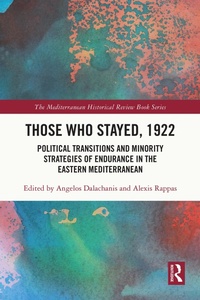
Those Who Stayed, 1922
Political Transitions and Minority Strategies of Endurance in the Eastern Mediterranean
Published on 30. September 2025
236 pages
978-1-040-43342-3 (ISBN)
Description

The year 1922 marks a major turning point in Eastern Mediterranean history, with the abolition of the Ottoman Sultanate concluding a long period of upheaval known as the "Eastern Question." As the empire gave way to European colonization and the nation-state model, its once multicultural societies were homogenized through violence, population transfers, and treaties. The liberal principle of national self-determination often led to devastating human costs, as populations were either massacred, forcibly exchanged, or reduced to "minorities" within new political entities.
While scholarship has thoroughly documented the demographic changes that accompanied the post-Ottoman transition, this volume focuses on a less explored dimension: the agency of those labeled as minorities. It examines how these communities navigated their new reality within emerging nation-states or League of Nations mandates. Adopting a broad and situational understanding of "minority," it includes both legally defined groups and those marginalized in practice, such as Muslims in Western Thrace, Christians in Istanbul, Armenians in Jerusalem, Muslims in Serbia, and Jews in Salonica.
The volume uses diverse methodologies-archival research, network analysis, microhistory, and translocal perspectives - to investigate the lived experiences of entrenched minorities. It offers new insights into both lesser-known and familiar minority groups, while engaging critically with existing literature. By emphasizing these groups' strategies and resilience, the volume challenges narratives dominated by violence and nostalgia, offering a more nuanced understanding of post-1922 Eastern Mediterranean history. It will appeal not only to scholars of minority studies but to anyone interested in the region's modern past.
While scholarship has thoroughly documented the demographic changes that accompanied the post-Ottoman transition, this volume focuses on a less explored dimension: the agency of those labeled as minorities. It examines how these communities navigated their new reality within emerging nation-states or League of Nations mandates. Adopting a broad and situational understanding of "minority," it includes both legally defined groups and those marginalized in practice, such as Muslims in Western Thrace, Christians in Istanbul, Armenians in Jerusalem, Muslims in Serbia, and Jews in Salonica.
The volume uses diverse methodologies-archival research, network analysis, microhistory, and translocal perspectives - to investigate the lived experiences of entrenched minorities. It offers new insights into both lesser-known and familiar minority groups, while engaging critically with existing literature. By emphasizing these groups' strategies and resilience, the volume challenges narratives dominated by violence and nostalgia, offering a more nuanced understanding of post-1922 Eastern Mediterranean history. It will appeal not only to scholars of minority studies but to anyone interested in the region's modern past.
More details
Series
Language
English
Place of publication
London
United Kingdom
Publishing group
Taylor & Francis Ltd
Target group
College/higher education
Illustrations
12 Halftones, black and white; 12 Illustrations, black and white
File size
12,64 MB
ISBN-13
978-1-040-43342-3 (9781040433423)
Copyright in bibliographic data and cover images is held by Nielsen Book Services Limited or by the publishers or by their respective licensors: all rights reserved.
Schweitzer Classification
Other editions
Additional editions
Angelos Dalachanis | Alexis Rappas
Those Who Stayed, 1922
Political Transitions and Minority Strategies of Endurance in the Eastern Mediterranean
Book
09/2025
1st Edition
Routledge
€207.60
Shipment within 10-20 days
Persons
Angelos Dalachanis is a Researcher at the French National Centre for Scientific Research (CNRS), based at the Institute of Early Modern and Modern History in Paris. His research focuses on migration, labor and the Greek diaspora in the modern Eastern Mediterranean. He is the author of The Greek Exodus from Egypt: Diaspora Politics and Emigration, 1937-1962 (2017) and co-author of Monde reve, monde collectionne: la Mediterannee orientale d'Antonis Benakis (1900-1931) (2025). He co-directs the journal Diasporas. Circulations, migrations, histoire, and co-leads two research projects at the Ecole francaise d'Athenes on post-Ottoman minorities (with Alexis Rappas) and object circulation (with Mercedes Volait).
Alexis Rappas is Associate Professor of History, and Associate Dean of the College of Social Sciences and Humanities at Koc University in Istanbul. His research focuses on the impact of European colonialism in post-Ottoman settings. He is the author of the Runciman award shortlisted book Cyprus in the 1930s: British Colonial Rule and the Roots of the Cyprus Conflict (2014). His subsequent research has focused on the entanglement between property and sovereignty in British Cyprus, the Italian Dodecanese and French Mandate Syria. He is in addition co-directing (with Angelos Dalachanis) an Ecole francaise d'Athenes five-year research project on minorities in the post-Ottoman Mediterranean.
Alexis Rappas is Associate Professor of History, and Associate Dean of the College of Social Sciences and Humanities at Koc University in Istanbul. His research focuses on the impact of European colonialism in post-Ottoman settings. He is the author of the Runciman award shortlisted book Cyprus in the 1930s: British Colonial Rule and the Roots of the Cyprus Conflict (2014). His subsequent research has focused on the entanglement between property and sovereignty in British Cyprus, the Italian Dodecanese and French Mandate Syria. He is in addition co-directing (with Angelos Dalachanis) an Ecole francaise d'Athenes five-year research project on minorities in the post-Ottoman Mediterranean.
Content
Introduction: Minority Forms of Resilience in the Post-Ottoman World
Part 1: Shifting Grounds for Transient Minorities
Chapter 1
Civilising Mission or Reproduction of the Ottoman Governance? Minorities and Greek Imperial Formation in the Occupied Territories of Trabzon and Smyrna (1916-1922)
Lukas Tsiptsios
Chapter 2
Catholic Entrenchment, Political Incertitude and Global Relief in Occupied Istanbul (1918-1923)
Gabriel John Doyle
Part 2: Survival Beyond the State
Chapter 3
Entrenchment of the Armenian Genocide: Memorialisation by the Patriarchate of Jerusalem as Diasporic Identity Politics
Arman Khachatryan
Chapter 4
Enduring a Transition: Cretan Jews in Post-Ottoman Hania
Katerina Anagnostaki
Part 3: Resilience Within the Nation-State
Chapter 5
"Let's Found the Jewish Secondary School This Year": A Debate on Schooling and Language in Hellenising Salonika (1926-1928)
Defne OEzoezer
Chapter 6
The Kingdom of Yugoslavia and Minorities in South Serbia
Klara Volaric
Chapter 7
Economic Nationalism and Non-Muslims in Early Republican Turkey: The Limitations of Exclusion
Semih Goekatalay
Epilogue
Language of Politics, Politics of Language
Alexis Wick
Part 1: Shifting Grounds for Transient Minorities
Chapter 1
Civilising Mission or Reproduction of the Ottoman Governance? Minorities and Greek Imperial Formation in the Occupied Territories of Trabzon and Smyrna (1916-1922)
Lukas Tsiptsios
Chapter 2
Catholic Entrenchment, Political Incertitude and Global Relief in Occupied Istanbul (1918-1923)
Gabriel John Doyle
Part 2: Survival Beyond the State
Chapter 3
Entrenchment of the Armenian Genocide: Memorialisation by the Patriarchate of Jerusalem as Diasporic Identity Politics
Arman Khachatryan
Chapter 4
Enduring a Transition: Cretan Jews in Post-Ottoman Hania
Katerina Anagnostaki
Part 3: Resilience Within the Nation-State
Chapter 5
"Let's Found the Jewish Secondary School This Year": A Debate on Schooling and Language in Hellenising Salonika (1926-1928)
Defne OEzoezer
Chapter 6
The Kingdom of Yugoslavia and Minorities in South Serbia
Klara Volaric
Chapter 7
Economic Nationalism and Non-Muslims in Early Republican Turkey: The Limitations of Exclusion
Semih Goekatalay
Epilogue
Language of Politics, Politics of Language
Alexis Wick
