

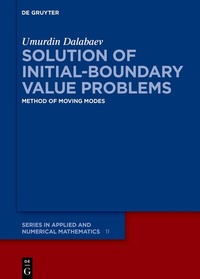
Solution of Initial-Boundary Value Problems
Description

Methods for solving problems of mathematical physics can be divided into the following four classes.
Analytical methods (the method of separation of variables, the method of characteristics, the method of Green's functions, etc.) methods have a relatively low degree of universality, i.e. focused on solving rather narrow classes of problems.
Approximate analytical methods (projection, variational methods, small parameter method, operational methods, various iterative methods) are more versatile than analytical ones.
Numerical methods (finite difference method, direct method, control volume method, finite element method, etc.) are very universal methods.
Probabilistic methods (Monte Carlo methods) are highly versatile. Can be used to calculate discontinuous solutions. However, they require large amounts of calculations and, as a rule, they lose with the computational complexity of the above methods when solving such problems to which these methods are applicable.
Comparing methods for solving problems of mathematical physics, it is impossible to give unconditional primacy to any of them. Any of them may be the best for solving problems of a certain class.
The proposed method of moving nodes for boundary value problems of differential equations combines a combination of numerical and analytical methods. In this case, we can obtain, on the one hand, an approximately analytical solution of the problem, which is not related to the methods listed above. On the other hand, this method allows one to obtain compact discrete approximations of the original problem. Note that obtaining an approximately analytical solution of differential equations is based on numerical methods. The nature of numerical methods also allows obtaining an approximate analytical expression for solving differential equations
More details
Other editions
Additional editions
Person
Dr. Dalabaev is a professor at the University of World Economy and Diplomacy, Department of Mathematic modelling & Information Systems, Tashkent, Uzbekistan. His research interests are in computational fluid dynamics, numerical methods, modelling two phase flow, particle motion in fluids, moving node method, approximate-analytical solution of a differential equation.
Content
- Intro
- Contents
- Introduction
- Chapter 1 Basics of numerical methods
- Chapter 2 The method of moving nodes for two-point boundary value problems
- Chapter 3 Solution of the Cauchy problem
- Chapter 4 Solution of initial-boundary value problems for a parabolic equation
- Chapter 5 Solving boundary value problems for elliptic equations
- Conclusions
- References
- Index
