

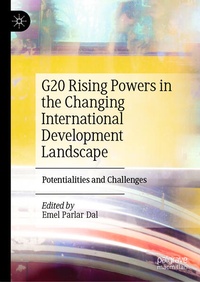
G20 Rising Powers in the Changing International Development Landscape
Description

This book aims to explore and contextualize G20 rising powers' increasing role in international development from a comprehensive and multidimensional perspective. This book will scrutinize the G20 rising powers' evolving role as international development actors around three research questions: 1) How do we contextualize and locate G20 rising powers as emerging actors in international development? 2) What are the main contributions, trends and limits of G20 rising powers in South-South Cooperation? 3) Does G20 rising powers' active involvement in international development support their foreign policy objectives and challenge the international development order? Based on these three, interrelated research questions, this cluster of chapters is structured as follows: The first part, elaborated under the first research question, focuses on the historical development and current dynamics of (G20) rising powers' evolving actorness in international development to assess their main motivations, ambitions and instruments. The second part examines the main contributions, trends and limits of G20 rising powers in South-South Cooperation. The third part delves into an assessment of the linkage between G20 rising powers' active involvement in international development and their foreign policies.
Reviews / Votes
"The G20 brings together the most important global actors. The club sharpens the international development agenda. They all use development cooperation as a soft power. That is why international development is always used as an important instrumental approach to foreign policy. This timely reader is a crucial contribution to better understanding the G20 in a highly dynamic and disruptive global context." ( Stephan Klingebiel , Chair of the Research Programme "International and Transnational Cooperation" of the German Development Institute)"This edited work, connecting the role of the G20 with the changing development landscape, is valuable in stretching our traditional understanding of these dynamics. Originally elevated as a crisis committee in the context of the 2008 Global Financial Crisis, the G20 has struggled to widen its agenda. As well mobilized by Emel Parlar Dal, the collection demonstrates both the will and skill of select non-Western countries within the G20 topush the privileging of South-South development cooperation and an alternative policy consensus more generally. Although facing some structural limitations, the book is testimony to the expansion of agency in an increasingly multi-polar world that needs to be considered by both scholars and practitioners." ( Andrew F. Cooper , University Research Chair, Department of Political Science, and Professor, the Balsillie School of International Affairs, University of Waterloo)
More details
Other editions
Additional editions
Person
Emel Parlar Dal is Professor at Marmara University's Department of International Relations. Her recent publications have appeared in Third World Quarterly (SSCI), Global Policy (SSCI), Contemporary Politics, International Politics (SSCI), Turkish Studies (SSCI), and International Journal. She has been awarded the Jean Monnet Chair on the EU and Rising Powers in the Evolving Multilateralism for 2020-2023, alongside an EU grant for her Jean Monnet Center of Excellence project on the EU's sustainability in Global Governance (2022-2025). During 2020-2022 she received research grants respectively from the Academy of Korean Studies (2020-2022) and NATO Public Diplomacy Division (2020-2021).
