

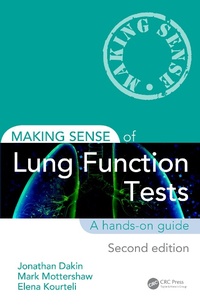
Making Sense of Lung Function Tests
2nd Edition
Published on 6. July 2017
224 pages
978-1-4822-4969-9 (ISBN)
Description

Respiratory problems are the most common cause of acute admission to hospital. A variety of diagnostic investigations are required, both for acute and clinic assessment. Making Sense of Lung Function Tests, Second Edition familiarises both trainees and more experienced clinicians with the interpretation of a range of respiratory parameters. It places lung function in a clinical context using real-life examples and provides invaluable hands-on guidance.
For this second edition Consultant Respiratory Physician Jonathan Dakin and Consultant Anaesthetist Elena Kourteli are joined by Mark Mottershaw, Chief Respiratory Physiologist from Queen Alexandra Hospital, Portsmouth, all contributing a broad range of expertise and perspectives. Together they have updated the book throughout and added new chapters including an algorithm for interpretation of pulmonary function tests, exhaled nitric oxide (FENO) and cardiopulmonary exercise testing.
The text offers a clear explanation of the concepts which students find difficult, including:
The basis of obstructive and restrictive defects
Pattern recognition of the flow volume loop
Differences between TLCO and KCO
Assessment of oxygenation using PO2 and SO2
The basis of Type 1 and type 2 respiratory failure
Distinguishing respiratory and metabolic acidosis
The relationship between sleep and respiratory failure
The information is presented in an accessible way, suitable for those seeking a basic grounding in spirometry or blood gases, but also sufficiently comprehensive for readers completing specialist training in general or respiratory medicine.
For this second edition Consultant Respiratory Physician Jonathan Dakin and Consultant Anaesthetist Elena Kourteli are joined by Mark Mottershaw, Chief Respiratory Physiologist from Queen Alexandra Hospital, Portsmouth, all contributing a broad range of expertise and perspectives. Together they have updated the book throughout and added new chapters including an algorithm for interpretation of pulmonary function tests, exhaled nitric oxide (FENO) and cardiopulmonary exercise testing.
The text offers a clear explanation of the concepts which students find difficult, including:
The basis of obstructive and restrictive defects
Pattern recognition of the flow volume loop
Differences between TLCO and KCO
Assessment of oxygenation using PO2 and SO2
The basis of Type 1 and type 2 respiratory failure
Distinguishing respiratory and metabolic acidosis
The relationship between sleep and respiratory failure
The information is presented in an accessible way, suitable for those seeking a basic grounding in spirometry or blood gases, but also sufficiently comprehensive for readers completing specialist training in general or respiratory medicine.
More details
Series
Edition
2nd edition
Language
English
Place of publication
London
United Kingdom
Publishing group
Taylor & Francis Ltd
Target group
College/higher education
Professional and scholarly
Illustrations
52 s/w Abbildungen, 34 s/w Tabellen, 4 s/w Photographien bzw. Rasterbilder, 48 s/w Zeichnungen
34 Tables, black and white; 48 Line drawings, black and white; 4 Halftones, black and white; 52 Illustrations, black and white
File size
2,45 MB
ISBN-13
978-1-4822-4969-9 (9781482249699)
Copyright in bibliographic data and cover images is held by Nielsen Book Services Limited or by the publishers or by their respective licensors: all rights reserved.
Schweitzer Classification
Other editions
Additional editions
Jonathan Dakin | Mark Mottershaw | Elena Kourteli
Making Sense of Lung Function Tests
A hands-on guide
Book
09/2017
2nd Edition
CRC Press
€49.50
Article not available for order
Jonathan Dakin | Mark Mottershaw | Elena Kourteli
Making Sense of Lung Function Tests
A hands-on guide
Book
07/2017
2nd Edition
CRC Press
€259.98
Shipment within 10-20 days
Persons
Jonathan Dakin MD FRCP BSc Hons, is Consultant Respiratory Physician at Royal Surrey County Hospital NHS Foundation Trust, Surrey. He is also Honorary Consultant Respiratory Physician at Portsmouth Hospitals NHS Trust, Hampshire.
Mark Mottershaw is Chief Respiratory Physiologist at Queen Alexandra Hospital, Portsmouth Hospitals NHS Trust, Hampshire.
Elena Kourteli is Consultant Anaesthetist at St George's University Hospitals Foundation NHS Trust, London.
Mark Mottershaw is Chief Respiratory Physiologist at Queen Alexandra Hospital, Portsmouth Hospitals NHS Trust, Hampshire.
Elena Kourteli is Consultant Anaesthetist at St George's University Hospitals Foundation NHS Trust, London.
Content
Tests of airway function and mechanical properties. Blood gas interpretation. Exercise testing. Interpretation.
