

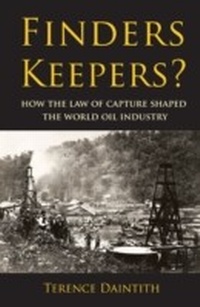
Finders Keepers?
How the Law of Capture Shaped the World Oil Industry
1st Edition
Published on 23. September 2010
520 pages
978-1-136-52283-3 (ISBN)
Description

Since the beginnings of the oil industry, production activity has been governed by the 'law of capture,' dictating that one owns the oil recovered from one's property even if it has migrated from under neighboring land. This 'finders keepers' principle has been excoriated by foreign critics as a 'law of the jungle' and identified by American commentators as the root cause of the enormous waste of oil and gas resulting from US production methods in the first half of the twentieth century. Yet while in almost every other country the law of capture is today of marginal significance, it continues in full vigour in the United States, with potentially wasteful results.
In this richly documented account, Terence Daintith adopts a historical and comparative perspective to show how legal rules, technical knowledge (or the lack of it) and political ideas combined to shape attitudes and behavior in the business of oil production, leading to the original adoption of the law of capture, its consolidation in the United States, and its marginalization elsewhere.
In this richly documented account, Terence Daintith adopts a historical and comparative perspective to show how legal rules, technical knowledge (or the lack of it) and political ideas combined to shape attitudes and behavior in the business of oil production, leading to the original adoption of the law of capture, its consolidation in the United States, and its marginalization elsewhere.
Reviews / Votes
'Daintith's excellent research has produced a work full of vivid and interesting detail. The book's greatest virtue is in pulling together contemporaneous activities in many parts of the world and comparing them to the pattern of development in the U.S. oil industry. Historians, scholars, policy analysts, and those interested in the history of the oil and gas industry will enjoy this informative and original account of the law of capture.'Jacqueline L. Weaver, University of Houston Law Center
'Professor Daintith has provided a thorough analysis of the most fundamental of all rules of oil and gas law. Every oil and gas lawyer, petroleum landman, petroleum geologist, and petroleum engineer should read this important book.'
Owen L. Anderson, The University of Oklahoma College of Law, USA
'Terence Daintith's comprehensive review of the law of capture seeks to address the needs of both the expert practitioner and the non specialist enquirer and leaves neither wanting. This definitive text is a thoroughly enjoyable read. A quite splendid accomplishment by one of the foremost experts in the field.'
Malcolm Webb. Chief Executive, Oil & Gas UK
'Daintith brings to life one of the most important aspects affecting the evolution of global oil and gas. His comprehensive research coupled with an engaging writing style allows for a most interesting and educational analysis. To tame the Rule of Capture, governments have adopted policies relating to how oil and gas is shared and developed. Daintith discusses, analyzes, and evaluates these efforts. His observations and insights are essential to understanding the history of how we developed today's rules and provide a foundation to understanding oil and gas unitizations--which are about to transform oil and gas in the next century as the Rule of Capture did in the prior century.'
Andrew B. Derman, Partner, International Energy Practice Group Leader, Thompson & Knight LLP, Dallas, USA
'Be warned, when you do pick it
More details
Edition
1. Auflage
Language
English
Place of publication
London
United Kingdom
Publishing group
Taylor & Francis Ltd
Target group
College/higher education
Product notice
Reflowable
File size
4,97 MB
ISBN-13
978-1-136-52283-3 (9781136522833)
Copyright in bibliographic data and cover images is held by Nielsen Book Services Limited or by the publishers or by their respective licensors: all rights reserved.
Schweitzer Classification
Other editions
Additional editions
Book
08/2010
1st Edition
Resources for the Future Press (RFF Press)
€88.08
Shipment within 3-4 weeks
Book
08/2010
1st Edition
Resources for the Future Press (RFF Press)
€245.11
Shipment within 3-4 weeks
Person
Terence Daintith is the former director of the University of London's Institute of Advanced Legal Studies. He is a visiting professor at the University of Western Australia and at the University of Melbourne Law School, and is co-editor of the standard treatise on United Kingdom oil and gas law.
Content
Preface and Acknowledgments
Part I: The Beginnings of the Rule of Capture in the United States
1. Naming and Blaming
2. The Leading Cases and their Legal Background
3. Practice and Belief in the Early Petroleum Industry
Part II: Alternatives and Parallels
4. The Mineral Water Industry in France: Protection and Competition
5. Asphalt in Trinidad: Digging your Neighbour's Pitch
6. America's Early Oil Rivals: Petroleum and Property Rights in Galicia, Romania and Russia
Part III: Modified Capture: The United States in the 20th Century
7. Correlative Rights and the Beginnings of Conservation
8. Oil and Gas in the Public Lands
9. Conservation Regulation and the Institutionalization of Capture
Part IV: Evading Capture?
10. Securing Unified National Control of Petroleum Resources
11. Capture Revivified? Competitive Acreage Allocation by Governments
12. The Cross-Boundary Petroleum Deposit as a Federal and International Issue
Part V: Conclusion
13. The Least Worst Property Rule?
References
Part I: The Beginnings of the Rule of Capture in the United States
1. Naming and Blaming
2. The Leading Cases and their Legal Background
3. Practice and Belief in the Early Petroleum Industry
Part II: Alternatives and Parallels
4. The Mineral Water Industry in France: Protection and Competition
5. Asphalt in Trinidad: Digging your Neighbour's Pitch
6. America's Early Oil Rivals: Petroleum and Property Rights in Galicia, Romania and Russia
Part III: Modified Capture: The United States in the 20th Century
7. Correlative Rights and the Beginnings of Conservation
8. Oil and Gas in the Public Lands
9. Conservation Regulation and the Institutionalization of Capture
Part IV: Evading Capture?
10. Securing Unified National Control of Petroleum Resources
11. Capture Revivified? Competitive Acreage Allocation by Governments
12. The Cross-Boundary Petroleum Deposit as a Federal and International Issue
Part V: Conclusion
13. The Least Worst Property Rule?
References
