

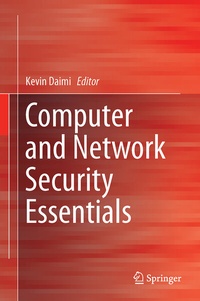
Computer and Network Security Essentials
Published on 12. August 2017
XV, 618 pages
978-3-319-58424-9 (ISBN)
Description

This book introduces readers to the tools needed to protect IT resources and communicate with security specialists when there is a security problem. The book covers a wide range of security topics including Cryptographic Technologies, Network Security, Security Management, Information Assurance, Security Applications, Computer Security, Hardware Security, and Biometrics and Forensics. It introduces the concepts, techniques, methods, approaches, and trends needed by security specialists to improve their security skills and capabilities. Further, it provides a glimpse into future directions where security techniques, policies, applications, and theories are headed. The book represents a collection of carefully selected and reviewed chapters written by diverse security experts in the listed fields and edited by prominent security researchers. Complementary slides are available for download on the book's website at Springer.com.
Reviews / Votes
"The book contains a productive compendium of articles written by security experts with varied specializations. It covers a wide range of security topics and will serve as a good introduction to modern topics related to computer and network security. . The book is suitable for teaching introductory courses on computer and network security although no exercises have been included for pedagogy. The book will be useful for students, teachers, professionals, and researchers with an interest in computer security." (S. V. Nagaraj, Computing Reviews, February, 2018)
More details
Series
Edition
1st ed. 2018
Language
English
Place of publication
Cham
Switzerland
Publishing group
Springer International Publishing
Target group
Professional and scholarly
Product notice
Reflowable
Illustrations
XV, 618 p. 80 illus., 50 illus. in color.
File size
13,10 MB
ISBN-13
978-3-319-58424-9 (9783319584249)
DOI
10.1007/978-3-319-58424-9
Schweitzer Classification
Other editions
Additional editions
Kevin Daimi
Computer and Network Security Essentials
Book
08/2017
Springer
€192.59
Shipment within 10-15 days
Persons
Editor:
Kevin Daimi
received his Ph.D. from the University of Cranfield, England. He has a long mixture of academia and industry experience. His industry experience includes working as Senior Programmer/Systems Analyst, Computer Specialist, and Computer Consultant. He is currently Professor and Director of Computer Science and Software Engineering Programs at the University of Detroit Mercy. His research interests include Computer and Network Security with emphasis on vehicle network security, Software Engineering, Data Mining, and Computer Science and Software Engineering Education. Two of his publications received the Best Paper Award from two international conferences. He has been chairing the annual International Conference on Security and Management (SAM) since 2012. Kevin is a Senior Member of the Association for Computing Machinery (ACM), a Senior Member of the Institute of Electrical and Electronic Engineers (IEEE), and a Fellow ofthe British Computer Society (BCS). He served as a Program Committee member for many international conferences and chaired some of them. In 2103, he received the Faculty Excellence Award from the University of Detroit Mercy. He is also the recipient of the Outstanding Achievement Award in Recognition and Appreciation of his Leadership, Service and Research Contributions to the Field of Network Security, from the 2010 World Congress in Computer Science, Computer Engineering, and Applied Computing (WORLFCOMP'10).
Associate Editors: Guillermo A. Francia , III received his BS degree in Mechanical Engineering from Mapua Tech in 1978. His Ph.D. in Computer Science is from New Mexico Tech. Before joining Jacksonville State University (JSU), he was the chairman of the Computer Science department at Kansas Wesleyan University. Dr. Francia is a recipient of numerous grants and awards. His projects have been funded by prestigiousinstitutions such as the National Science Foundation, Eisenhower Foundation, Department of Education, Department of Defense, National Security Agency, and Microsoft Corporation. Dr. Francia served as a Fulbright scholar to Malta in 2007 and is among the first cohort of cyber security scholars awarded by the UK Fulbright Commission for the 2016-2017 academic year. He has published articles and book chapters on numerous subjects such as Computer Security, Digital Forensics, Regulatory Compliance, Educational Technology, Expert Systems, Computer Networking, Software Testing, and Parallel Processing. Currently, Dr. Francia holds a Distinguished Professor position and is the Director of the Center for Information Security and Assurance at JSU.
Levent Ertaul is a full professor at the California State University, East Bay, USA. He received a Ph.D. degree from Sussex University, UK in 1994. He specializes in Network Security. He has more than 75 refereedpapers published in the Cyber Security, Network Security, Wireless Security and Cryptography areas. He also delivered more than 40 seminars and talks and participated in various panel discussions related to Cyber Security. In the last couple of years, Dr. Ertaul has given Privacy and Cyber Security speeches at US universities and several US organizations. He received 4 awards for his contributions to Network Security from WORLDCOMP. He also received a fellowship to work at the Lawrence Livermore National Laboratories (LLNL) in the Cyber Defenders program for last 4 years. He has more than 25 years of teaching experience in Network Security, Cyber Security. He participated in several hacking competitions nationwide. His current research interests are Wireless Hacking Techniques, Wireless Security, and Security of IoTs.
Luis Hernández Encinas is a researcher at the Department of Information Processing and Cryptography (TIC) at the Institute of Physical andInformation Technologies (ITEFI), Spanish National Research Council (CSIC) in Madrid (Spain). He obtained his Ph.D. in Mathematics from the University of Salamanca (Spain) in 1992. He has participated in more than 30 research projects. He is the author of 9 books, 9 patents, and more than 150 papers. He has more than 100 contributions to workshops and conferences. He has delivered more than 50 seminars and lectures. Luis is a member of several international Committees on Cybersecurity. His current research interests include Cryptography and Cryptanalysis of public key cryptosystems (RSA, ElGamal and Chor-Rivest), Cryptosystems based on elliptic and hyper elliptic curves, Graphic Cryptography, Pseudorandom number generators, Digital signature schemes, Authentication and Identification protocols, Crypto-Biometry, Secret sharing protocols, Side channel attacks, and Number Theory problems.
Eman El-Sheikh is Director of the Center for Cybersecurity and Professor of Computer Science at the University of West Florida. She teaches and conducts research related to the development and evaluation of Artificial Intelligence and Machine Learning for cybersecurity, education, software architectures and robotics. She has published over 70 peer-reviewed articles and given over 90 research presentations and invited talks. Dr. El-Sheikh received several awards related to cybersecurity education and diversity, and several grants to enhance cybersecurity education and training for pre-collegiate and college students that emphasize increasing the participation of women and underrepresented groups in cybersecurity. She leads the UWF ADVANCE Program, an NSF-funded grant aimed at enhancing the culture for recruiting, retaining and advancing women in STEM. She enjoys giving presentations related to cybersecurity education and workforce development and mentoring students. El-Sheikh holds a Ph.D. in Computer Science from Michigan State University.
Associate Editors: Guillermo A. Francia , III received his BS degree in Mechanical Engineering from Mapua Tech in 1978. His Ph.D. in Computer Science is from New Mexico Tech. Before joining Jacksonville State University (JSU), he was the chairman of the Computer Science department at Kansas Wesleyan University. Dr. Francia is a recipient of numerous grants and awards. His projects have been funded by prestigiousinstitutions such as the National Science Foundation, Eisenhower Foundation, Department of Education, Department of Defense, National Security Agency, and Microsoft Corporation. Dr. Francia served as a Fulbright scholar to Malta in 2007 and is among the first cohort of cyber security scholars awarded by the UK Fulbright Commission for the 2016-2017 academic year. He has published articles and book chapters on numerous subjects such as Computer Security, Digital Forensics, Regulatory Compliance, Educational Technology, Expert Systems, Computer Networking, Software Testing, and Parallel Processing. Currently, Dr. Francia holds a Distinguished Professor position and is the Director of the Center for Information Security and Assurance at JSU.
Levent Ertaul is a full professor at the California State University, East Bay, USA. He received a Ph.D. degree from Sussex University, UK in 1994. He specializes in Network Security. He has more than 75 refereedpapers published in the Cyber Security, Network Security, Wireless Security and Cryptography areas. He also delivered more than 40 seminars and talks and participated in various panel discussions related to Cyber Security. In the last couple of years, Dr. Ertaul has given Privacy and Cyber Security speeches at US universities and several US organizations. He received 4 awards for his contributions to Network Security from WORLDCOMP. He also received a fellowship to work at the Lawrence Livermore National Laboratories (LLNL) in the Cyber Defenders program for last 4 years. He has more than 25 years of teaching experience in Network Security, Cyber Security. He participated in several hacking competitions nationwide. His current research interests are Wireless Hacking Techniques, Wireless Security, and Security of IoTs.
Luis Hernández Encinas is a researcher at the Department of Information Processing and Cryptography (TIC) at the Institute of Physical andInformation Technologies (ITEFI), Spanish National Research Council (CSIC) in Madrid (Spain). He obtained his Ph.D. in Mathematics from the University of Salamanca (Spain) in 1992. He has participated in more than 30 research projects. He is the author of 9 books, 9 patents, and more than 150 papers. He has more than 100 contributions to workshops and conferences. He has delivered more than 50 seminars and lectures. Luis is a member of several international Committees on Cybersecurity. His current research interests include Cryptography and Cryptanalysis of public key cryptosystems (RSA, ElGamal and Chor-Rivest), Cryptosystems based on elliptic and hyper elliptic curves, Graphic Cryptography, Pseudorandom number generators, Digital signature schemes, Authentication and Identification protocols, Crypto-Biometry, Secret sharing protocols, Side channel attacks, and Number Theory problems.
Eman El-Sheikh is Director of the Center for Cybersecurity and Professor of Computer Science at the University of West Florida. She teaches and conducts research related to the development and evaluation of Artificial Intelligence and Machine Learning for cybersecurity, education, software architectures and robotics. She has published over 70 peer-reviewed articles and given over 90 research presentations and invited talks. Dr. El-Sheikh received several awards related to cybersecurity education and diversity, and several grants to enhance cybersecurity education and training for pre-collegiate and college students that emphasize increasing the participation of women and underrepresented groups in cybersecurity. She leads the UWF ADVANCE Program, an NSF-funded grant aimed at enhancing the culture for recruiting, retaining and advancing women in STEM. She enjoys giving presentations related to cybersecurity education and workforce development and mentoring students. El-Sheikh holds a Ph.D. in Computer Science from Michigan State University.
Content
Part I.COMPUTER SECURITY.- Chapter 1.Computer Security.- Chapter 2.A Survey and Taxonomy of Classifiers of Intrusion Detection Systems.- Chapter 3.A Technology for Detection of Advanced Persistent Threat in Networks and Systems Using a Finite Angular State Velocity Machine and Vector Mathematics.- Chapter 4.Information-theoretically Secure Privacy Preserving Approaches for Collaborative Association Rule Mining.- Chapter 5.A Postmortem Forensic Analysis for a JavaScript Based Attack.- Part II. NETWORK SECURITY.- Chapter 6.Malleable Cryptosystems and Their Applications in Wireless Sensor Networks.- Chapter 7. A Survey and Taxonomy on Data and Pre-processing Techniques of Intrusion Detection Systems.- Chapter 8. Security protocols for networks and Internet: A global vision.- Chapter 9. Differentiating Security from Privacy in Internet of Things-A Survey of Threats and Solutions.- Chapter 10. Reliable Transmission Protocol for Underwater Acoustic Networks.- Chapter 11. Using Sports Plays to Con?gure Honeypots Environments to form a Virtual Security Shield.- PART 3: CRYPTOGRAPHIC TECHNOLOGIES.- Chapter 12.Security Threats and Solutions for Two Dimensional Barcodes: A Comparative Study.- Chapter 13. Searching Encrypted Data on the Cloud.- Chapter 14. A Strong Single Sign on User Authentication Scheme without Verifier Table for Cloud Based Services.- Chapter 15.Review of the Main Security Threats and Challenges in Free-Access Public Cloud Storage Servers.- Chapter 16.Secure elliptic curves in Cryptography.- Chapter 17.Network models for malware propagation in Wireless Sensor Networks: An Analysis.- PART 4: BIOMETRICS AND FORENSICS.- Chapter 18. Biometric Systems for User Authentication.- Chapter 19. Biometric Authentication and Data Security in Cloud Computing.- Chapter 20. Approximate Search in Digital Forensics.- Chapter 21.Privacy Preserving Internet Browsers - Forensic Analysis.- Part v. HARDWARE SECURITY.- Chapter 22. Experimental Digital Forensics of SubscriberIdentification Module (SIM) Card.- Chapter 23. A Dynamic Area-Efficient Technique to Enhance ROPUFs Security against Modeling Attacks.- Chapter 24. Physical Unclonable Functions (PUFs) Design Technologies: Advantages and Trade Offs.- PART 6. SECURITY APPLICATIONS.- Chapter 25. Generic Semantics Specification and Processing for Inter-System Information Flow Tracking.- Chapter 26. On Inferring and Characterizing Large-Scale Probing and DDoS Campaigns.- Chapter 27.Design of a Secure Framework for Session Mobility as a Service in Cloud Computing Environment.- PART 7: SECURITY MANAGEMENT.- Chapter 28. Securing the Internet of Things: Best Practices for Deploying IoT Devices.- Chapter 29. Cognitive Computing and Multiscale Analysis for Cyber Security.- Chapter 30. A Comparative Study of Neural Network Training Algorithms for the Intelligent Security Monitoring of Industrial Control Systems.- Chapter 31. Cloud Computing: Security Issues and Establishing Virtual Cloud Environment via Vagrant to Secure Cloud Hosts.- Chapter 32. A Survey and Comparison of Performance Evaluation in Intrusion Detection Systems.- Chapter 33. Accountability for Federated Clouds.- Chapter 34. A Cognitive and Concurrent Cyber Kill Chain Model.- Chapter 35.Defense Methods Against Social Engineering Attacks.
