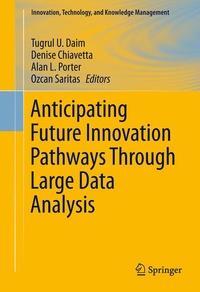
Anticipating Future Innovation Pathways Through Large Data Analysis
Description

This book aims to identify promising future developmental opportunities and applications for Tech Mining. Specifically, the enclosed contributions will pursue three converging themes:
-
The increasing availability of electronic text data resources relating to Science, Technology and Innovation (ST&I).
-
The multiple methods that are able to treat this data effectively and incorporate means to tap into human expertise and interests.
-
Translating those analyses to provide useful intelligence on likely future developments of particular emerging S&T targets.
Tech Mining can be defined as text analyses of ST&I information resources to generate Competitive Technical Intelligence (CTI). It combines bibliometrics and advanced text analytic, drawing on specialized knowledge pertaining to ST&I. Tech Mining may also be viewed as a special form of "Big Data" analytics because it searches on a target emerging technology (or key organization) of interest in global databases. One then downloads, typically, thousands of field-structured text records (usually abstracts), and analyses those for useful CTI. Forecasting Innovation Pathways (FIP) is a methodology drawing on Tech Mining plus additional steps to elicit stakeholder and expert knowledge to link recent ST&I activity to likely future development.
A decade ago, we demeaned Management of Technology (MOT) as somewhat self-satisfied and ignorant. Most technology managers relied overwhelmingly on casual human judgment, largely oblivious of the potential of empirical analyses to inform R&D management and science policy. CTI, Tech Mining, and FIP are changing that. The accumulation of Tech Mining research over the past decade offers a rich resource of means to get at emerging technology developments and organizational networks to date. Efforts to bridge from those recent histories ofdevelopment to project likely FIP, however, prove considerably harder. One focus of this volume is to extend the repertoire of information resources; that will enrich FIP.
Featuring cases of novel approaches and applications of Tech Mining and FIP, this volume will present frontier advances in ST&I text analytics that will be of interest to students, researchers, practitioners, scholars and policy makers in the fields of R&D planning, technology management, science policy and innovation strategy.
More details
Other editions
Additional editions