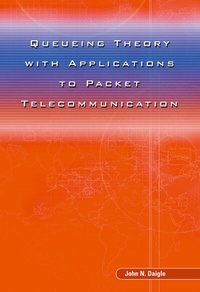
Queueing Theory with Applications to Packet Telecommunication
Description

Queueing Theory with Applications to Packet Telecommunication is an efficient introduction to fundamental concepts and principles underlying the behavior of queueing systems and its application to the design of packet-oriented electrical communication systems. In addition to techniques and approaches found in earlier works, the author presents a thoroughly modern computational approach based on Schur decomposition. This approach facilitates solution of broad classes of problems wherein a number of practical modeling issues may be explored.
Key features of communication systems, such as correlation in packet arrival processes at IP switches and variability in service rates due to fading wireless links are introduced. Numerous exercises embedded within the text and problems at the end of certain chapters that integrate lessons learned across multiple sections are also included. In all cases, including systems having priority, developments lead to procedures or formulae that yield numerical results from which sensitivity of queueing behavior to parameter variation can be explored. In several cases multiple approaches to computing distributions are presented.
Queueing Theory with Applications to Packet Telecommunication is intended both for self study and for use as a primary text in graduate courses in queueing theory in electrical engineering, computer science, operations research, and mathematics. Professionals will also find this work invaluable because the author discusses applications such as statistical multiplexing, IP switch design, and wireless communication systems. In addition, numerous modeling issues, such as the suitability of Erlang-k and Pade approximations are addressed.
More details
Other editions
Additional editions