

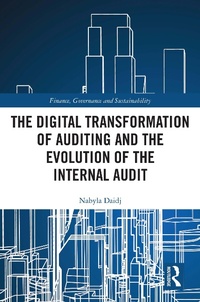
The Digital Transformation of Auditing and the Evolution of the Internal Audit
1st Edition
Published on 18. October 2022
211 pages
978-1-000-78110-6 (ISBN)
Description

The main objective of this book is to provide both academics and practitioners with a global vision of the evolution of internal auditing in a fast-changing business landscape driven by digital transformation.
Digital transformation has been first associated with the emergence and the development of new technologies (artificial intelligence, blockchain, cloud computing, data analytics, predictive analytics, robotic process automation, IOT, drones etc.). Beyond the technological dimensions, this transformation has several impacts on businesses, organizations and processes and raises several questions for auditing activities. This book explores how digitalization not only has an impact on the audit environment, but also on internal audit practices and methodologies, information technology (IT)/information system (IS) audit, IT governance and risk management.
The auditing profession also has to face the same challenges. Auditors should develop new skills. To continue to provide high quality service in such an environment, the methodologies, the process and the tools used for conducting an audit have progressively changed from those applied to the traditional audit. Internal audit, as a key strategic function, must evolve too.
Finally, the book also investigates the impact of the COVID-19 pandemic on internal auditing. The author highlights the need for a new vision and renewed forecasting tools. The post-COVID-19 business and corporate world has changed. Internal audit, as a key strategic function, must evolve too.
Digital transformation has been first associated with the emergence and the development of new technologies (artificial intelligence, blockchain, cloud computing, data analytics, predictive analytics, robotic process automation, IOT, drones etc.). Beyond the technological dimensions, this transformation has several impacts on businesses, organizations and processes and raises several questions for auditing activities. This book explores how digitalization not only has an impact on the audit environment, but also on internal audit practices and methodologies, information technology (IT)/information system (IS) audit, IT governance and risk management.
The auditing profession also has to face the same challenges. Auditors should develop new skills. To continue to provide high quality service in such an environment, the methodologies, the process and the tools used for conducting an audit have progressively changed from those applied to the traditional audit. Internal audit, as a key strategic function, must evolve too.
Finally, the book also investigates the impact of the COVID-19 pandemic on internal auditing. The author highlights the need for a new vision and renewed forecasting tools. The post-COVID-19 business and corporate world has changed. Internal audit, as a key strategic function, must evolve too.
More details
Series
Edition
1. Auflage
Language
English
Place of publication
London
United Kingdom
Publishing group
Taylor & Francis Ltd
Target group
College/higher education
Illustrations
66 Tables, black and white; 11 Line drawings, black and white; 11 Illustrations, black and white
ISBN-13
978-1-000-78110-6 (9781000781106)
Copyright in bibliographic data and cover images is held by Nielsen Book Services Limited or by the publishers or by their respective licensors: all rights reserved.
Schweitzer Classification
Other editions
Additional editions
Book
05/2024
1st Edition
Routledge
€63.10
Shipment within 10-20 days
Book
10/2022
1st Edition
Routledge
€185.90
Shipment within 10-20 days
Person
Nabyla Daidj (PhD, HDR) is Associate Professor of Strategic Management and Management Information Systems (MIS) at Institut Mines-Telecom Business School, Paris, France.
Content
Introduction 1. An historical perspective of internal audit: the impact of digital transformation 2. Aligning internal audit with the organization's strategy 3. IT governance, risks and compliance 4. The evolution of auditing methodologies 5. The evolution of IT/IS audit activities in the digital era: the impact of technology-enabled internal audit 6. The impact of the COVID-19 crisis on internal audit function and related activities
