

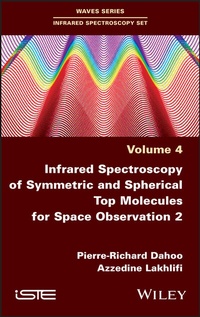
Infrared Spectroscopy of Symmetric and Spherical Spindles for Space Observation, Volume 2
1st Edition
Published on 13. September 2021
320 pages
978-1-119-86596-4 (ISBN)
Description

This book, Volume 4 in the series, is dedicated to the relationship between laboratory spectroscopy, recording ever-more-complex spectra using increasingly powerful instruments benefiting from the latest technology, and the development of observation using instruments that are embedded in mobile probes or nanosatellites. The theoretical models described in Volumes 1, 2 and 3 are used in this volume, applying the cumulant theorem in the mean-field theory framework to interpret the near and mid-infrared spectra of symmetric top molecules, such as ammonia (NH3) and spherical molecules, such as methane (CH4). These molecules can be isolated in their gaseous form or subjected to the environmental constraints of a nano-cage (a substitution site, clathrate, fullerene or zeolite) or surfaces. These methods are not only valuable in the fields of environmental sciences, planetology and astrophysics, but also fit into the framework of data processing and the concept of Big Data.
More details
Other editions
Additional editions
Pierre-Richard Dahoo | Azzedine Lakhlifi
Infrared Spectroscopy of Symmetric and Spherical Top Molecules for Space Observation, Volume 2
Book
12/2021
1st Edition
ISTE Ltd
€164.50
Shipment within 3-4 weeks
Content
- Cover
- Half-Title Page
- Title Page
- Copyright Page
- Contents
- Foreword
- Preface
- 1 IR Spectra in Space Observation
- 1.1. Introduction
- 1.2. Fourier transform spectroscopy
- 1.2.1. Principle of IR spectrum acquisition by interferometry
- 1.2.2. Design and operation of a long path difference interferometer
- 1.2.3. FTIR absorption spectroscopy in matrices
- 1.2.4. LIF and DR IR-IR spectroscopies in matrices
- 1.3. Resonant cavity laser absorption spectroscopy
- 1.3.1. Intracavity laser absorption spectroscopy (ICLAS)
- 1.3.2. Cavity ring-down spectroscopy (CRDS)
- 1.3.3. Frequency comb spectroscopy (FCS)
- 1.4. Spectroscopy for space observation
- 1.4.1. Spectroscopic ellipsometry for space observation
- 1.4.2. Space-borne spectroscopy
- 1.4.3. LIDAR spectroscopy for space observation
- 1.5. Conclusion
- 1.6. Appendices
- 1.6.1. Appendix 1: Measurement distortion and data processing
- 2 Interactions Between a Molecule and Its Solid Environment
- 2.1. Introduction
- 2.2. Active molecule - solid environment system
- 2.2.1. Binary interaction energy
- 2.2.2. Dispersion-repulsion contribution
- 2.2.3. Electrostatic contribution
- 2.2.4. Induction contribution
- 2.3. Two-center expansion of the term
- 2.4. Conclusion
- 2.5. Appendices
- 2.5.1. Appendix 1: Multipole moments and dipole polarizability of a molecule with respect to its fixed reference frame (G,X,Y,Z)
- 2.5.2. Appendix 2: Elements of the rotational matrix
- 2.5.3. Appendix 3: Clebsch-Gordan coefficients
- 3 Nanocage of Rare Gas Matrix
- 3.1. Introduction
- 3.2. Rare gases in solid state
- 3.3. Molecule inclusion and deformation of the doped crystal inclusion
- 3.3.1. Molecule
- 3.3.2. Deformation of the doped crystal
- 3.3.3. NH3 in an argon matrix
- 3.3.4. Renormalization of the system's Hamiltonian
- 3.4. Motions of NH3 trapped in an argon matrix
- 3.4.1. Vibration-inversion mode v2
- 3.4.2. Orientational motion
- 3.4.3. Translational motion
- 3.4.4. Orientational motion-heat bath coupling
- 3.5. Infrared spectra
- 3.5.1. Infrared absorption coefficient
- 3.5.2. Bar spectrum
- 3.5.3. Spectral profile
- 3.6. Appendices
- 3.6.1. Appendix 1: Normal modes of vibrations of a Bravais lattice with face centered cubic (fcc) symmetry
- 3.6.2. Appendix 2: Adjustment of the weakly perturbed rotational potential energy on the basis of the rotation matrix elements
- 3.6.3. Appendix 3: Expansion coefficients of the coupling between the orientation of the molecule and lattice vibrations (phonons)
- 4 Nanocages of Hydrate Clathrates
- 4.1. Introduction
- 4.2. The extended substitution model
- 4.3. Clathrate structures
- 4.4. Inclusion of a CH4 or NH3 molecule in a clathrate nanocage model
- 4.4.1. Inclusion
- 4.4.2. Interaction potential energy - equilibrium configuration
- 4.5. System Hamiltonian and separation of movements
- 4.6. Translational motion
- 4.6.1. CH4 - nanocages of the sI structure
- 4.6.2. NH3 - nanocages of the sI structure
- 4.7. Vibrational motions
- 4.7.1. CH4 - nanocages of the sI structure
- 4.7.2. NH3 - nanocages of the sI structure
- 4.8. Orientational motion
- 4.8.1. CH4 - nanocages of the sI structure
- 4.8.2. NH3 - nanocages of the sI structure
- 4.9. Bar spectra
- 4.9.1. Far infrared
- 4.9.2. Near infrared
- 4.10. Appendices
- 4.10.1. Appendix 1: Expressions of the orientational transition elements in the harmonic librators approximation
- 4.10.2. Appendix 2: Dipole moment as a function of dimensionless normal coordinates
- 5 Fullerene Nanocage
- 5.1. Introduction
- 5.2. Ammonia molecule trapped in a fullerene C60 nanocage
- 5.2.1. Structure of the fullerene C60 nanocage
- 5.2.2. Inclusion of NH3 in a fullerene C60 nanocage
- 5.2.3. Interaction potential energy - equilibrium configuration
- 5.3. Potential energy surfaces - inertial model
- 5.3.1. Orientation-translational motion
- 5.3.2. Translational motion
- 5.3.3. Vibration-inversion-translational motion
- 5.3.4. Kinetic Lagrangian
- 5.4. Quantum treatment
- 5.4.1. Vibrational modes - frequency shifts
- 5.4.2. Vibration-inversion mode
- 5.4.3. Orientational motions
- 5.5. Bar spectra
- 5.5.1. Far infrared and microwaves
- 5.5.2. Near infrared
- 5.6. Appendices
- 5.6.1. Appendix 1: FORTRAN program
- 5.6.2. Appendix 2: Expressions of the components of the dipole moment vector and its derivatives with respect to the normal vibrational coordinates
- 6 Adsorption on a Graphite Substrate
- 6.1. Introduction
- 6.2. "NH3 molecule-substrate" system interaction energy
- 6.2.1. Description of the system
- 6.3. Equilibrium configuration and potential energy surfaces
- 6.3.1. Adsorption energy
- 6.4. Hamiltonian of the system
- 6.4.1. Separation of movements
- 6.4.2. Renormalized Hamiltonians
- 6.4.3. Translational motions
- 6.4.4. Vibrational motions
- 6.4.5. Orientational motion
- 6.4.6. Orientational motion - heat bath dynamic coupling
- 6.5. Infrared spectra of the NH3 molecule adsorbed on the graphite substrate
- 6.5.1. Far-infrared spectrum
- 6.5.2. Near-infrared spectrum
- 6.6. Conclusion
- 6.7. Appendices
- 6.7.1. Appendix 1: FORTRAN program
- 6.7.2. Appendix 2: Expressions of the molecule orientation - heat bath phonons coupling terms
- 6.7.3. Appendix 3: Expressions of the components of the dipole moment vector and its derivatives with respect to the normal vibration coordinates
- References
- Index
- Other titles from iSTE in Waves
- EULA
