

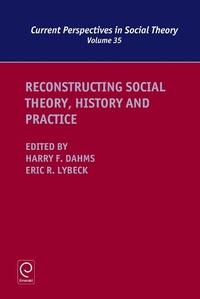
Reconstructing Social Theory, History and Practice
Published on 5. December 2016
304 pages
978-1-78635-469-3 (ISBN)
Description

With regard to developments in social theory, the past 30 years can be characterized as an Age of Deconstruction. Inspired by post-structuralism, postmodernism, critical theory, and science studies, as well as combinations of related approaches, theorists have endeavored to shatter historical meta-narratives and struggled to include previously excluded standpoints in social thought. This important trend has informed our understanding of the role of discourse, difference and expertise in determining relations of power and inequality.
This volume focusses on "Reconstruction", dedicated to taking account of and interrogating the possibility of picking up the pieces. The papers were presented at the 2015 International Social Theory Consortium (ISTC). It considers questions such as, are there limits to the deconstruction project, and have these limits been reached? What are the possibilities for the reconstruction of narratives of long-term historical change? Is it possible to include and integrate the insights and contribution of various critiques of knowledge, while at the same time developing new forms of knowledge?
This volume focusses on "Reconstruction", dedicated to taking account of and interrogating the possibility of picking up the pieces. The papers were presented at the 2015 International Social Theory Consortium (ISTC). It considers questions such as, are there limits to the deconstruction project, and have these limits been reached? What are the possibilities for the reconstruction of narratives of long-term historical change? Is it possible to include and integrate the insights and contribution of various critiques of knowledge, while at the same time developing new forms of knowledge?
Reviews / Votes
Philosophy, political science, and sociology scholars from the US, UK, and Australia present nine essays mostly based on papers presented at the annual conference of the International Social Theory Consortium in the UK in June 2015. They address the need for reconstruction after a long period of deconstruction in social theory, to take account of and examine the possibility of reassembling and rebuilding what was deconstructed. They consider reconstruction in social theory, history, and practice, discussing "the True, the Good, and the Beautiful" in European social thought; Axel Honneth's work on Hegel's theory of normative reconstruction; the dichotomy between aporia and euphoria; Erving Goffman's work; Weber's social theory as a basis for understanding suffering, in addition to the work of Emmanuel Levinas; Rowan Williams, Hans-George Gadamer, and Juergen Habermas and religion; the intellectual and political origins of the Swedish, egalitarian, democratic welfare-state ideology in the 1930s; and the political philosophy of Europe and Habermas' model of reconstruction. -- Annotation (c)2017 * (protoview.com) *More details
Series
Language
English
Place of publication
Bingley
United Kingdom
Target group
Professional and scholarly
File size
0,49 MB
ISBN-13
978-1-78635-469-3 (9781786354693)
Copyright in bibliographic data and cover images is held by Nielsen Book Services Limited or by the publishers or by their respective licensors: all rights reserved.
Schweitzer Classification
Other editions
Additional editions
Harry F. Dahms | Eric R. Lybeck
Reconstructing Social Theory, History and Practice
Book
12/2016
Emerald Group Publishing Limited
€188.70
Shipment within 10-20 days
Persons
Harry F. Dahms, Department of Sociology, University of Tennessee, Knoxville, TN, USA
Eric R. Lybeck, Department of Sociology, University of Exeter, Exeter, UK
Eric R. Lybeck, Department of Sociology, University of Exeter, Exeter, UK
Content
Introduction
PART I: PROJECTS OF RECONSTRUCTION IN HISTORY: NEO-PLATONISM, HEGEL, HONNETH, AND DERRIDA
The Birth Of The True, The Good, And The Beautiful: Toward An Investigation Of The Structures Of Social Thought - John Levi Martin
The Concept Of Normative Reconstruction: Honneth, Hegel, And The Aims Of Critical Social Theory - Andrew Buchwalter
Euporia: On The Limits, Horizons And Possibilities Of Critique (Or: On Reconstruction) - Raymond Aaron Younis
PART II: PROJECTS OF RECONSTRUCTION IN SOCIAL THEORY: SELF, SUFFERING, AND RELIGION IN MODERNITY
Reconstructing The Self: A Goffmanian Perspective - Simon Susen
Weber And Levinas On Modernity And The Problem Of Suffering: Reconstructing Social Theory As Ethically Framed Rather Than Epistemologically Framed - Stan J. Knapp
Rowan Williams And Hans-Georg Gadamer Contra Juergen Habermas: Rethinking The Problem Of Religion For Liberals As A Problem Of Dialogue - Justin Cruickshank
PART III: RECONSTRUCTION AND POLITICAL PRACTICE
Theoretical Reconstruction For Welfare State Democracy: `Third Way' Sociology And The Art Of The Possible - E. Stina Lyon
Reconstructive Science And The European Constitution: Habermas, Citizenship, And The Tension Between Facts And Norms - William Outhwaite
PART IV: REVIEW ESSAY
Turning The Circle: Considerations Of "The Postmodern Turn" A La Simon Susen - Lawrence Hazelrigg
PART I: PROJECTS OF RECONSTRUCTION IN HISTORY: NEO-PLATONISM, HEGEL, HONNETH, AND DERRIDA
The Birth Of The True, The Good, And The Beautiful: Toward An Investigation Of The Structures Of Social Thought - John Levi Martin
The Concept Of Normative Reconstruction: Honneth, Hegel, And The Aims Of Critical Social Theory - Andrew Buchwalter
Euporia: On The Limits, Horizons And Possibilities Of Critique (Or: On Reconstruction) - Raymond Aaron Younis
PART II: PROJECTS OF RECONSTRUCTION IN SOCIAL THEORY: SELF, SUFFERING, AND RELIGION IN MODERNITY
Reconstructing The Self: A Goffmanian Perspective - Simon Susen
Weber And Levinas On Modernity And The Problem Of Suffering: Reconstructing Social Theory As Ethically Framed Rather Than Epistemologically Framed - Stan J. Knapp
Rowan Williams And Hans-Georg Gadamer Contra Juergen Habermas: Rethinking The Problem Of Religion For Liberals As A Problem Of Dialogue - Justin Cruickshank
PART III: RECONSTRUCTION AND POLITICAL PRACTICE
Theoretical Reconstruction For Welfare State Democracy: `Third Way' Sociology And The Art Of The Possible - E. Stina Lyon
Reconstructive Science And The European Constitution: Habermas, Citizenship, And The Tension Between Facts And Norms - William Outhwaite
PART IV: REVIEW ESSAY
Turning The Circle: Considerations Of "The Postmodern Turn" A La Simon Susen - Lawrence Hazelrigg
