

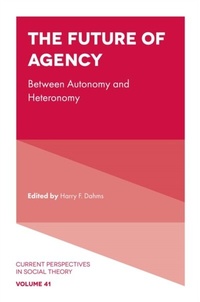
The Future of Agency
Between Autonomy and Heteronomy
1st Edition
Published on 31. January 2025
288 pages
978-1-83608-978-0 (ISBN)
Description

In this thought-provoking volume, leading scholars address the multifaceted concept of agency, dissecting its significance, applications, and challenges across various domains, and situate agency in changing socio-historical contexts in which individuals as members of larger groups try to reconcile guiding norms and values with the material conditions of their lives.
From sociological analyses to political explorations, the chapters traverse a rich landscape of ideas. The volume's centerpiece (Part I) are two essays by lead authors Axel van den Berg, a prominent Canadian social theorist at McGill University in Montreal, and Emre Amasyali, a sociologist at Institut Barcelona d'Estudis Internacionals (IBEI), along with responses by other prominent social theorists provide reactions to and assessments of the two pieces, with a reply to critics by the authors. The second and third parts do not address the concept of agency explicitly, but they do provide treatments of the larger context in which the phenomenon is situated. Part Two includes an analysis of the relevance of the category of social class via Erik Olin Wright's reception of Max Weber and a reconstruction of how the idea of a guaranteed minimum (or basic) income can be traced alongside the history of social theory, beginning with Hegel. Part Three reflect on political transformations that have manifested in the United States in recent years, which are having a bearing on the reality of agency, and on opportunities to create documentaries in order to relay social-theoretical ideas and concepts to larger audiences.
The Future of Agency ignites intellectual curiosity, challenges assumptions, and redefines our understanding of human agency and its ever-evolving role in our complex world.
From sociological analyses to political explorations, the chapters traverse a rich landscape of ideas. The volume's centerpiece (Part I) are two essays by lead authors Axel van den Berg, a prominent Canadian social theorist at McGill University in Montreal, and Emre Amasyali, a sociologist at Institut Barcelona d'Estudis Internacionals (IBEI), along with responses by other prominent social theorists provide reactions to and assessments of the two pieces, with a reply to critics by the authors. The second and third parts do not address the concept of agency explicitly, but they do provide treatments of the larger context in which the phenomenon is situated. Part Two includes an analysis of the relevance of the category of social class via Erik Olin Wright's reception of Max Weber and a reconstruction of how the idea of a guaranteed minimum (or basic) income can be traced alongside the history of social theory, beginning with Hegel. Part Three reflect on political transformations that have manifested in the United States in recent years, which are having a bearing on the reality of agency, and on opportunities to create documentaries in order to relay social-theoretical ideas and concepts to larger audiences.
The Future of Agency ignites intellectual curiosity, challenges assumptions, and redefines our understanding of human agency and its ever-evolving role in our complex world.
More details
Series
Language
English
Place of publication
Bingley
United Kingdom
Target group
Professional and scholarly
ISBN-13
978-1-83608-978-0 (9781836089780)
Copyright in bibliographic data and cover images is held by Nielsen Book Services Limited or by the publishers or by their respective licensors: all rights reserved.
Schweitzer Classification
Other editions
Additional editions
Book
01/2025
Emerald Publishing Limited
€141.36
Shipment within 3-4 weeks
Person
Harry F. Dahms is Professor of Sociology, Co-Director of the Center for the Study of Social Justice, and Co-Chair of the Committee on Social Theory at the University of Tennessee - Knoxville. He is the editor of Current Perspectives in Social Theory and director of the International Social Theory Consortium.
Content
INTRODUCTION
Surviving (in) a World of Contradictions: Conceptualizing Agency between Autonomy and Heteronomy; Harry F. Dahms
PART I. THE PERSISTENT PROBLEM AND CHALLENGE OF AGENCY (SOCIOLOGICAL THEORY)
Chapter 1. What Do We Need 'Agency' for? A Critical Analysis of Reasons for the Use of 'Agency' in Sociology; Axel van den Berg and Emre Amasyali
Chapter 2. What Do We Use 'Agency' for? A Critical Empirical Examination of Its Uses in the Sociological Literature; Emre Amasyali and Axel van den Berg
Chapter 3. Curiously Footnoted Conceptualizations of Agency; Steven Hitlin
Chapter 4. Agency between Freedom/Action and Determinism/Structure: Comment on van den Berg and Amasyali; John Levi Martin
Chapter 5. The Great Agency Muddle; Stephen Turner
Chapter 6. Why Do We Need to Discuss Agency?; Axel van den Berg and Emre Amasyali
PART II. THE PROBLEM AND CHALLENGE OF AUTONOMY (CLASSICAL AND CONTEMPORARY THEORY)
Chapter 7. Erik Olin Wright's Selective Interpretation of Weber and Exploitation: A Discussion and Evaluation; Sandro Segre
Chapter 8. A Lost Horizon: Revisiting "The Societal Rationalization of the Economy" (Translator's Introduction); Anthony J. Knowles
Chapter 9. The Societal Rationalization of the Economy: Guaranteed Minimum Income as a Constitutional Right; Harry F. Dahms
PART III. THE PROBLEM AND CHALLENGE OF HETERONOMY (APPLIED CRITICAL THEORY)
Chapter 10. Authoritarianism from Below: Why and How Trump Follows His Followers; David Norman Smith and Eric Allen Hanley
Chapter 11. Project 2025 Environmental Policy: Post-Factual Ecocatastrophe; Robert J. Antonio
Chapter 12. Filmmaking as Pedagogy and Praxis: An Interview with Garry Potter; Daniel M. Harrison
Surviving (in) a World of Contradictions: Conceptualizing Agency between Autonomy and Heteronomy; Harry F. Dahms
PART I. THE PERSISTENT PROBLEM AND CHALLENGE OF AGENCY (SOCIOLOGICAL THEORY)
Chapter 1. What Do We Need 'Agency' for? A Critical Analysis of Reasons for the Use of 'Agency' in Sociology; Axel van den Berg and Emre Amasyali
Chapter 2. What Do We Use 'Agency' for? A Critical Empirical Examination of Its Uses in the Sociological Literature; Emre Amasyali and Axel van den Berg
Chapter 3. Curiously Footnoted Conceptualizations of Agency; Steven Hitlin
Chapter 4. Agency between Freedom/Action and Determinism/Structure: Comment on van den Berg and Amasyali; John Levi Martin
Chapter 5. The Great Agency Muddle; Stephen Turner
Chapter 6. Why Do We Need to Discuss Agency?; Axel van den Berg and Emre Amasyali
PART II. THE PROBLEM AND CHALLENGE OF AUTONOMY (CLASSICAL AND CONTEMPORARY THEORY)
Chapter 7. Erik Olin Wright's Selective Interpretation of Weber and Exploitation: A Discussion and Evaluation; Sandro Segre
Chapter 8. A Lost Horizon: Revisiting "The Societal Rationalization of the Economy" (Translator's Introduction); Anthony J. Knowles
Chapter 9. The Societal Rationalization of the Economy: Guaranteed Minimum Income as a Constitutional Right; Harry F. Dahms
PART III. THE PROBLEM AND CHALLENGE OF HETERONOMY (APPLIED CRITICAL THEORY)
Chapter 10. Authoritarianism from Below: Why and How Trump Follows His Followers; David Norman Smith and Eric Allen Hanley
Chapter 11. Project 2025 Environmental Policy: Post-Factual Ecocatastrophe; Robert J. Antonio
Chapter 12. Filmmaking as Pedagogy and Praxis: An Interview with Garry Potter; Daniel M. Harrison
