

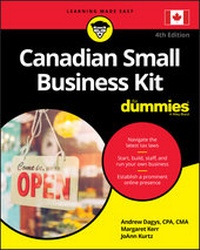
Canadian Small Business Kit For Dummies
Description

The bestselling book you need to succeed in small business
Canadian Small Business Kit For Dummies is the bestselling Canadian guide to starting and running a successful small business. This guide covers every aspect of starting, building, staffing, and running a small business.
Offering information for entrepreneurs starting from scratch, people buying a business, or new franchise owners, it features updated information about the latest tax laws and its impact on small businesses, along with insight into how small business can take advantage of social media such as Facebook, LinkedIn, Twitter, and Instagram, etc.
- Covers the latest changes to taxes, finances, and marketing
- Helpful forms on Dummies.com make learning easier
- Expert advice makes this a worthwhile investment for all entrepreneurs
- Brand-new coverage devoted to starting a cannabis business
If you're looking to start a new business-or want to improve the one that's already underway-this helpful guide makes it easier.
More details
Other editions
Additional editions
Content
Chapter 1
Do You Have the Right Stuff?
IN THIS CHAPTER
Knowing the upsides and downsides of small business ownership
Identifying a good idea and business opportunity
Assessing your true entrepreneurial spirit
Looking at timing and resources
Deciding if you should keep your day job
So you're thinking of starting your own business! Every year, lots of Canadians of all ages and backgrounds get the entrepreneurial urge and take the leap to start businesses. Some of those businesses become very successful, and some of them fail.
Business success or failure isn't the result of fate, or random chance. A business does well for good reasons - like providing a great product or service, having a solid marketing plan, and having an owner with good management skills.
Likewise, when a business goes under, you can often identify the reasons - lack of money to get properly started, poor timing or location for entering the market, or a wipeout on the customer service front. Whatever the reason for a business failure, it usually boils down to this: The business owner didn't look carefully before leaping into a new business frontier.
This chapter and the others in this section of the book help you think about going into business before you hit the ignition button and blast off. Think of this first section as "countdown."
Weighing the Pros and the Cons of Small Business Ownership
People start up their own businesses for different reasons. One of the best reasons is that they've found a business opportunity and idea that are just too attractive to pass up. A good reason is that they want to work for themselves rather than for someone else. A discouraging - but still valid - reason is that their other job options are poor (the number of small business start-ups always rises when the economy sinks or stinks).
Whatever your reason is for wanting to become an entrepreneur, you should know that life as an entrepreneur is a bit of a mixed bag. Don't say we didn't warn you! Running your own business has some great advantages, but it also has its share of disadvantages.
The pros
Here are some of the good things about going into business for yourself:
- You're free! You'll have the freedom to
- Make your own decisions - you're in charge now. Only investors (see Chapter 9), customers and clients (see Chapter 13), government regulators (see Chapter 6), and so on will tell you what to do.
- Choose your own work hours - in theory, anyway. You may not be able to get away with sleeping in until noon or concentrating your productive hours around 3 a.m. But you're more likely to be able to pick up the kids from school at 3 p.m., or exercise from 10 a.m. to 11 a.m., or grocery shop during normal office hours.
- Create your own work environment (see Chapters 7 and 8) - surround yourself with dirty coffee cups and empty candy wrappers if you feel like it.
- You can be creative! You can build your business from scratch following your own ideas rather than following someone else's master plan. (See Chapter 3.)
- You'll face new challenges! Every day. And twice as many on days that end in a y. You'll never be able to say that work is always the same old boring routine.
- Your job will be secure . as long as you have a business! Your business may fail - but no one can fire you. You can ask yourself to resign, though. (See Chapter 20 for information about the depressing prospect of running out of money.)
- You'll have increased financial opportunities! If your business is successful, you have the potential to make more than you could as an employee.
- You'll have tax advantages! This is especially true if your business is not incorporated (a sole proprietorship or a partnership), but it's also true in a different way if your business is incorporated (see Chapter 6).
The cons
Do you think we used enough exclamation marks in the exuberant section just before this one? Bet they got you all enthused and excited about entrepreneurship. But calm down for a minute - being an entrepreneur has plenty of disadvantages, too. For some people, they outweigh the advantages. For example:
- You may not make a lot of money. You may make enough money to live on, but it may not come in regularly like an employment paycheque, so you'll have cash flow predictability and budgeting problems. Or you may not make enough money to live on. You may not even make any money at all. You may go bankrupt and lose not only your business, but most of your personal possessions as well. See Chapter 20 for comfort (or failing comfort, at least for information).
- You lose easy and inexpensive access to employment benefits if you don't hang on to employment elsewhere. These may be benefits that you have come to count on - extended health and dental benefits, disability insurance, life insurance, a pension plan, and so on.
- You'll have to work really hard. That is, if you want to succeed - and you won't just be working at the business your business is about. You'll also have to do stuff you may not be trained to do, such as accounting, sales, and collection work. (But see Chapters 13 and 17 for some help.)
- You may not have a lot of free time. You may see less of your friends, family, and pets (even if you're working at home) and have less time for your favourite activities. Getting a business up and running takes more than hard work; it also takes your time and commitment. Don't scoff that you won't let that happen to you, at least not until you've put in hours filling out government paperwork (GST/HST for example - see Chapter 16) on a beautiful sunny day that would be perfect for, well, almost anything else. By the way, you don't get paid for your sacrificed time, either.
- You may have to put a lot of your own money into starting up the business. And even if you can borrow the money, unless the lender is The Bank of Mom and Dad, you'll have to give personal guarantees that the money will be repaid (with interest) within a certain time. The pressure is building! (For more on borrowing, see Chapter 9.) By the way, not to add to the pressure or anything, but you should know that you might lose your own money or not be able to repay borrowed money because of factors beyond your control. You could get sick (and now you probably don't have disability insurance), be flattened by a competitor, squashed by a nose-diving economy, or whacked by a partner who pulls out on you. (See Chapter 20 for advice on how to deal with some of these problems).
- You are the bottom line. No excuses - success is up to you, and failure is your fault. You'll have to keep on top of changes in your field, the impact of new technology, economic fluctuations. .
- Your personal life can stick its nose into your business life in a major way. If you and your spouse split up, your spouse may be able to claim a share of your business under equalization provisions in the family law of some provinces. You might have to sell your home, your business, or your business assets (business property) to pay off your spouse. (Chapter 21 looks at selling your business.)
Choosing Your Business
After you're aware of the upside and the downside to running your own business, start considering how people choose a business to go into.
Five main kinds of businesses exist:
- Service: Doing things for others, including the professions (doctors, engineers, lawyers, dentists, architects, accountants, pilots); skilled trades (plumbers, electricians, carpet installers, bookkeepers, renovators, truckers, carpenters, landscapers); and a huge range of other things for which you might need a lot of training and skill, or at least some talent and willingness. We're talking about teachers, data scientists, financial planners, real estate agents, painters, insurance brokers, management consultants, taxi and Uber drivers, travel agents, dry cleaners, caterers, event planners, hairdressers, equipment repairers, commercial printers, photographers, gardeners, snow removers . this list could go on.
- Retail: Selling things to the general public, such as jewellery, groceries, clothing, appliances, books, furniture, antiques and collectibles, toys, hardware, cards and knick-knacks, garden accessories, plants, cars . this list could also go on.
- Wholesale: Buying large quantities of goods from manufacturers at a discount and selling in smaller quantities to others - usually retailers - for a higher price. For example, you could buy nails in bulk from a manufacturer and resell them to hardware stores. Wholesalers sometimes also sell to the general public, usually without the frills of a retail establishment (for example, bulk food, carpets, and clothing).
- Manufacturing: Making things from scratch - from designing and sewing baby clothes for sale through a local children's clothing store to making furniture in a workshop to manufacturing steel ingots in a mammoth industrial...
