

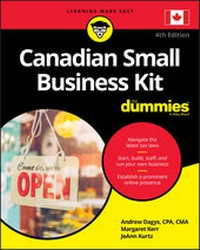
Canadian Small Business Kit For Dummies
4th Edition
Published on 7. May 2019
528 pages
978-1-119-57584-9 (ISBN)
Description

The bestselling book you need to succeed in small business
Canadian Small Business Kit For Dummies is the bestselling Canadian guide to starting and running a successful small business. This guide covers every aspect of starting, building, staffing, and running a small business.
Offering information for entrepreneurs starting from scratch, people buying a business, or new franchise owners, it features updated information about the latest tax laws and its impact on small businesses, along with insight into how small business can take advantage of social media such as Facebook, LinkedIn, Twitter, and Instagram, etc.
- Covers the latest changes to taxes, finances, and marketing
- Helpful forms on Dummies.com make learning easier
- Expert advice makes this a worthwhile investment for all entrepreneurs
- Brand-new coverage devoted to starting a cannabis business
If you're looking to start a new business-or want to improve the one that's already underway-this helpful guide makes it easier.
More details
Other editions
Additional editions
Andrew Dagys | Margaret Kerr | JoAnn Kurtz
Canadian Small Business Kit For Dummies
Book
06/2019
4th Edition
Wiley
€37.50
Article exhausted; check different version
Content
- Intro
- Title Page
- Copyright Page
- Table of Contents
- Introduction
- About This Book
- Foolish Assumptions
- Icons Used in This Book
- Beyond the Book
- Where to Go from Here
- Part 1 Small Business Essentials
- Chapter 1 Do You Have the Right Stuff?
- Weighing the Pros and the Cons of Small Business Ownership
- The pros
- The cons
- Choosing Your Business
- Those who have a clue
- Those who are clueless
- Determining If You Have the Small Business Personality
- The small business personality aptitude test
- Considering Other Factors Before Starting Your Business
- Your personal life
- Your practical resources
- The broader economy, the industry, and the specific market
- Easing into It: Knowing If and When to Give Up Your Day Job
- Chapter 2 Seeking Out Helpful Business Information
- Getting Started
- The Government of Canada: Core resources for entrepreneurs
- Provincial/territorial government websites
- Bank and trust company websites
- Small business or entrepreneurship centres
- Business incubators
- Getting Information Geared to Your Specific Business
- Innovation, Science, and Economic Development Canada
- Trade and professional associations
- Obtaining Essential Business Skills
- Skills for your particular business
- General business skills
- Finding Professional and Other Help
- Determining whom you need to help you
- Identifying the right people
- Finding peer support
- Getting the Scoop on Customers and Suppliers
- Customers
- Suppliers
- Chapter 3 What's the Big Idea? Intellectual Property and You
- What a Fine Idea
- Investigating the value of an idea
- Determining who owns an idea
- Protecting ideas from unauthorized use
- Manufacturing or Selling a Product in Your Business
- Manufacturing or selling a product from a design
- Manufacturing a product that you've invented
- Manufacturing or selling a product that someone else has invented
- Using a Name or Word in Your Business
- Naming your business
- Selecting a name, slogan, or logo that identifies your business or product
- Using Written Materials in Your Business
- Understanding copyright
- Using someone else's written material
- Using someone else's confidential materials
- Using your own written materials
- Using Pictures and Drawings in Your Business
- Using Music in Your Business
- Chapter 4 Choosing a Product or Service
- Developing Your Product or Service with a Market in Mind
- Eureka!
- Asking yourself some sobering questions
- Tinker with your idea
- Finding the Best Route to Your Target Market
- From your business directly to your customer
- From your business to another business to your target customer
- Pricing Your Product or Service
- Deciding on the minimum price you can charge
- Deciding on the maximum price you can charge
- Setting your price
- Part 2 Getting Started
- Chapter 5 Custom-Made Business - or Off-the-Shelf?
- Why Buy an Existing Business?
- Shopping for a Business
- Looking Carefully at Potential Existing Businesses
- Why is the owner selling the business?
- What is the reputation of the business?
- What is the reason for the success of the business?
- How's the neighbourhood?
- What do the financial statements tell you?
- What is the "corporate culture"?
- Deciding on a Price for a Business
- What's a business worth?
- Sources of information for valuing a business
- Putting the Deal Together
- Buy assets or buy shares?
- Deciding between a share purchase and an asset purchase
- Allocation of the purchase price in an asset purchase
- The dear departed - can you control the former owner?
- Considering a Franchise
- Checking out the advantages of a franchise
- Investigating the disadvantages of a franchise
- Finding a franchise
- Evaluating the franchises you find
- Doing due diligence before you sign
- Chapter 6 Ownership Issues
- Should You Go Alone or Take on a Co-Pilot?
- Should You Incorporate?
- What are your options?
- What's the difference?
- The Corporation - A Form of Business with a Life All Its Own
- Understanding corporations
- Setting up a corporation
- Running a corporation
- Reviewing the advantages of incorporation
- Delving into the disadvantages of incorporation
- Protecting Your Assets without Incorporating
- Your Choices If You're the Only Owner
- Sole proprietorship
- A solely owned corporation
- Your Choices If the Business Has Multiple Owners
- Partnership
- A multi-shareholder corporation
- So How Do You Choose?
- Other Start-Up Issues
- Investigating permits, licences, and other government requirements
- Registering for payroll taxes and GST or HST
- Chapter 7 Getting Your Gear Together
- Setting Up Your Business Office
- Choosing between functional and fancy
- Finding furniture
- Finding furnishings
- Stocking survival equipment
- Getting low-tech hardware
- Getting high-tech hardware
- Getting software and services
- Establishing an online presence
- Getting remote access to your data and colleagues
- Specific Equipment for Your Business
- Buying Equipment versus Leasing Equipment
- Buying
- Leasing
- Looking for help?
- Getting Business Stationery and Printed Materials
- Well-managed
- Successful
- Putting It All Together
- Chapter 8 Your Business Coordinates
- Working from Home
- Should you have a home-based business?
- Tips for working at home successfully
- Working from Real Business Premises
- Premises available, apply within
- Space-sharing arrangements
- Renting Business Premises
- Knowing what you're looking for
- Finding what you're looking for
- Determining the cost of your space
- Exploring commercial leases
- Buying Business Premises
- Chapter 9 Figuring Out Finances
- Your Business Needs Capital
- Forecasting How Much Your Business Will Need to Operate
- Projecting your expenses and revenues
- Preparing a forecast of revenue and expenses
- Projected cash flow
- Locating Sources of Financing for a Start-Up Operation
- Mix-and-match financing
- Personal assets
- Money from family and friends
- Money borrowed from commercial lenders
- Micro-credit funds
- Credit from suppliers and clients
- Sale of accounts receivable
- Government loans and grants
- Arm's-length investment
- Crowdfunding
- Applying for Money
- Chapter 10 Writing a Business Plan That Gets You Money
- Don't Panic!
- First reason not to panic
- Second reason not to panic
- Third reason not to panic
- First Step
- Filling Out an Application Form
- Preparing a Business Plan
- Checking Out What Goes into a Business Plan
- A full-scale business plan
- A mini business plan
- Stating How Much You Want (Your Objective)
- Describing Your Business
- Your product or service
- The goals of your business
- Your business within the industry
- Why your business can compete successfully
- Your market
- Your competitors
- Explaining How Your Business Runs
- Business info and history
- Business managers
- Business operations
- Supplying Financial Information
- Capital requirements of your business
- Assets and liabilities of your business
- Projected revenue and expenses of your business
- Your personal capital
- Providing References
- Pulling the Final Product Together
- Cover
- Executive summary
- Getting Help with Your Business Plan
- Chapter 11 Making a Marketing Buzz
- Finding Customers or Clients
- Promotion
- Advertising
- Publicity
- Professional help
- Don't get discouraged
- Establishing a Web Presence for Your Business
- Getting a Website of Your Own
- Understanding the importance of a website
- Deciding between a server of your own or a web host
- Claiming your domain name
- Putting content on your website
- Attracting visitors
- Marketing with Email
- Developing and maintaining a permission-based email list
- Maximizing deliverability of your emails
- Creating an email newsletter
- Getting help
- Blogging
- Understanding the importance of blogging
- Adding a blog to your website
- Putting content on your blog
- Using Social Media to Market Your Business
- Getting to know the major social media sites
- Telling your business story with Instagram
- Managing your social media marketing time
- Monitoring the Web
- Now Get Out There and Sell!
- Part 3 Operating Your Small Business
- Chapter 12 Managing Risk
- What Kind of Risks Does a Business Face?
- Strategic risk
- Growth and expansion risks
- Financial risk
- Organizational risk
- Operational risk
- External risk
- Reputational risk
- Recognizing the Risk of Not Seizing Opportunities
- Paying Extra Attention to Legal and Regulatory Risks
- Injury to others
- Injury to your business
- Injury to you and your business associates
- Minimizing Your Legal, Regulatory, and Similar Risks
- Injury to others due to safety, legal, and contractual issues
- Mitigating physical, financial, information technology, and business resilience risks
- Transferring Your Risks to Somebody Else
- Have you already got insurance?
- Do you really need insurance?
- Examining Different Insurance Policies
- Insurance in case your business causes damage
- Insurance against damage to your business, staff, and data
- Insurance to protect the people working in your business
- Chapter 13 Working with Customers and Clients
- Recognizing What You Want from Your Customers or Clients
- Reviewing What Happens in the Usual Business Transaction
- Making the Sale
- The pitch and the close
- First impressions
- Documenting Your Agreement
- Contracts for the sale of goods
- Contracts for services
- Speak to your lawyer
- Doing the Work
- Happy customers
- Unhappy customers
- Getting Paid
- Planning to get paid
- Collecting your accounts receivable
- Getting Paid Online
- Merchant account
- Third-party processor
- Apple Pay
- Addressing Customer Privacy
- Getting Repeat Business and Referrals
- When Peaceful Coexistence Is Shattered
- If you get fired for no good reason
- If you really screw up
- Chapter 14 Dealing with Suppliers and Advisors
- So Now You're the Customer
- Determining what goods and services you need
- Finding suppliers
- Choosing a supplier
- Establishing Credit with Your Suppliers
- Entering into Contracts with Your Suppliers
- Contracts for goods
- Contracts for services
- Speak to your lawyer
- Establishing a Good Relationship with Your Suppliers
- Problems with Suppliers
- Avoiding problems in the first place
- Considering some problems that can arise
- Knowing what to do if you suffer loss or damage because of your supplier
- Using Suppliers of Professional Services
- Finding professional help
- Entering into contracts with professional advisors
- Working with professional advisors
- Dealing with problems with professional advisors
- Chapter 15 Beam Up the Crew
- What Are You Getting Yourself Into?
- Paying wages
- Providing paid vacation and statutory holidays
- Paying taxes
- Providing a safe workplace
- Taking responsibility for your employees' actions
- Hiring an Employee
- Drafting a job description and qualifications
- Funding an employee
- Finding job candidates
- Reviewing the job applications
- Interviewing the most promising candidates
- Checking out the candidates
- Making an offer
- Contacting the unsuccessful candidates
- Being an Employer
- Being a manager
- Complying with government requirements
- Maintaining records
- Establishing policies
- Firing an Employee
- Firing for just cause
- Firing without just cause
- Examining wrongful dismissal
- Addressing human rights concerns
- When Your Employee Is Gone
- Chapter 16 Tax Attacks!
- Choosing Your Tax Tactics
- Doing your own taxes
- Enlisting cyber help
- Recruiting a Certified Public Accountant
- Income Taxes
- Understanding what income a business is taxed on
- Defining business income
- Discovering what legitimate business expenses are
- Assessing how much tax you will pay
- Determining when and how you have to pay
- Being penalized
- Keeping the proper records
- Dealing with an audit
- Sales Taxes
- Provincial sales tax
- Goods and Services Tax
- Harmonized Sales Tax
- Payroll Taxes
- Business Taxes
- Chapter 17 Close Encounters with Accounting
- What's Accounting and Why Is It Important?
- Bookkeeping
- Creating and saving source documents
- Recording your transactions
- Sorting your revenue and expenses by category
- Handling the bookkeeping burden
- Inventory Accounting
- Internal Controls
- Preparing Financial Documents
- Tax and related returns
- Financial statements
- Historical Financial Statements
- Creating financial statements
- The income statement
- The balance sheet
- Case Study: E.T.&T. Telecommunications Inc.
- Cash-Flow Projections
- Hiring an Accountant
- Considering what an accountant does
- Determining what kind of accountant you need
- Part 4 What Does the Future Hold?
- Chapter 18 Getting Bigger
- What "Doing More Business" Means
- Don't Do More Business If . . .
- Lowering expenses
- Raising prices
- How Do You Find More Business?
- See if you can do more of the same work for existing customers
- Find more customers for the same work
- Do new and additional work for existing customers
- Find new customers for new products or services
- How Do You Finance Your Expansion?
- Sale or sale and leaseback of equipment
- Retained earnings
- Equity investment
- How Do You Manage a Bigger Business?
- Learning personal management techniques
- Learning business management techniques
- Chapter 19 Starting a Cannabusiness
- Determining If You Have What It Takes
- Seeking Out Helpful Business Information
- Industry information
- Legal and regulatory information
- Getting Clear on Your Big Product or Service Idea
- Generating a unique cannabusiness idea
- Considering start-up and ongoing costs
- Understanding your consumer base
- Exploring the Opportunities
- Producing, cultivating, or growing cannabis
- Exploring cannabis processing
- Selling cannabis as a legal retailer or dispensary
- Running a cannabis delivery service
- Providing advertising, public relations, marketing, and branding services
- Offering security services
- Considering ancillary products and services
- Chapter 20 Anticipating Problems
- No Money
- Your business can't make a payment that's due
- You've personally guaranteed a debt for your business and your business can't pay
- Your business can't pay its rent
- Your business can't pay a mortgage on real property
- Your business can't pay its taxes
- Your business is insolvent
- Bankruptcy
- Disputes
- Negotiation of a settlement
- Alternative dispute resolution (ADR)
- Litigation
- Chapter 21 Closing Up Shop
- Parting from Your Business May Be a Joint Venture
- Tax Considerations When You Get Out of Business
- Taxation of capital gains
- Calculation of capital gains
- Dealing with the tax bill
- Selling Your Business as a Going Concern
- Knowing what your business is worth
- Finding a buyer
- Dealing with prospective buyers
- Putting the deal together
- Going Out of Business
- Finding buyers for your business's assets
- Unloading leased equipment
- Paying off your debts
- Notifying your clients or customers
- Notifying your suppliers
- Negotiating with your landlord
- Being Put Out of Business
- How your secured creditors can put you out of business
- How your unsecured creditors can put you out of business
- Dying to Get Out of Business
- Short-term planning versus long-term planning
- Keeping it in the family
- Selling to an outsider
- Part 5 The Part of Tens
- Chapter 22 Ten Questions Every Prospective Small Business Owner Should Ask
- Do I Have the Right Personality to Run My Own Business?
- What Should My Business Produce or Sell?
- Should I Buy an Existing Business or Start from Scratch?
- Should I Incorporate My Business?
- How Will I Finance My Business?
- Should I Work from Home?
- What's the Best Way to Market My Business?
- How Can I Keep My Customers Happy?
- When Should I Take On Employees?
- What Professional Help Do I Need?
- Chapter 23 Ten Key Documents for a Small Business
- Partnership Agreement or Shareholder Agreement
- Lease for Your Business Premises
- Insurance Policy
- Business Plan
- Loan Documents
- Standard Customer Contract
- Employment Contract
- Confidential Disclosure Agreement
- Non-Competition Agreement
- Privacy Policy
- Chapter 24 Ten Internet Resources You May Find Useful
- The Government of Canada
- Provincial/Territorial Government Websites
- Innovation, Science, and Economic Development Canada
- Business Development Bank of Canada
- Canada Revenue Agency
- Bank and Trust Company Websites
- The Yellow Pages
- Top Ten Reviews
- HowStuffWorks
- Mashable
- Index
- EULA
