

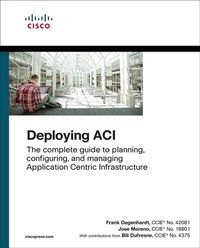
Deploying ACI
The complete guide to planning, configuring, and managing Application Centric Infrastructure
1st Edition
Published on 10. March 2021
704 pages
978-0-13-466107-0 (ISBN)
Description

Use ACI fabrics to drive unprecedented value from your data center environment
With the Cisco Application Centric Infrastructure (ACI) software-defined networking platform, you can achieve dramatic improvements in data center performance, redundancy, security, visibility, efficiency, and agility. In Deploying ACI, three leading Cisco experts introduce this breakthrough platform, and walk network professionals through all facets of design, deployment, and operation. The authors demonstrate how ACI changes data center networking, security, and management; and offer multiple field-proven configurations.
Deploying ACI is organized to follow the key decision points associated with implementing data center network fabrics. After a practical introduction to ACI concepts and design, the authors show how to bring your fabric online, integrate virtualization and external connections, and efficiently manage your ACI network.
You'll master new techniques for improving visibility, control, and availability; managing multitenancy; and seamlessly inserting service devices into application data flows. The authors conclude with expert advice for troubleshooting and automation, helping you deliver data center services with unprecedented efficiency.
Understand the problems ACI solves,and how it solves them
Design your ACI fabric, build it, and interface with devices to bring it to life
Integrate virtualization technologieswith your ACI fabric
Perform networking within an ACI fabric (and understand how ACI changes data center networking)
Connect external networks and devices at Layer 2/Layer 3 levels
Coherently manage unified ACI networks with tenants and application policies
Migrate to granular policies based on applications and their functions
Establish multitenancy, and evolve networking, security, and services to support it
Integrate L4-7 services: device types, design scenarios, and implementation
Use multisite designs to meet rigorous requirements for redundancy and business continuity
Troubleshoot and monitor ACI fabrics
Improve operational efficiency through automation and programmability
With the Cisco Application Centric Infrastructure (ACI) software-defined networking platform, you can achieve dramatic improvements in data center performance, redundancy, security, visibility, efficiency, and agility. In Deploying ACI, three leading Cisco experts introduce this breakthrough platform, and walk network professionals through all facets of design, deployment, and operation. The authors demonstrate how ACI changes data center networking, security, and management; and offer multiple field-proven configurations.
Deploying ACI is organized to follow the key decision points associated with implementing data center network fabrics. After a practical introduction to ACI concepts and design, the authors show how to bring your fabric online, integrate virtualization and external connections, and efficiently manage your ACI network.
You'll master new techniques for improving visibility, control, and availability; managing multitenancy; and seamlessly inserting service devices into application data flows. The authors conclude with expert advice for troubleshooting and automation, helping you deliver data center services with unprecedented efficiency.
Understand the problems ACI solves,and how it solves them
Design your ACI fabric, build it, and interface with devices to bring it to life
Integrate virtualization technologieswith your ACI fabric
Perform networking within an ACI fabric (and understand how ACI changes data center networking)
Connect external networks and devices at Layer 2/Layer 3 levels
Coherently manage unified ACI networks with tenants and application policies
Migrate to granular policies based on applications and their functions
Establish multitenancy, and evolve networking, security, and services to support it
Integrate L4-7 services: device types, design scenarios, and implementation
Use multisite designs to meet rigorous requirements for redundancy and business continuity
Troubleshoot and monitor ACI fabrics
Improve operational efficiency through automation and programmability
All prices
More details
Edition
1. Auflage
Language
English
Place of publication
Indianapolis
United States
Publishing group
Pearson Education (US)
Target group
College/higher education
File size
59,24 MB
ISBN-13
978-0-13-466107-0 (9780134661070)
Copyright in bibliographic data and cover images is held by Nielsen Book Services Limited or by the publishers or by their respective licensors: all rights reserved.
Schweitzer Classification
Other editions
Additional editions
Frank Dagenhardt | Jose Moreno | Bill Dufresne
Deploying ACI: The complete guide to planning, configuring, and managing Application Centric Infrastructure
The complete guide to planning, configuring, and managing Application Centric Infrastructure
Book
04/2018
1st Edition
Cisco Press
€54.49
Shipment within 3-4 weeks
Persons
Frank Dagenhardt, CCIE No. 42081, is a technical solutions architect for Cisco focusing on next-generation data center architectures. Frank has over 22 years in Information Technology and holds certifications from HP, Microsoft, Citrix, and Cisco. A Cisco veteran of over 11 years, he works with customers daily, designing, implementing, and supporting end-to-end architectures and solutions. In recent months, he has been focusing on policy, automation, and analytics. Frank has worked on and continues to be involved in publications about Cisco products. He presents regularly at Cisco Live on data center topics. He lives in Michigan with his wife and four wonderful children.
Jose Moreno, CCIE No. 16601 and CCDE No. 20100008, attended the Polytechnic Universities of Madrid and Milan. After he graduated, he started his career as a network architect in a big data center in Germany, at Amadeus Data Processing. In 2007 he moved to Cisco, where he started working as data center systems engineer. Since then he has worked in many different Cisco data center technologies, including Cisco Unified Compute System and the Cisco Nexus switching series. Since 2014 Jose has focused on Cisco Application Centric Infrastructure as a technical solutions architect. Jose has presented multiple times at Cisco Live. He lives with his wife and children in Munich, Germany.
Bill Dufresne is a Distinguished Systems Engineer and member of the Data Center/Cloud Team at Cisco. He regularly works with customers on complex technical designs while leading global teams in various disciplines. He has been with Cisco since 1996 and has more than 31 years of experience in the IT industry. Bill has held several industry certifications, including Cisco CCIE for more than 19 years, VMware VCP, CISSP, Microsoft, and even Banyan Vines. He is an expert in Routing & Switching, Data Center Compute Infrastructure, Software Defined Networking, Virtual Networking, Analytics, and foremost, an expert in Systems, Application, and Cloud Adoption. Bill is a frequent speaker at a multitude of industry conferences including Cisco Live, VMWorld, Vmware Partner Exchange, VMware User Groups, EMC World, and various other events. He has worked with many customers of all sizes, across verticals such as Global Financial; Transportation; Retail; Healthcare; State, Local, and National Government; and Higher Education. Bill lives south of Nashville, TN with his wonderful wife, enjoying their 'empty nest' years.
Jose Moreno, CCIE No. 16601 and CCDE No. 20100008, attended the Polytechnic Universities of Madrid and Milan. After he graduated, he started his career as a network architect in a big data center in Germany, at Amadeus Data Processing. In 2007 he moved to Cisco, where he started working as data center systems engineer. Since then he has worked in many different Cisco data center technologies, including Cisco Unified Compute System and the Cisco Nexus switching series. Since 2014 Jose has focused on Cisco Application Centric Infrastructure as a technical solutions architect. Jose has presented multiple times at Cisco Live. He lives with his wife and children in Munich, Germany.
Bill Dufresne is a Distinguished Systems Engineer and member of the Data Center/Cloud Team at Cisco. He regularly works with customers on complex technical designs while leading global teams in various disciplines. He has been with Cisco since 1996 and has more than 31 years of experience in the IT industry. Bill has held several industry certifications, including Cisco CCIE for more than 19 years, VMware VCP, CISSP, Microsoft, and even Banyan Vines. He is an expert in Routing & Switching, Data Center Compute Infrastructure, Software Defined Networking, Virtual Networking, Analytics, and foremost, an expert in Systems, Application, and Cloud Adoption. Bill is a frequent speaker at a multitude of industry conferences including Cisco Live, VMWorld, Vmware Partner Exchange, VMware User Groups, EMC World, and various other events. He has worked with many customers of all sizes, across verticals such as Global Financial; Transportation; Retail; Healthcare; State, Local, and National Government; and Higher Education. Bill lives south of Nashville, TN with his wonderful wife, enjoying their 'empty nest' years.
Content
1. Introduction to ACI
2. Building a Fabric
3. Bringing up a Fabric
4. Integration of Virtualization Technologies with ACI
5. Introduction to Networking with ACI
6. External Routing with ACI
7. How is Life Different with ACI?
8. Moving to Application Centric Networking
9. Multitenancy
10. Integrating L4-7 Services
11. Multi-Site
12. Troubleshooting and Monitoring
13. Programmability and Automation Overview
2. Building a Fabric
3. Bringing up a Fabric
4. Integration of Virtualization Technologies with ACI
5. Introduction to Networking with ACI
6. External Routing with ACI
7. How is Life Different with ACI?
8. Moving to Application Centric Networking
9. Multitenancy
10. Integrating L4-7 Services
11. Multi-Site
12. Troubleshooting and Monitoring
13. Programmability and Automation Overview
