

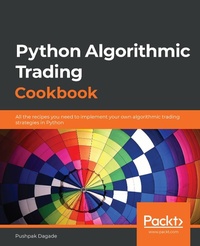
Python Algorithmic Trading Cookbook
All the recipes you need to implement your own algorithmic trading strategies in Python
Published on 23. September 2024
542 pages
978-1-83898-251-5 (ISBN)
Description

Build a solid foundation in algorithmic trading by developing, testing and executing powerful trading strategies with real market data using Python
Key Features
Build a strong foundation in algorithmic trading by becoming well-versed with the basics of financial markets
Demystify jargon related to understanding and placing multiple types of trading orders
Devise trading strategies and increase your odds of making a profit without human intervention
Book DescriptionIf you want to find out how you can build a solid foundation in algorithmic trading using Python, this cookbook is here to help. Starting by setting up the Python environment for trading and connectivity with brokers, you'll then learn the important aspects of financial markets. As you progress, you'll learn to fetch financial instruments, query and calculate various types of candles and historical data, and finally, compute and plot technical indicators. Next, you'll learn how to place various types of orders, such as regular, bracket, and cover orders, and understand their state transitions. Later chapters will cover backtesting, paper trading, and finally real trading for the algorithmic strategies that you've created. You'll even understand how to automate trading and find the right strategy for making effective decisions that would otherwise be impossible for human traders. By the end of this book, you'll be able to use Python libraries to conduct key tasks in the algorithmic trading ecosystem. Note: For demonstration, we're using Zerodha, an Indian Stock Market broker. If you're not an Indian resident, you won't be able to use Zerodha and therefore will not be able to test the examples directly. However, you can take inspiration from the book and apply the concepts across your preferred stock market broker of choice.What you will learn
Use Python to set up connectivity with brokers
Handle and manipulate time series data using Python
Fetch a list of exchanges, segments, financial instruments, and historical data to interact with the real market
Understand, fetch, and calculate various types of candles and use them to compute and plot diverse types of technical indicators
Develop and improve the performance of algorithmic trading strategies
Perform backtesting and paper trading on algorithmic trading strategies
Implement real trading in the live hours of stock markets
Who this book is forIf you are a financial analyst, financial trader, data analyst, algorithmic trader, trading enthusiast or anyone who wants to learn algorithmic trading with Python and important techniques to address challenges faced in the finance domain, this book is for you. Basic working knowledge of the Python programming language is expected. Although fundamental knowledge of trade-related terminologies will be helpful, it is not mandatory.
Key Features
Build a strong foundation in algorithmic trading by becoming well-versed with the basics of financial markets
Demystify jargon related to understanding and placing multiple types of trading orders
Devise trading strategies and increase your odds of making a profit without human intervention
Book DescriptionIf you want to find out how you can build a solid foundation in algorithmic trading using Python, this cookbook is here to help. Starting by setting up the Python environment for trading and connectivity with brokers, you'll then learn the important aspects of financial markets. As you progress, you'll learn to fetch financial instruments, query and calculate various types of candles and historical data, and finally, compute and plot technical indicators. Next, you'll learn how to place various types of orders, such as regular, bracket, and cover orders, and understand their state transitions. Later chapters will cover backtesting, paper trading, and finally real trading for the algorithmic strategies that you've created. You'll even understand how to automate trading and find the right strategy for making effective decisions that would otherwise be impossible for human traders. By the end of this book, you'll be able to use Python libraries to conduct key tasks in the algorithmic trading ecosystem. Note: For demonstration, we're using Zerodha, an Indian Stock Market broker. If you're not an Indian resident, you won't be able to use Zerodha and therefore will not be able to test the examples directly. However, you can take inspiration from the book and apply the concepts across your preferred stock market broker of choice.What you will learn
Use Python to set up connectivity with brokers
Handle and manipulate time series data using Python
Fetch a list of exchanges, segments, financial instruments, and historical data to interact with the real market
Understand, fetch, and calculate various types of candles and use them to compute and plot diverse types of technical indicators
Develop and improve the performance of algorithmic trading strategies
Perform backtesting and paper trading on algorithmic trading strategies
Implement real trading in the live hours of stock markets
Who this book is forIf you are a financial analyst, financial trader, data analyst, algorithmic trader, trading enthusiast or anyone who wants to learn algorithmic trading with Python and important techniques to address challenges faced in the finance domain, this book is for you. Basic working knowledge of the Python programming language is expected. Although fundamental knowledge of trade-related terminologies will be helpful, it is not mandatory.
More details
Edition
Digital original
Language
English
Place of publication
Birmingham
United Kingdom
Target group
Professional and scholarly
US School Grade: College Graduate Student
Edition type
Digital original
File size
25,91 MB
ISBN-13
978-1-83898-251-5 (9781838982515)
Copyright in bibliographic data and cover images is held by Nielsen Book Services Limited or by the publishers or by their respective licensors: all rights reserved.
Schweitzer Classification
Other editions
Additional editions
Pushpak Dagade
Python Algorithmic Trading Cookbook
All the recipes you need to implement your own algorithmic trading strategies in Python
Book
08/2020
Packt Publishing
€58.00
Shipment within 3-4 weeks
Person
Dagade Pushpak :
Pushpak Dagade is working in the area of algorithmic trading with Python for more than 3 years. He is a co-founder and CEO of AlgoBulls, an algorithmic trading platform.
Pushpak Dagade is working in the area of algorithmic trading with Python for more than 3 years. He is a co-founder and CEO of AlgoBulls, an algorithmic trading platform.
Content
Table of Contents
Handling and Manipulating Date, Time, and Time Series Data
Stock Markets - Primer on Trading
Fetching Financial Data
Computing Candlesticks and Historical Data
Computing and Plotting of Technical Indicators
Placing Trading Orders on the Exchange
Placing Bracket and Cover Orders on the Exchange
Algorithmic Trading Strategies
Algorithmic Trading
Algorithmic Trading
Algorithmic Trading
Appendix I
Appendix II
Appendix III
Handling and Manipulating Date, Time, and Time Series Data
Stock Markets - Primer on Trading
Fetching Financial Data
Computing Candlesticks and Historical Data
Computing and Plotting of Technical Indicators
Placing Trading Orders on the Exchange
Placing Bracket and Cover Orders on the Exchange
Algorithmic Trading Strategies
Algorithmic Trading
Algorithmic Trading
Algorithmic Trading
Appendix I
Appendix II
Appendix III
