

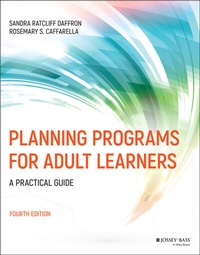
Planning Programs for Adult Learners
Description

Planning Programs for Adult Learners: A Practical Guide, 4th Edition is an interactive, practical, and essential guide for anyone involved with planning programs for adult learners. Containing extensive updates, refinements, and revisions to this celebrated book, this edition prepares those charged with planning programs for adult learners across a wide variety of settings.
* Spanning a variety of crucial subjects, this book will teach readers how to:
* Plan, organize, and complete other administrative tasks with helpful templates and practical guides
* Focus on challenges of displacement, climate change, economic dislocation, and inequality
* Plan programs using current and emerging digital delivery tools and techniques including virtual and augmented reality
Planning Programs for Adult Learners provides an international perspective and includes globally relevant examples and research that will inform and transform your program planning process. Perfect for adult educators and participants in continuing education programs for adults, the book will also be illuminating for graduate students in fields including education, nursing, human resource development, and more.
More details
Other editions
Additional editions
Persons
SANDRA RATCLIFF DAFFRON is a program planner, professional educator, project and program director, administrator, and organizational executive in the U.S. and the Middle East. She has extensive experience working with lawyers, judges, teachers, correctional educators, physicians, military trainers, and graduate students. She is Professor Emeritus of Adult and Continuing Education at Western Washington University in Bellingham, Washington.
ROSEMARY S. CAFFARELLA is an emerita professor of education in the College of Agriculture and Life Science at Cornell University. Her research and writing activities have focused on adult development and learning, and program planning and evaluation. She has authored or coauthored a number of books, including the award-winning Learning in Adulthood.
Content
Figures and Exhibits ix
Preface xiii
Acknowledgments xix
Dedication xxi
The Authors xxiii
1 Planning Programs for Adults: What It's About Today, Tomorrow, and into the Future 1
2 Introducing the Interactive Model 29
3 Planning Programs in Difficult Times Using Technological Tools 55
4 Exploring the Foundations of Program Planning 91
5 Discerning the Context 115
6 Building Support and Identifying Needs 145
7 Developing Program Goals and Objectives 181
8 Designing Instruction 211
9 Transfer of Training: Adult Education and Workplace Learning 249
10 Formulating Program Evaluation Plans 283
11 Selecting Formats, Scheduling, and Staffing Programs 311
12 Preparing and Managing Budgets 343
13 Marketing Programs 379
14 It's All in the Details 407
15 Using the Interactive Model and Looking to the Future 441
References 461
Index 511
Preface
PLANNING PROGRAMS FOR ADULT education And training is often challenging but always exciting for those who understand and embrace a detail-oriented reality. Sometimes the challenges come when the goals and objectives of the program are unclear and ever changing. Sometimes the challenges come from mixed messages sent from those sitting around the planning table. Other times the details of managing all the administrative tasks are the challenging part of planning. But when the program is presented and all goes well, there is a real sense of satisfaction that we did what was intended: we presented a successful program to adult learners. Some programs run smoothly from beginning to end. Other programs have minor but fixable glitches, such as presenters going over their time limit or equipment not working or soggy potato chips for lunch. Still other programs seem to wander all over the place, with lots of revisions and changes along the way, and some even stall before they get off the ground. But we know that in the end, we have found our profession, our career path, our excitement and satisfaction in helping other adults as they learn and achieve knowledge, skills, and abilities and for the program sponsors, a good return on investment.
In this fourth edition of Planning Programs for Adult Learners, you will find many scenarios in each chapter that are true and show the challenges presented to the program planner, and then you will find solutions as you read through the chapter. For example, imagine it is the night before a conference you are organizing, and the keynote speaker texts you to say she is stuck at the airport in another region. She has been there most of the day and has just learned that she cannot get a flight out until early tomorrow morning. Unfortunately, her presentation is scheduled for the opening address in the morning. It's time to reorganize the schedule, contact other speakers and move them into the opening session, and reschedule the keynote speaker for the afternoon. The next morning the announcement is made about the switch in schedule and the program goes forward as planned. Several attendees comment that they appreciate the way the dilemma was handled. Whew! Or there was the time that management complained to you because the new virtual reality caused by the pandemic meant the virtual meetings should be more professional without kids and dogs interrupting the agenda. Now what do I do? Even when these seemingly unmanageable problems spring up, we know programs still can have successful endings, and we feel a real sense of accomplishment and satisfaction with our work when this happens. We wrote this fourth edition to assist those who take on this challenge of putting together the many components and tasks that are a normal part of planning programs for adults.
If one searches "Program Planning Models" or checks "Images" of "Program Planning Models," hundreds of planning models come up. But if the search is narrowed to models for planning education and training programs for adult learners, there are few. They range from conceptual and data-based studies on program planning and graphics of complicated, often linear models and how-to handbooks, guides, and workbooks. Some of the planning models are considered seminal works, such as R. W. Tyler's Basic Principles of Curriculum and Instruction (1949), Cyril Houle's The Design of Education (1972, 1996), Malcolm Knowles's The Modern Practice of Adult Education (1970), and Ron Cervero and Arthur Wilson's Planning Responsibly for Adult Education: A Guide to Negotiating Power and Interests (1994). Käpplinger and Sork (2014) have provided a useful examination of the field of program planning, but they found there is little new research about planning models or even new models to be used. Among the hundreds of program planning models found in a search, most of them have limited application as they are targeted at planners who work in very specific contexts, and most are not interactive in design.
Planning Programs for Adult Learners is distinctive for two major reasons. First, the Interactive Model of Program Planning presented in this fourth edition both captures and reconfigures classical and current descriptions of the program planning process. The result is a comprehensive 14-component model, the Interactive Model of Program Planning, which draws on the best conceptual, empirical, and practice knowledge from across a variety of contexts-the corporate sector, continuing education for the professions, public schools, colleges and universities, health care, international development projects, social agencies, nonprofit organizations, governmental agencies, community action programs, religious institutions, and other less formal programs. In addition, the Interactive Model takes into account three key factors that make this model a viable resource for educational planners: the practicality and usefulness as a technical description of the planning process, the emphasis on stakeholders being at the heart of the process, and the recognition that we live in a globalized world where the diverse culture of the audiences attending education and training programs has become the norm and enriches the program.
Second, the fourth edition of Planning Programs for Adult Learners provides a concrete framework for program planning and a how-to guide and resource book for practitioners. This 14-component framework can be applied in many ways, as there is no one best way of planning education and training programs.
Program planners are asked, for example, to select which components of the model to use and when and how to apply these components based on their professional judgment. Effective and successful planners make these decisions in collaboration with other key stakeholders. Planners also may start the process at varying points, focus on only one component at a time, or work on a number of components simultaneously, depending on their specific planning situation. In addition, they also may choose to give some tasks more emphasis than others and may need to revisit components or tasks more than once during the planning process. Therefore, program planning for adults, working within this framework, is an interactive and action-oriented process, in which decisions and choices are made about learning opportunities for adults; thus, flexibility is a fundamental norm of the planning process.
The Interactive Model of Planning Programs for Adult Learners serves as a practical guide and provides hands-on resources for planners, most of whom are constantly in the middle of planning one program or another. The many exhibits, figures, and checklists presented throughout the text give readers substantial information in a concise and easily usable format. In addition, in this fourth edition, we have added prototypes for collaborative e-learning and emergency staff training and a template for preparing lesson plans. We also have provided theories of adult learning as well as research articles pertaining to the many components of planning. We have created these materials to be used by planners to assist them in completing the different tasks required for successful programs.
This book is intended for novice and experienced planners who plan education and training programs for adults in a variety of settings. It is targeted primarily at people who either have obtained or aspire to obtain positions as program planners. These people already have (or will have) major responsibilities related to planning education and training programs as all or part of their jobs. Their work settings are diverse, with multiple responsibilities. In addition, there are two other audiences for whom Planning Programs for Adult Learners can be helpful. The first is paid staff members who plan education and training programs as only a small but important part of what they do, whether or not planning is a part of their official position descriptions. For example, many staff members who are not identified as program planners, such as managers, supervisors, and subject matter specialists, are expected to plan education and training opportunities for their staff members. The second audience is the volunteers who develop programs for adult learners-from committee and board members of social service agencies to community action groups. The commonality among all the many audiences for this book is that they are all responsible in some way for planning programs for adult learners, whether these learners are colleagues, other staff members, customers, external audiences, or the general community.
Overview of the Contents
Planning Programs for Adult Learners is organized into 15 chapters with numerous exhibits and figures that allow readers to see the tools for planning and a glimpse of the future of program planning. The chapters of the book lay the planning groundwork by introducing what program planning is all about, in other words, the Interactive Model that provides the framework for the remainder of the book and the basic knowledge bases on which the model is grounded. More specifically,
- Chapter 1 provides a glimpse of who program planners are, what they do, where and when they work, and why they present programs. The chapter presents the newest approaches to planning programs with a global look at programs in a variety of settings planning. We introduce a new topic, "Wicked Problems," that is a focus throughout the book. A new feature, "Going Deeper," is found at the end of each chapter and challenges the reader to dig...
