

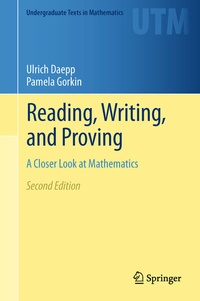
Reading, Writing, and Proving
Description

This book, which is based on Pólya's method of problem solving, aids students in their transition from calculus (or precalculus) to higher-level mathematics. The book begins by providing a great deal of guidance on how to approach definitions, examples, and theorems in mathematics and ends with suggested projects for independent study.
Students will follow Pólya's four step approach: analyzing the problem, devising a plan to solve the problem, carrying out that plan, and then determining the implication of the result. In addition to the Pólya approach to proofs, this book places special emphasis on reading proofs carefully and writing them well. The authors have included a wide variety of problems, examples, illustrations and exercises, some with hints and solutions, designed specifically to improve the student's ability to read and write proofs.
Historical connections are made throughout the text, and students are encouraged to use the rather extensivebibliography to begin making connections of their own. While standard texts in this area prepare students for future courses in algebra, this book also includes chapters on sequences, convergence, and metric spaces for those wanting to bridge the gap between the standard course in calculus and one in analysis.
Reviews / Votes
From the reviews of the second edition:"The book is written in an informal way, which could please the beginners and not offend the more experienced reader. A reader can find a lot of problems for independent study as well as a lot of illustrations encouraging him/her to draw pictures as an important part of the process of mathematical thinking."-European Mathematical Society, September 2011"Several areas like sets, functions, sequences and convergence are dealt with and several exercises and projects are provided for deepening the understanding. .It is the impression of the author of this review that the book can be particularly strongly recommended for teacher students to enable them to catch and transfer the "essence" of mathematical thinking to their pupils. But also everybody else interested in mathematics will enjoy this very well written book.-Burkhard Alpers (Aalen), zbMATH"The book is primarily concerned with an exposition of those parts of mathematics in which students need a more thorough grounding before they can work successfully in upper-division undergraduate courses. . a mathematically-conventional but pedagogically-innovative take on transition courses." -Allen Stenger, The Mathematical Association of America, September, 2011More details
Other editions
Additional editions
Previous edition
Persons
Content
-Preface. -1. The How, When, and Why of Mathematics.- 2. Logically Speaking.- 3.Introducing the Contrapositive and Converse.- 4. Set Notation and Quantifiers.- 5. Proof Techniques.- 6. Sets.- 7. Operations on Sets.- 8. More on Operations on Sets.- 9. The Power Set and the Cartesian Product.- 10. Relations.- 11. Partitions.- 12. Order in the Reals.- 13. Consequences of the Completeness of (\Bbb R).- 14. Functions, Domain, and Range.- 15. Functions, One-to-One, and Onto.- 16. Inverses.- 17. Images and Inverse Images.- 18. Mathematical Induction.- 19. Sequences.- 20. Convergence of Sequences of Real Numbers.- 21. Equivalent Sets.- 22. Finite Sets and an Infinite Set.- 23. Countable and Uncountable Sets.- 24. The Cantor-Schröder-Bernstein Theorem.- 25. Metric Spaces.- 26. Getting to Know Open and Closed Sets.- 27. Modular Arithmetic.- 28. Fermat's Little Theorem.- 29. Projects.- Appendix.- References.- Index.
