

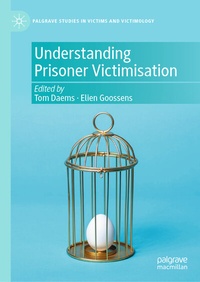
Understanding Prisoner Victimisation
Description

People in prison are usually (and often exclusively) seen and approached as persons who have committed one or more crimes and who have to pay their debt to society. However, while in prison, they often get victimised themselves. Research has demonstrated that prisons tend to be unsafe environments where various forms of victimisation take place. These forms of victimisation often go unnoticed and usually do not attract much interest from policymakers or society at large: prisoners are, indeed, far from 'ideal victims'. This book is devoted to understanding prisoner victimisation, in particular from a European perspective. Chapters in this volume focus on recent empirical work in a number of European countries (Belgium, England and Wales and the Netherlands). These chapters are complemented with a series of reflections from a conceptual, methodological and human rights perspective.
Chapter "The Victim-Offender Overlap in Prisons and Associated Challenges for Prison Managers" is available open access under a Creative Commons Attribution 4.0 International License via link.springer.com.
Reviews / Votes
" Understanding Prisoner Victimisation is a timely and carefully curated volume that brings long overduescholarly and policy attention to the experiences of prisoners as victims of crime and harm. . Understanding Prisoner Victimisation makes a landmark contribution to both victimology and prison studies. . For academics of penology, desistance, and social harm, as well as for practitioners and policymakers aiming to build more humane and rights-based penal regimes, this book is essential reading." (Simon Scott, International Review of Victimology_September, Vol. 31 (3), 2025)
More details
Other editions
Additional editions
Persons
Tom Daems is Professor of Criminology at the Leuven Institute of Criminology, KU Leuven, Belgium.
Elien Goossens is PhD Researcher at the Leuven Institute of Criminology, KU Leuven, Belgium.
Content
