

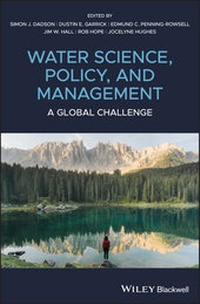
Water Science, Policy and Management
Description

Provides an in-depth look at science, policy and management in the water sector across the globe
Sustainable water management is an increasingly complex challenge and policy priority facing global society. This book examines how governments, municipalities, corporations, and individuals find sustainable water management pathways across competing priorities of water for ecosystems, food, energy, economic growth and human consumption. It looks at the current politics and economics behind the management of our freshwater ecosystems and infrastructure and offers insightful essays that help stimulate more intense and informed debate about the subject and its need for local and international cooperation.
This book celebrates the 15-year anniversary of Oxford University's MSc course in Water Science, Policy and Management. Edited and written by some of the leading minds in the field, writing alongside alumni from the course, Water Science, Policy and Management: A Global Challenge offers in-depth chapters in three parts: Science; Policy; and Management. Topics cover: hydroclimatic extremes and climate change; the past, present, and future of groundwater resources; water quality modelling, monitoring, and management; and challenges for freshwater ecosystems. The book presents critical views on the monitoring and modelling of hydrological processes; the rural water policy in Africa and Asia; the political economy of wastewater in Europe; drought policy management and water allocation. It also examines the financing of water infrastructure; the value of wastewater; water resource planning; sustainable urban water supply and the human right to water.
- Features perspectives from some of the world's leading experts on water policy and management
- Identifies and addresses current and future water sector challenges
- Charts water policy trends across a rapidly evolving set of challenges in a variety of global areas
- Covers the reallocation of water; policy process of risk management; the future of the world's water under global environmental change; and more
Water Science, Policy and Management: A Global Challenge is an essential book for policy makers and government agencies involved in water management, and for undergraduate and postgraduate students studying water science, governance, and policy.
More details
Other editions
Additional editions
Persons
SIMON J. DADSON, PHD, is Professor of Hydrology at the University of Oxford, and the Centre for Ecology and Hydrology and a Fellow of Christ Church.
DUSTIN E. GARRICK, PHD, is an Associate Professor of Environmental Management at the Smith School of Enterprise and the Environment and a Fellow of Green Templeton College.
EDMUND C. PENNING-ROWSELL, PHD, is Professor of Geography and Pro Vice-Chancellor at Middlesex University, and a Visiting Academic at the School of Geography and the Environment at the University of Oxford.
JIM W. HALL, PHD, FREng, is Professor of Climate and Environmental Risks in the School of Geography and the Environment and a Senior Research Fellow in the Department of Engineering Science at the University of Oxford, and Fellow of Linacre College.
ROB HOPE, PHD, is Professor of Water Policy at the School of Geography and the Environment, and Director of the Water Programme at the Smith School of Enterprise and the Environment.
JOCELYNE HUGHES, PHD, is Departmental Lecturer and Course Director, for MSc/MPhil in Water Science, Policy and Management at the University of Oxford.
Content
List of Contributors xvii
Foreword xxi
Acknowledgements xxiii
1 Water Science, Policy, and Management: Introduction 1
Simon J. Dadson, Edmund C. Penning-Rowsell, Dustin E. Garrick, Rob Hope, Jim W. Hall, and Jocelyne Hughes
1.1 Introduction 1
1.2 Drivers of Change: Environment, Politics, Economics 2
1.3 Responses to Change: Technology, Information, Equity 4
1.4 Science, Policy and Management 6
Part I Water Science 9
2 Hydroclimatic Extremes and Climate Change 11
Simon J. Dadson, Homero Paltan Lopez, Jian Peng, and Shuchi Vora
2.1 Introduction 11
2.2 Key Concepts in Climate Science 12
2.2.1 The Water Cycle in the Earth System 12
2.2.2 Radiative Energy Transfer in the Atmosphere 12
2.2.3 Convection and Atmospheric Stability 13
2.2.4 The General Circulation 14
2.3 Hydroclimatic Variability and Extremes 14
2.3.1 Modes of Hydroclimatic Variability 14
2.3.2 El Niño-Southern Oscillation (ENSO) 14
2.3.3 South Asian Monsoon 16
2.3.4 North Atlantic Oscillation (NAO) 16
2.3.5 Other Modes of Variability 17
2.4 Climate Change and Hydrology 18
2.4.1 Understanding the Link Between Climate Change and Hydroclimatic Extremes 18
2.4.2 Climate Models and Climate Projections 18
2.4.3 Downscaling and Uncertainty 19
2.5 Managing Hydroclimatic Extremes 20
2.5.1 Quantifying Risk and Uncertainty 20
2.5.2 Planning for Extremes in Flood Risk and Water Resources Management 22
2.5.3 Comparing Top-down with Bottom-up Approaches 22
2.6 Conclusion 25
References 25
3 Groundwater Resources: Past, Present, and Future 29
Abi Stone, Michelle Lanzoni, and Pauline Smedley
3.1 Introduction to Groundwater Science 29
3.2 Quantities of Groundwater: Storage, Recharge, and Abstraction 31
3.2.1 What Do We Know? 31
3.2.2 Future Outlook on Measuring Groundwater Quantity 34
3.2.3 Improving Scientific Knowledge of Groundwater Volumes and Fluxes 39
3.3 Groundwater Quality 39
3.3.1 The Composition of Groundwater: Natural Baselines and Pollution 39
3.3.2 Future Outlook on Groundwater Water Quality: Key Constraints and Approaches to Addressing Them 45
3.4 Groundwater and Climate Change 48
3.4.1 Long-term Climatic Influences on Groundwater 48
3.4.2 Current and Future Influences of Climate Change on Groundwater 48
3.5 Continuing Challenges for Groundwater Science 49
3.6 Concluding Points 50
References 51
4 Water Quality Modelling, Monitoring, and Management 55
Paul Whitehead, Michaela Dolk, Rebecca Peters, and Hannah Leckie
4.1 Water Quality Modelling Background 55
4.1.1 Water Quality: The Problem 55
4.1.2 Management Model Approaches and History 56
4.1.3 Generic Types of Water Quality Models 57
4.1.4 Lumped Modelling Approaches 58
4.1.5 Case Study 1: Modelling of Metals Downstream of Mines in Transylvania 59
4.2 Water Quality Modelling at the Catchment Scale 59
4.2.1 Integrated Catchment Approach - A Brief Review 59
4.2.2 The Integrated Catchments (INCA) Model System 61
4.2.3 Case Study 2: Modelling Contaminants Using INCA - Metaldehyde in the Thames 62
4.2.4 Case Study 3: Water Quality in the Turag-Balu River System, Dhaka, Bangladesh 62
4.2.5 Model Uncertainty 63
4.3 Monitoring Strategies Past and Present 65
4.3.1 Global Monitoring 66
4.3.2 National-scale Monitoring 66
4.3.3 Long-term Monitoring of Key Scientific Sites 66
4.3.4 Citizen Science Monitoring 68
4.3.5 Case Study 4: Monitoring and Modelling the Murray-Darling System in Australia 68
4.4 Conclusions 70
References 70
5 Challenges for Freshwater Ecosystems 75
Jocelyne Hughes, Heather Bond, Clarke Knight, and Kieran Stanley
5.1 How do Freshwater Ecosystems Work? 75
5.1.1 Structure and Function of Freshwater Ecosystems 75
5.1.2 Key Challenges in Freshwater Ecology 76
5.2 The Challenge of Water Quality Management: Linking Freshwater Ecosystems to Water Quality 78
5.2.1 'The Kidneys of the Landscape' 78
5.2.2 Constructed Wetlands 78
5.2.3 Managing Freshwater Ecosystems for Water Quality Enhancement 81
5.3 The Challenge of Invasive Non-native Species: Impacts on Diversity and Ecosystem Function 82
5.3.1 The Spread of Non-native Freshwater Species 82
5.3.2 Impacts of INNS 82
5.3.3 What Can be Done About the Problem? 84
5.4 The Challenge of Environmental Change : Managing Biogeochemical Cycles and Water Security in Freshwaters 85
5.4.1 Impacts of Warming and Changing Atmospheric GHGs on Freshwaters 85
5.4.2 Environmental Flows 87
5.5 Approaches to Tackling the Challenges of Freshwater Ecosystem Conservation and Management 89
5.5.1 Technical Innovations 89
5.5.1.1 Environmental DNA 89
5.5.1.2 Remote Sensing Methods and Databases 89
5.5.2 Social Science Innovations 91
References 92
6 Water and Health: A Dynamic, Enduring Challenge 97
Katrina J. Charles, Saskia Nowicki, Patrick Thomson, and David Bradley
6.1 Introduction 97
6.2 Classifying and Measuring Health Outcomes 97
6.3 Politics and Innovation in Water and Health 99
6.3.1 Measurement: Understanding the Role of Malnutrition and Infection in Diarrhoea 100
6.3.2 Treatment: Oral Rehydration Therapy (ORT) 100
6.3.3 Knowledge: Emerging Health Issues 101
6.3.4 Politics and the Pace of Disruption 101
6.4 Beyond Outbreaks: The Underreported Health Burden of Inadequate Water Supplies 102
6.5 Enteric Environmental Dysfunction 103
6.5.1 Visible Disease from Chemical Exposure 103
6.5.2 Hypertension and Cancer 105
6.5.3 Cognitive Impairment 106
6.5.4 Psychosocial Distress 107
6.5.5 Revisiting the Water-Related Burden of Disease 107
6.6 Water and Health Challenges in the SDG Period 108
6.6.1 Improving Service Levels 109
6.6.2 Improving Water Quality Testing Methods 110
6.6.3 Leaving No One Behind 111
6.7 Conclusions 112
References 113
7 Monitoring and Modelling Hydrological Processes 117
Simon J. Dadson, Feyera Hirpa, Patrick Thomson, and Megan Konar
7.1 Modelling Hydrological Systems: Current Approaches 117
7.1.1 From Local Catchment Models to Global Hydrological Studies 119
7.1.2 Validation, Verification, and Confirmation in Hydrological Modelling 121
7.1.3 Representing Human-managed Water Systems 122
7.2 Monitoring Hydrological Systems 124
7.2.1 Monitoring the Global Water Cycle Across Scales 124
7.2.2 Decline of In Situ Monitoring 125
7.2.3 The Role of EO 126
7.2.4 Land-based and Airborne Techniques 127
7.2.5 Non-traditional Hydrological Monitoring Systems 128
7.3 Future Challenges 128
7.4 Conclusion 129
References 130
Part II Policy 139
8 Reallocating Water 141
Dustin E. Garrick, Alice Chautard, and Jonathan Rawlins
8.1 Water Crises as Allocation Challenges 141
8.2 Navigating Reallocation 142
8.3 Socio-cultural Dimensions 144
8.3.1 Navigating the Changing Culture of Water in Spain 146
8.4 Natural and Technological Dimensions 147
8.5 Political Economy Dimensions 149
8.5.1 Barriers to Reallocation from Agriculture to the City of Cape Town 151
8.6 A Ladder of Interventions? 152
8.7 Frontiers of Water Allocation 153
References 154
9 Rural Water Policy in Africa and Asia 159
Rob Hope, Tim Foster, Johanna Koehler, and Patrick Thomson
9.1 Fifty Years of Rural Water Policy in Africa and Asia 159
9.2 Pillars of Rural Water Policy 160
9.3 Community Access, 1980-2000 163
9.4 Rights and Results, 2000-2020 166
9.5 Regulated Services, 2020-2030 169
9.6 Limits to Progress 173
References 174
10 The Human Right to Water 181
Rhett Larson, Kelsey Leonard, and Richard Rushforth
10.1 The Legal and Historical Background of the Human Right to Water 181
10.2 Defining the Human Right to Water 185
10.2.1 Difference Between Human Right to Water and Water Rights 187
10.3 Implementing the Human Right to Water 188
10.4 Gap Between Policy Articulation and Implementation of the Human Right to Water 190
10.5 Key Policy Challenges Facing the Human Right to Water 192
10.6 Conclusion 193
References 193
11 Policy Processes in Flood Risk Management 197
Edmund C. Penning-Rowsell, Joanna Pardoe, Jim W. Hall, and Julie Self
11.1 Introduction 197
11.2 Flood Risk: Global and Local Scales 198
11.3 Three Theories of the Policy Process 199
11.3.1 Punctuated Equilibrium 199
11.3.2 Multiple Streams 200
11.3.3 Advocacy Coalitions 201
11.4 Four Contrasting Case Studies of the Policy Process 201
11.4.1 South Africa: 1994-2002 and Beyond 201
11.4.2 Advocacy Coalitions in Bangladesh and the Role of Donor Agencies 204
11.4.3 Flood Risk Management in Tanzania: The President as Policy Entrepreneur 205
11.4.4 Flood Insurance in the UK: Six Decades of Relative Policy Stability 207
11.5 Conclusions 210
References 211
12 The Political Economy of Wastewater in Europe 215
Heather M. Smith and Gareth Walker
12.1 Introduction 215
12.2 Models of Service Delivery 216
12.3 Wastewater as a Driver of Investment and Cost Recovery 219
12.4 Case Studies - Paris and Ireland 221
12.4.1 Paris 221
12.4.2 Ireland 224
12.5 Discussion and Conclusion 226
12.5.1 The Hidden Role of Wastewater 226
12.5.2 Emerging Needs and Opportunities in Wastewater 227
References 229
13 Drought Policy and Management 233
Rachael McDonnell, Stephen Fragaszy, Troy Sternberg, and Swathi Veeravalli
13.1 Introduction 233
13.2 Drought, Aridity, Water Scarcity, and Desertification 234
13.3 Climate Change and Drought 237
13.4 Drought Policy and Management Development 238
13.4.1 Drought Legislation 238
13.4.2 Drought Policies 239
13.4.3 Drought Governance 240
13.5 The 'Three Pillars' of Drought Management 240
13.5.1 Pillar 1: Drought Monitoring and Early Warning Systems 241
13.5.2 Pillar 2: Drought Impact and Vulnerability Assessments 241
13.5.3 Pillar 3: Drought Preparedness Planning 242
13.5.4 A Range of Policy Instruments Including Insurance and Water Allocation Regimes 243
13.6 Drought in Mongolia 243
13.6.1 Pillars 1 and 2: Drought Monitoring, Impacts, and Vulnerability 244
13.6.2 Pillar 3: Drought Preparedness, Mitigation, and Response Strategies 245
13.7 The Example of the Middle East and North Africa Region 245
13.7.1 Pillar 1: Technical and Institutional Drought Monitoring Challenges 246
13.7.2 Pillars 2 and 3: Drought Management Institutional Coordination Challenges 247
13.7.3 Building Resilience - The Moroccan Drought Insurance Example 248
13.8 Discussion 248
13.8.1 Case Studies Synthesis 248
13.8.2 Future Directions for Research 249
13.9 Conclusions 249
References 250
Part III Water Management 255
14 Water Resource System Modelling and Decision Analysis 257
Jim W. Hall, Edoardo Borgomeo, Mohammad Mortazavi-Naeini, and Kevin Wheeler
14.1 The Challenge of Sustainable Water Supply 257
14.2 The Water Resource System Problem 259
14.3 Dealing with Multiple Objectives 261
14.4 Variability and Risk 263
14.5 Uncertainty and Decisions 264
14.6 Embedding Simulation Modelling in Practical Decision-making 266
14.7 The Expanding Boundaries of Water Resource Systems 268
14.7.1 New Data Sources 268
14.7.2 Economics 268
14.7.3 Finance 269
14.7.4 Society 269
14.7.5 The Environment 269
14.8 Conclusions 270
References 271
15 Financing Water Infrastructure 275
Alex Money
15.1 Introduction 275
15.2 The Infrastructure Financing Challenge 276
15.3 Bridging the Gap 278
15.4 Stakeholder Collaboration and the Constructive Corporation 279
15.5 Hybridity and Blended Finance 280
15.6 Blended Returns on Investments in Infrastructure 282
15.7 Water Infrastructure Portfolio Management 283
15.8 Hybrid Income 284
15.9 Synthesis 285
15.10 Scaling the Model 286
15.11 Conclusion 286
References 287
16 Wastewater: From a Toxin to a Valuable Resource 291
David W.M. Johnstone, Saskia Nowicki, Abishek S. Narayan, and Ranu Sinha
16.1 Introduction 291
16.2 The Early Formative Years 291
16.3 Early Full-Scale Application and Process Development 294
16.4 The Age of Understanding 294
16.5 Some Important Legislative and Institutional Changes 295
16.6 More Understanding and a Plethora of Processes 296
16.7 The Question of Sludge 298
16.7.1 Heavy Metals 298
16.7.2 Toxic Organic Chemicals 299
16.7.3 Pathogens 299
16.8 A New Philosophy; A New Paradigm? 299
16.8.1 Water 300
16.8.2 Energy 300
16.8.3 Fertilisers 301
16.8.4 Phosphate 301
16.8.5 Other Recoverable Materials 301
16.9 The Uncollected and Untreated 301
16.9.1 Sewers 303
16.9.2 Innovative Institutional Arrangements 303
16.10 Concluding
Remarks 303
References 305
17 A Road Map to Sustainable Urban Water Supply 309
Michael Rouse and Nassim El Achi
17.1 Introduction 309
17.2 International Stimuli - What Has Been Achieved? 309
17.2.1 A Brief History Before the Water Decade of 1981-1990 309
17.2.2 The Water Decade 1981-1990 310
17.2.3 Millennium Development Goals (MDGs) 312
17.3 Sustainable Development Goals (SDGs) 312
17.3.1 Formation and Definitions 312
17.3.2 Water and Sanitation as a Human Right 313
17.4 Challenges to be Faced 314
17.4.1 Sustained Political Commitment to Goal 314
17.4.2 Reliable Data 315
17.4.3 Effective Planning 315
17.4.4 Water Resources 317
17.4.5 Water Distribution 318
17.4.6 City Planning 320
17.4.7 Finance 321
17.5 Reform Requirements 321
17.5.1 Phnom Penh 321
17.5.2 National Water and Sewerage Corporation (NWSC), Uganda 322
17.5.3 Chile 323
17.5.4 Singapore 324
17.5.5 Conclusions 324
17.6 Achieving Awareness of What Needs to Be Done 325
17.7 An Outline Road Map to the Sustainable Development Goal (SDG) on Water 325
References 326
18 Equity and Urban Water Security 329
Katrina J. Charles, Thanti Octavianti, Erin Hylton, and Grace Remmington
18.1 Introduction 329
18.2 Urban Water Security: Framing the Global Challenge 330
18.2.1 Urban Water Security 330
18.2.2 The Importance of the Urban Space 331
18.2.3 The Challenge of Water Security for Urban Spaces 332
18.3 Trade-offs in Urban Water Security 334
18.3.1 The Water Security Challenge 335
18.3.2 One Solution for a Complex Issue 335
18.3.3 Universal and Equitable Development 337
18.4 Inclusive Water Security: A Case Study of São Paulo's Water 339
18.5 Conclusions 340
References 341
19 Reflections on Water Security and Humanity 345
David Grey
19.1 Introduction 345
19.2 Human Origins and Water: Then and Now 346
19.2.1 African Beginnings 346
19.2.2 The Nile 346
19.2.3 The Tigris and Euphrates 347
19.2.4 The Indus 347
19.2.5 What Might We Learn from These Reflections? 348
19.3 Water Security and Risk 349
19.4 Eight Major Global Water Security Challenges 351
19.4.1 The Dynamic Challenge of Water Security Risks in Changing Climates 351
19.4.2 The Challenge of Water Supply and Sanitation 352
19.4.3 The Challenge of Hunger 352
19.4.4 The Challenge of Floods 353
19.4.5 The Challenge of Drought 353
19.4.6 The Challenge of International and Transboundary Waters 354
19.4.7 The Challenge of 'Spillovers': From Local to Global 355
19.4.8 The Challenge for the World's 'Low Latitude' Regions 355
19.5 Conclusions: Priorities and Pathways for Policy-makers 356
19.5.1 Three Priorities for Investment 356
19.5.2 Pathways to Water Security 357
References 358
20 Charting the World's Water Future? 363
Simon J. Dadson, Edmund C. Penning-Rowsell, Dustin E. Garrick, Rob Hope, Jim W. Hall , and Jocelyne Hughes
20.1 Linking Water Science, Policy, and Management 363
20.2 Charting the World's Water Future: Five Key Challenges 363
20.3 A Vision for Interdisciplinary Water Education 365
Index 367
1
Water Science, Policy, and Management: Introduction
Simon J. Dadson1, Edmund C. Penning-Rowsell1,2, Dustin E. Garrick3, Rob Hope1,3, Jim W. Hall4, and Jocelyne Hughes1
1 School of Geography and the Environment, University of Oxford, UK
2 Flood Hazard Research Centre, Middlesex University, London, UK
3 Smith School of Enterprise and the Environment, University of Oxford, UK
4 Environmental Change Institute, University of Oxford, UK
1.1 Introduction
Understanding the risks and opportunities presented by the changing water cycle, and the intensifying demands and competition for freshwater, is one of the most pressing challenges facing scientists, water managers and policy-makers. In the context of rapid climate, land cover and other environmental changes, the requirement to protect communities against water-related natural hazards, the stewardship of water resources to provide reliable water quantity and quality, and the provision of clean, safely-managed drinking water and improved sanitation to a population predicted to exceed 9 billion, constitute a defining challenge for the twenty-first century. This challenge has inspired the University of Oxford to offer a graduate programme in Water Science Policy and Management since 2004, which to date has seen over 350 students from 57 countries graduate, of which more than half are women. This book is formed from contributions by more than a dozen academics and practitioners who have taught the course, in each case writing in co-authorship with more than two dozen alumni.
This introductory chapter outlines key drivers of change in the water environment and explains how these drivers may evolve into the future, creating new issues and risks requiring interventions. We then outline what we consider to be key challenges facing those responsible for water and its governance and management, globally, in the context of scientific understandings, policy priorities, and management opportunities. We make reference here to the chapters that follow on particular aspects of water science, policy and management, thereby contextualizing those chapters and enabling the reader to see them in a broader context. The final chapter of this book (Chapter 20) gives our vision for the future role of interdisciplinary water education and research in creating greater understanding of the complexities involved and the opportunities for progress.
1.2 Drivers of Change: Environment, Politics, Economics
The water sector is strongly impacted by the recent, rapid, and widespread effect of economic growth, often exacerbated by weak governance and inequality. Alongside these human drivers, environmental change, including climate change and variability and changes in land cover and land management, exerts impacts which are often felt most acutely in societies least able to adapt. The opportunities and challenges presented by growing and moving populations, in the context of changing water availability, threaten the sustainable, equitable and efficient use of water resources for economic development.
As demonstrated in Chapter 2, the evidence is overwhelmingly in support of anthropogenic global warming, and it is notable that climate science has unequivocally demonstrated that observed historical climate change is due to anthropogenic emission of fossil carbon (Box 1.1). In the presence of overwhelming evidence, the debate has now shifted towards understanding the regional and local consequences of warming, and their impacts on hydroclimatic variability and extremes. Revealing the regional picture adds additional uncertainty and raises the crucial question of how much additional evidence must we wait for before we act, either in mitigation of future change, or in order to adapt to what may constitute a 'new normal' range of climatic variability? There are many tools at our disposal to answer such questions. Indeed, the challenge to policy-makers and their advisors, and to practitioners in the field of water management, is to extract the salient information on which to base decisions from the plethora of data currently available on the subject (see Chapters 2 and 14).
Box 1.1 The Paris Agreement
The Accord de Paris is an agreement within the United Nations Framework Convention on Climate Change (UNFCCC 2015), dealing with greenhouse-gas emissions mitigation, adaptation, and finance, starting in the year 2020. The agreement was negotiated by representatives of 196 countries at the 21st Conference of the Parties of the UNFCCC in Le Bourget, France, and adopted by consensus on 12 December 2015. The Agreement's long-term goal is to keep the increase in global average temperature to well below 2°C above pre-industrial levels, and to limit the increase to 1.5°C, to substantially reduce the risks and effects of climate change. Under the Agreement, each country must determine, plan, and regularly report on the contribution that it undertakes to mitigate global warming. No mechanism forces a country to set a specific target by a specific date, but each target should go beyond previously set targets. In addition to reporting information on mitigation, adaptation and support, the Agreement requires that the information submitted by each country undergoes international technical expert review.
The consequences of failing to meet the Paris commitments for flooding and water resources are potentially serious, although there is considerable uncertainty in current projections (see Chapter 2). Even with 1.5°C warming, significant increases in rainfall and therefore flood risk are likely, particularly in flood-prone south-east Asia. The outlook for water resources is also strongly dependent on the Paris Accord, with projections of exacerbated water scarcity in already drought-prone areas, should the 1.5°C commitment not be met. Nonetheless, much uncertainty remains, not least because the pathways to 1.5°C involve changes not only to greenhouse gas concentrations but also to atmospheric aerosols and land use.
UNFCCC. (2015). Paris Agreement . Available at: https://unfccc.int/files/meetings/paris_nov_2015/application/pdf/paris_agreement_english_.pdf.
Whilst global attention has quite properly focused on climate change, widespread policy-driven changes in land cover and management also rank amongst the most striking perturbations to the natural environment that impinge on the water sector. Land cover changes may occur by direct policy intervention; they may also occur as land managers respond individually to market forces and the regulatory environment. Together these changes can also impact land use (tree planting, agricultural practices) by affecting what it is economic to do in the rural environment. The impact, for example, of nitrate on long-lived groundwater quality is of particular note (Chapters 3 and 4), as is the impact of regulatory practices on water quality as evidenced by the EU Water Framework Directive, which is credited with driving a significant, but small, improvement in aquatic biodiversity (Chapter 5). Policies and economic incentives exert a powerful control over land management and agriculture, with impacts that are often felt more immediately and with greater certainty than climatic variability or change but which also act as threat multipliers or stressors of freshwater ecosystems when combined with climate change (e.g. algal blooms, Chapter 4; invasive species proliferation, Chapter 5).
Demographic drivers of change include the growth of global population centres in Asia and Africa, including 'mega-cities' with populations greater than 10 million. Nonetheless, the reality of population growth, urbanization, and the growth of agriculture to support a growing affluent population in the developing world will have profound consequences for water consumption (Chapter 8) and for water quality. As such it is vital to consider not only the physical and natural consequences but also the potential political responses in the light of projected growth of urban populations (Chapters 12 and 18).
Water plays a crucial role in many sectors of the economy and is frequently analysed as a factor of production or as a public economic good. Connections with the energy and agricultural sectors are often highlighted, not least because agriculture consumes by far the most water of any economic sector, and reliable water supplies are needed for energy production. These linkages serve both to amplify the sensitivities of the water sector to global change, and to mandate broad consideration of water-related impacts on other economic sectors in policy development and the consequent enactment of management decisions, particularly in relation to water allocation and reallocation in a rapidly changing world (Chapter 8).
The global importance of water in industrialized and developing economies is also recognized via the Sustainable Development Goals (SDGs), which explicitly mandate universal and equitable drinking water supplies and improved sanitation services, sustainable water withdrawals and protection of ecosystems (Box 1.2). Compared with the earlier Millennium Development Goals, the SDGs bring a stronger and broader framing of sustainable management of water resources to meet human and environmental needs. The role of water for development is partly to...
