

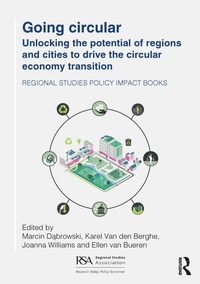
Going Circular
Unlocking the potential of regions and cities to drive the circular economy transition
Published on 12. May 2025
112 pages
978-1-040-40034-0 (ISBN)
Description

Going Circular explores the concept of a circular economy (CE) and its transformative potential for cities and regions. It emphasises the importance of spatial planning and the role of urban and regional authorities in driving the transition to a more sustainable, resilient and inclusive economic and societal model. The authors offer a critical perspective, arguing that there is no onesize-fits-all approach to regional and urban CE policies. Instead, they advocate for a context-specific understanding of CE, emphasising the importance of: local and regional conditions for circular activities; the spatial patterns in resource stocks and flows within territories, and the need to engage a range of stakeholders and communities in decision-making processes.
Going Circular tackles the pivotal policy issues and challenges related to CE transitions in cities and regions. It will inform and equip public and private policymakers, urban planners and regional authorities with the knowledge and tools needed to foster a CE and nudge cities and regions towards sustainable futures.
Despite extensive data and knowledge available on cities and regions, terms such as 'circularity', 'economy' and 'space' often remain disjointed for researchers, policymakers and practitioners alike. This book presents a frank and insightful exploration of the spatial dimension of the circular economy, challenging assumptions and idealisms. It provides practical opportunities for action by underscoring the importance of geopolitics, empathy and justice, ecosystems restoration, and assessment of progress on the transition pathways towards a circular economy. The book equips readers with language and visual concepts needed to engage with and communicate this topic confidently. I highly recommend it as both an introduction and a refresher on the topic of circular regions and cities.
Adrian Vickery Hill, Strategist and designer - director, Osmos Network
This book outlines a path to trigger circular economy processes that can transform cities and regions, guiding them towards a more resilient and sustainable future, while producing context-appropriate solutions. Circular economy is a context-specific, place-based process that requires a holistic and systemic perspective, in which space plays a crucial role. In six thematic chapters, the book proposes a pathway analysing several key issues: the spatial dimension of circular economy; the opportunities for more ecologically healthy, resource-sufficient metropolitan regions; the integration of social justice and the concept of "care-full" circular economy; the ecological implications of the transition in line with the urban circular bioeconomy; the multidimensional assessment of the transition progress and cross-level interdependencies; as well as policy recommendations for multi-level governance at various scales. This book provides an inspiring perspective on circular economy, not only as a technical and economic challenge, but also as a social and political opportunity. It is highly recommended for anyone interested in fostering a more sustainable and circular future for our cities.
Prof. Maria Cerreta, University of Naples "Federico II"
Going Circular tackles the pivotal policy issues and challenges related to CE transitions in cities and regions. It will inform and equip public and private policymakers, urban planners and regional authorities with the knowledge and tools needed to foster a CE and nudge cities and regions towards sustainable futures.
Despite extensive data and knowledge available on cities and regions, terms such as 'circularity', 'economy' and 'space' often remain disjointed for researchers, policymakers and practitioners alike. This book presents a frank and insightful exploration of the spatial dimension of the circular economy, challenging assumptions and idealisms. It provides practical opportunities for action by underscoring the importance of geopolitics, empathy and justice, ecosystems restoration, and assessment of progress on the transition pathways towards a circular economy. The book equips readers with language and visual concepts needed to engage with and communicate this topic confidently. I highly recommend it as both an introduction and a refresher on the topic of circular regions and cities.
Adrian Vickery Hill, Strategist and designer - director, Osmos Network
This book outlines a path to trigger circular economy processes that can transform cities and regions, guiding them towards a more resilient and sustainable future, while producing context-appropriate solutions. Circular economy is a context-specific, place-based process that requires a holistic and systemic perspective, in which space plays a crucial role. In six thematic chapters, the book proposes a pathway analysing several key issues: the spatial dimension of circular economy; the opportunities for more ecologically healthy, resource-sufficient metropolitan regions; the integration of social justice and the concept of "care-full" circular economy; the ecological implications of the transition in line with the urban circular bioeconomy; the multidimensional assessment of the transition progress and cross-level interdependencies; as well as policy recommendations for multi-level governance at various scales. This book provides an inspiring perspective on circular economy, not only as a technical and economic challenge, but also as a social and political opportunity. It is highly recommended for anyone interested in fostering a more sustainable and circular future for our cities.
Prof. Maria Cerreta, University of Naples "Federico II"
More details
Series
Language
English
Place of publication
London
United Kingdom
Publishing group
Taylor & Francis Ltd
Target group
College/higher education
Illustrations
3 Tables, color; 2 Line drawings, color; 5 Halftones, color; 7 Illustrations, color
File size
14,23 MB
ISBN-13
978-1-040-40034-0 (9781040400340)
Copyright in bibliographic data and cover images is held by Nielsen Book Services Limited or by the publishers or by their respective licensors: all rights reserved.
Schweitzer Classification
Other editions
Additional editions
Marcin Dabrowski | Karel Van den Berghe | Joanna Williams
Going Circular
Unlocking the potential of regions and cities to drive the circular economy transition
Book
05/2025
1st Edition
Routledge
€45.00
Shipment within 15-20 days
Persons
Marcin Dabrowski teaches and researches spatial planning and (multi-level) governance issues related to sustainable urban and regional futures, at the Department of Urbanism, Delft University of Technology, The Netherlands.
Karel Van den Berghe is Assistant Professor in Spatial Planning and Urban Development Management at the Department of Management in the Built Environment, Delft University of Technology, The Netherlands.
Jo Williams is the Director of the Circular Cities Hub and Professor in Sustainable Development at the Bartlett School of Planning, UCL, London, UK.
Ellen van Bueren is Professor of Urban Development Management and Head of the Department of Management in the Built Environment, Delft University of Technology, The Netherlands.
Federica Bono is an Assistant Professor of Human Geography at Christopher Newport University (CNU), Virginia, USA.
Alexander Wandl is an associate professor and head of the Section of Environmental Technology and Design of the Department of Urbanism at the Faculty of Architecture and the Built Environment at Delft University of Technology, The Netherlands.
Elmar Willems is Program Lead Circular Local Governance at Circular Flanders, the hub for the circular economy transition in Flanders, Belgium.
Wendy Wuyts, with a PhD from Nagoya University, Japan, has contributed to the discourse on the social circular economy approach to the built environment.
Karel Van den Berghe is Assistant Professor in Spatial Planning and Urban Development Management at the Department of Management in the Built Environment, Delft University of Technology, The Netherlands.
Jo Williams is the Director of the Circular Cities Hub and Professor in Sustainable Development at the Bartlett School of Planning, UCL, London, UK.
Ellen van Bueren is Professor of Urban Development Management and Head of the Department of Management in the Built Environment, Delft University of Technology, The Netherlands.
Federica Bono is an Assistant Professor of Human Geography at Christopher Newport University (CNU), Virginia, USA.
Alexander Wandl is an associate professor and head of the Section of Environmental Technology and Design of the Department of Urbanism at the Faculty of Architecture and the Built Environment at Delft University of Technology, The Netherlands.
Elmar Willems is Program Lead Circular Local Governance at Circular Flanders, the hub for the circular economy transition in Flanders, Belgium.
Wendy Wuyts, with a PhD from Nagoya University, Japan, has contributed to the discourse on the social circular economy approach to the built environment.
Content
1. Circular regions and cities: towards a spatial perspective on circular economy 2. The window of opportunity for circular economy in Europe in the wake of the geopolitical turmoil: connecting scales and principles 3. Towards a care-full circular economy 4. Implementing the circular bioeconomy in metropolitan regions 5. Assessing circular economy transitions 6. Policy recommendations for facilitating an urban and regional circular economy
