

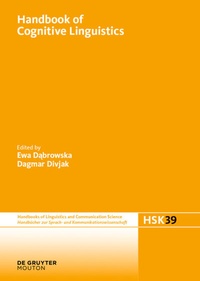
Handbook of Cognitive Linguistics
Description

Cognitive Linguistics is an approach to language study based on the assumptions that our linguistic abilities are firmly rooted in our cognitive abilities, that meaning is essentially conceptualization, and that grammar is shaped by usage. The Handbook of Cognitive Linguistics provides state-of-the-art overviews of the numerous subfields of cognitive linguistics written by leading international experts which will be useful for established researchers and novices alike. It is an interdisciplinary project with contributions from linguists, psycholinguists, psychologists, and computer scientists which will emphasise the most recent developments in the field, in particular, the shift towards more empirically-based research. In this way, it will, we hope, help to shape the field, encouraging methodologically more rigorous research which incorporates insights from all the cognitive sciences.
Editor Ewa Dabrowska was awarded the Alexander von Humboldt Professorship 2018.
Reviews / Votes
"The handbook by Dabrowska and Divjak is an important publication."Frank Polzenhagen in: Anglistik: International Journal of English Studies 28.1 (March 2017), pp. 156-160
More details
Other editions
Additional editions
Persons
Ewa Dabrowska , Northumbria University, Newcastle Upon Tyne, UK; Dagmar Divjak , University of Sheffield, UK.
Content
- Intro
- Contents
- Introduction
- I. The cognitive foundations of language
- 1. Embodiment
- 2. Attention and salience
- 3. Frequency and entrenchment
- 4. Categorization (without categories)
- 5. Abstraction, storage and naive discriminative learning
- 6. Construal
- 7. Metonymy
- 8. Metaphor
- 9. Representing Meaning
- 10. Blending in language and communication
- 11. Grammar and cooperative communication
- II. Overviews
- 12. Phonology
- 13. Lexical semantics
- 14. Usage-based construction grammar
- 15. Discourse
- 16. Historical linguistics
- 17. Variationist linguistics
- 18. First language acquisition
- 19. Second language acquisition
- 20. Poetics
- III. Central topics
- 21. Semantic typology
- 22. Polysemy
- 23. Space
- 24. Time
- 25. Motion
- 26. Fictive motion
- 27. Prototype effects in grammar
- 28. Argument structure constructions
- 29. Default nonliteral interpretations The case of negation as a low-salience marker
- 30. Tense, aspect and mood
- 31. Grammaticalization
- 32. Individual differences in grammatical knowledge
- 33. Signed languages
- 34. Emergentism
- Indexes
- Authors index
- Subject index
