

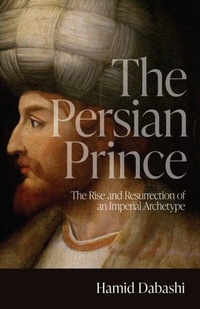
The Persian Prince
The Rise and Resurrection of an Imperial Archetype
Published on 6. June 2023
352 pages
978-1-5036-3575-3 (ISBN)
Available for download
Description

With its title borrowed from Machiavelli, The Persian Prince goes far beyond Machiavelli's wildest imagination as to how to rule the world. Hamid Dabashi articulates a bold new idea of the Persian Prince-a metaphor of political authority, a figurative ideal deeply rooted in the collective memories of multiple nations, and a literary construct that connected Muslim empires across time and space and continues to inform political debate today.
Drawing on works from Classical Antiquity and the vast Persianate worlds from India to the Mediterranean, as well as the Hebrew Bible and European medieval mirrors for princes, Dabashi engages a diverse body of political thought to reveal the construction of the Persian Prince as a potent archetype. He traces this archetype through its varied historic gestations and finds it resurfacing in postcolonial political thought as a rebel, a prophet, a poet, and a nomad. Bringing poetics and politics together, Dabashi shows how this archetypal figure has long defined political authority throughout the wider Iranian and Islamic worlds.
With meticulous attention to literary and poetic texts, moral and philosophical treatises, allegorical and anecdotal stories, sacred and secular evidence, visual and performing arts, histories of global empires and colonial conquests, this sweeping work offers a deeply learned, richly erudite, and transformative piece of critical thinking. As Dabashi shows, the Persian Prince remains the stuff of current debate across the Muslim and Persianate worlds, in contestations over the public domain and the collective will to power, and above all in the prospects of democratic institutions.
Drawing on works from Classical Antiquity and the vast Persianate worlds from India to the Mediterranean, as well as the Hebrew Bible and European medieval mirrors for princes, Dabashi engages a diverse body of political thought to reveal the construction of the Persian Prince as a potent archetype. He traces this archetype through its varied historic gestations and finds it resurfacing in postcolonial political thought as a rebel, a prophet, a poet, and a nomad. Bringing poetics and politics together, Dabashi shows how this archetypal figure has long defined political authority throughout the wider Iranian and Islamic worlds.
With meticulous attention to literary and poetic texts, moral and philosophical treatises, allegorical and anecdotal stories, sacred and secular evidence, visual and performing arts, histories of global empires and colonial conquests, this sweeping work offers a deeply learned, richly erudite, and transformative piece of critical thinking. As Dabashi shows, the Persian Prince remains the stuff of current debate across the Muslim and Persianate worlds, in contestations over the public domain and the collective will to power, and above all in the prospects of democratic institutions.
Reviews / Votes
"Hamid Dabashi's book takes the reader on a journey across time and place. 'More a persona than a person,' the Persian Prince reunites in one archetype such different images as the rebellious poet, the just monarch, and the charismatic prophet. Both a historical investigation and a philosophical-political proposal, the book will reward readers with many unusual intellectual encounters."-Giovanni Giorgini, University of Bologna and Columbia University "Disarmingly accessible, laden with millennia of Persian cultural riches, The Persian Prince deftly and decisively shifts the axis of history and of the conception of subjectivity itself. Colonizers and ayatollahs are mere blips in the long temporality of the Persian Prince, a figure of transformation that ultimately resides in the collective heart of rebellion."-Laura U. Marks, Simon Fraser University, author of Enfoldment and Infinity "In this gorgeously written tour de force, Hamid Dabashi spins the contrapuntal narrative of an archaic Iranian archetype as it weaves its way through political-poetical history. Building on his impressive body of work, The Persian Prince is a unique and formidable text that encapsulates the brilliance, vivacity, and political ferocity of Dabashi's mind."-Jeanne Morefield, University of Oxford, author of Unsettling the World "Hamid Dabashi's illuminating study, while both provincializing and enriching the classic frameworks of Machiavelli and Gramsci, provides a provocative and compelling archetype for understanding political power and organization."-Michael Hardt, Duke University, author of The Subversive Seventies "Rejecting an ideologically and politically manufactured binary between 'Islam and the West' and arguing for an 'irretrievably pluralistic' view of cultures and history, Dabashi illuminates the model of the Persian Prince as the archetype of 'a human being best fitted to face and embrace the world.' He eschews an overemphasis on 'political ideals' over 'literary aspects' in defining the nature of sovereignty and relations between rulers and the ruled, and he advocates a rediscovery of democratic institutions in the Muslim and Persianate worlds, and far beyond. Recommended."-B. Tavakolian, CHOICEMore details
Edition
New edition
Language
English
Place of publication
Palo Alto
United States
Target group
Professional and scholarly
Edition type
New edition
Illustrations
11 halftones
ISBN-13
978-1-5036-3575-3 (9781503635753)
Copyright in bibliographic data and cover images is held by Nielsen Book Services Limited or by the publishers or by their respective licensors: all rights reserved.
Schweitzer Classification
Other editions
Additional editions
Book
06/2023
Stanford University Press
€91.50
Shipment within 15-20 days
Book
06/2023
Stanford University Press
€28.50
Shipment within 15-20 days
Person
Hamid Dabashi is the Hagop Kevorkian Professor of Iranian Studies and Comparative Literature at Columbia University. He is the author of more than two dozen books, including The End of Two Illusions: Islam after the West (2022) and Iran: A People Interrupted (2007).
Content
Prelude: Who Is the Persian Prince-What Is the Persian Prince?
Chapter One: The Idea and the Dominion of the Persian Prince
Chapter Two: The Persian Prince Comes of Age
Chapter Three: On the Histories, Geographies, and Iconographies of Muslim Empires
Chapter Four: The Persian Literary Provenance of Muslim Empires
Five: In the Light and Shadows of the Persian Prince
Six: The Resurrection of the Persian Prince Under Colonial Duress
Seven: Colonial Modernity and the Metamorphosis of the Persian Prince
Eight: The Nomadic Fate of the Persian Prince
Conclusion: The Sublimation of an Imperial Archetype
Chapter One: The Idea and the Dominion of the Persian Prince
Chapter Two: The Persian Prince Comes of Age
Chapter Three: On the Histories, Geographies, and Iconographies of Muslim Empires
Chapter Four: The Persian Literary Provenance of Muslim Empires
Five: In the Light and Shadows of the Persian Prince
Six: The Resurrection of the Persian Prince Under Colonial Duress
Seven: Colonial Modernity and the Metamorphosis of the Persian Prince
Eight: The Nomadic Fate of the Persian Prince
Conclusion: The Sublimation of an Imperial Archetype

