

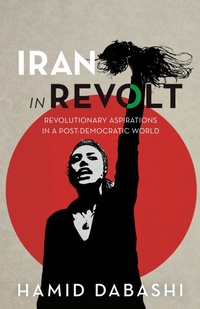
Iran in Revolt
Description

In his retelling of the boldness and tragedy of the Zhina uprising in Iran, Hamid Dabashi asks: What constitutes the success of revolutions and how do we measure their failures?
In September 2022, a young Kurdish woman, Zhina Mahsa Amini, was killed in police custody for failing to observe the strict dress code imposed on Iranian women. Her death sparked a massive social uprising within and outside of Iran. The slogan, "Woman, Life, Freedom," spread like wildfire from Amini's hometown to solidarity protests held in London, New York, Melbourne, Paris, Seoul and beyond. The pain felt by millions of Iranians, caused by the Islamic Republic, was on the global stage again.
Yet, misreadings of the Zhina uprising-both accidental and insidious-began to proliferate, with different parties vying for power. Iran in Revolt by author and scholar Hamid Dabashi cuts through the white noise of imperialist war mongers and social media bots to provide a careful and principled account of the revolution, and how it has forever altered the nature of politics in Iran and the wider region.
Iran in Revolt argues that "democracy" and the "nation-state" are tired concepts, exploring what it means to fight for a just society instead. Through detailed political, philosophical, and historical analysis, Dabashi shows that the vulnerable lives and fragile liberties of nations have never been so intimately connected, just as the pernicious cruelties of ruling regimes have never been so identical as they are today.
More details
Other editions
Additional editions
Person
Hamid Dabashi is the Hagop Kevorkian Professor of Iranian Studies and Comparative Literature at Columbia University. He received a dual Ph.D. in Sociology of Culture and Islamic Studies from the University of Pennsylvania in 1984, followed by a postdoctoral fellowship at Harvard University. Dabashi has written more than two dozen books, edited four, and contributed chapters to many more. Among his most recent books are The Shahnameh: The Persian Epic as World Literature (Columbia, 2019); On Edward Said: Remembrance of Things Past (Haymarket, 2020); and The Future of Two Illusions: Islam after the West (University of California Press, 2022). He is the author of over one hundred essays, articles, and book reviews on subjects ranging from Iranian and Islamic Studies, comparative literature, world cinema, and the philosophy of art. His books and articles have been translated into numerous languages, including Japanese, German, French, Spanish, Russian, Hebrew, Arabic, and Persian.
Content
Introduction: What if "Democracy" was in Bad Faith? 1. Revolutionary Aspirations in a Post-Democratic World 2. The Next Iranian Revolution will not be Theorized 3. The Real Perils and the False Promises of Ethnic Nationalism 4. Khizesh as Intifada at Large 5. Do Iranian Women Need Saving? 6. "Crowd is Untruth" 7. Return of the Pahlavis with a Vengeance 8. Towards a Post-Islamist Liberation Theology Conclusion: Can the Subaltern Speak Persian?
