


Can Non-Europeans Think?
1st Edition
Published on 30. April 2015
346 pages
978-1-78360-421-0 (ISBN)
Description

'In Can Non-Europeans Think? Dabashi takes his subtle but vigorous polemic to another level.'
Pankaj Mishra
What happens to thinkers who operate outside the European philosophical pedigree? In this powerfully honed polemic, Hamid Dabashi argues that they are invariably marginalised, patronised and misrepresented.
Challenging, pugnacious and stylish, Can Non-Europeans Think? forges a new perspective in postcolonial theory by examining how intellectual debate continues to reinforce a colonial regime of knowledge, albeit in a new guise.
Based on years of scholarship and activism, this insightful collection of philosophical explorations is certain to unsettle and delight in equal measure.
Pankaj Mishra
What happens to thinkers who operate outside the European philosophical pedigree? In this powerfully honed polemic, Hamid Dabashi argues that they are invariably marginalised, patronised and misrepresented.
Challenging, pugnacious and stylish, Can Non-Europeans Think? forges a new perspective in postcolonial theory by examining how intellectual debate continues to reinforce a colonial regime of knowledge, albeit in a new guise.
Based on years of scholarship and activism, this insightful collection of philosophical explorations is certain to unsettle and delight in equal measure.
Reviews / Votes
A much needed corrective to the complacent view that multicultural diversity reigns in US and European Universities. Hamid Dabashi's new work is a tour de force. * Drucilla Cornell, author of Law and Revolution in South Africa * Dabashi eloquently articulates the intellectual journey of a whole generation of postcolonial thinkers: its findings must be heard. * Elizabeth Suzanne Kassab, author of Contemporary Arab Thought * Drawing from his unrivalled inside knowledge of various intellectual traditions, Dabashi has written, with acuity, passion and humour, a critical synthesis of Western thought from the vantage point of the "dark races". * Mamadou Diouf, director of the Institute for African Studies, Columbia University * For decades, Hamid Dabashi has drawn from the histories of the non-West to argue for ways of thinking deemed illegitimate by the parochial but powerful guardians of intellectual life in the West. In Can Non-Europeans Think? he takes his subtle but vigorous polemic to another level. * Pankaj Mishra * With elegant irony, Can Non-Europeans Think? reorients our reading of the world. It is a passionate rejoinder to those who are unable to see beyond European framings and rootings. * S. Sayyid, author of Recalling the Caliphate * These essays are trenchant, witty, provocative, mischievous, and on target. * Souleymane Bachir Diagne, author of Comment philosopher en Islam * Hamid Dabashi's Can Non-Europeans Think? collects his important provocations on issues ranging from post-colonialism to democracy. These are pieces to wrestle with, to think about, to discuss and debate. Reading Dabashi is like going for an extended coffee with a very smart friend. * Vijay Prashad, author of The Poorer Nations: A Possible History of the Global South * Dabashi's book is both a panoramic critique of, and a revolt against, dominant forms of knowledge. It is characteristically lucid and accessible. A worthwhile read. * Wael Hallaq, Columbia University * Can Non-Europeans Think? The simple answer is yes. The more complicated answer is also yes, but requires that the reader dismantles the very notion of "West" and "European". This is a fabulous read. * Zillah Eisenstein, author of Sexual Decoys and The Audacity of Races and Genders *More details
Edition
1. Auflage
Language
English
Place of publication
London
United Kingdom
Publishing group
Bloomsbury Publishing PLC
ISBN-13
978-1-78360-421-0 (9781783604210)
Copyright in bibliographic data and cover images is held by Nielsen Book Services Limited or by the publishers or by their respective licensors: all rights reserved.
Schweitzer Classification
Other editions
Additional editions
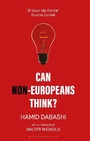
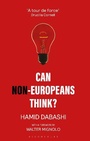
Hamid Dabashi
Can Non-Europeans Think?
Book
04/2015
Zed Books Ltd
€38.59
Article exhausted; check different version
Persons
Hamid Dabashi is the Hagop Kevorkian professor of Iranian studies and comparative literature at Columbia University. Born in Iran, he received a dual PhD in the sociology of culture and Islamic studies from the University of Pennsylvania, followed by a postdoctoral fellowship at Harvard University. Dabashi has written and edited many books, including Iran, the Green Movement and the USA and The Arab Spring, as well as numerous chapters, essays, articles and book reviews. He is an internationally renowned cultural critic, whose writings have been translated into numerous languages.
Dabashi has been a columnist for the Egyptian Al-Ahram Weekly for over a decade, and is a regular contributor to Al Jazeera and CNN. He has been a committed teacher for nearly three decades and is also a public speaker, a current affairs essayist, a staunch anti-war activist and the founder of Dreams of a Nation. He has four children and lives in New York with his wife, the Iranian-Swedish feminist scholar and photographer Golbarg Bashi.
Dabashi has been a columnist for the Egyptian Al-Ahram Weekly for over a decade, and is a regular contributor to Al Jazeera and CNN. He has been a committed teacher for nearly three decades and is also a public speaker, a current affairs essayist, a staunch anti-war activist and the founder of Dreams of a Nation. He has four children and lives in New York with his wife, the Iranian-Swedish feminist scholar and photographer Golbarg Bashi.
Content
Foreword: Yes, We Can by Walter Mignolo
Introduction: Can Europeans Read?
1. Can Non-Europeans Think?
2. The Moment of Myth Edward Said, 1935-2003
3. The Middle East is Changed Forever
4. The War between the Civilized Man and the Savage
5. Postcolonial Defiance or Still the Other
Conclusion: The Continued Regime of Knowledge
Introduction: Can Europeans Read?
1. Can Non-Europeans Think?
2. The Moment of Myth Edward Said, 1935-2003
3. The Middle East is Changed Forever
4. The War between the Civilized Man and the Savage
5. Postcolonial Defiance or Still the Other
Conclusion: The Continued Regime of Knowledge
