

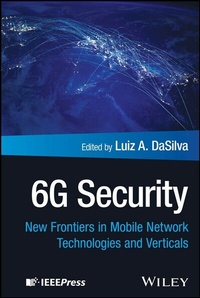
6G Security
Description

An authoritative and up-to-date discussion of securing future 6G networks
This book delivers a comprehensive, one-stop reference for 6G security, explaining the major technologies and use cases being contemplated for 6G, as well as the security issues relevant to those technologies and application areas. It explores security issues associated with key 6G technologies, including softwarization, disaggregation, slicing, blockchain, federated learning, non-terrestrial networks, and millimeter-wave, as well as major verticals enabled by 6G technology.
The book articulates critical technical challenges and opportunities for securing 6G systems, like how to secure autonomous vehicles with machine learning, and covers essential areas of a looming technological revolution that will pose significant security challenges for stakeholders.
Readers will also find:
- A thorough introduction to the new frontiers opened up by 6G technology
- Comprehensive explorations of securing radio access network slicing
- Practical discussions on how to secure management with blockchain-based federated learning
- Complete treatments of securing millimeter-wave communications and developing smart microgrids with distributed energy resources
Perfect for mobile network professionals and technologists, 6G Security will also benefit service providers, researchers, and students with an interest in communications networks and their security.
More details
Other editions
Additional editions
Person
Luiz A. DaSilva is the Bradley Professor of Cybersecurity in the Department of Electrical and Computer Engineering at Virginia Tech, USA. He is also the inaugural Executive Director of the Commonwealth Cyber Initiative, which brings together 46 higher education institutions in Virginia with a common mission of research, innovation, and workforce development for cybersecurity. He has extensive experience in wireless communications and networks research.
Content
List of Contributors xiii
About the Editor xvi
Foreword xvii
Acknowledgments xxii
Acronyms xxiii
1 Securing 6G: New Frontiers 1
Luiz A. DaSilva and Eric Burger
2 Securing Softwarization and Disaggregation 17
Mayukh Roy Chowdhury, Md. Habibur Rahman, Arham Siddique, Naveen Sapavath, Aloizio P. DaSilva, Vijay K. Shah and Duminda Wijesekera
3 Securing Radio Access Network Slicing 35
Yalin Sagduyu, Tugba Erpek, Safdar Hussain Bouk and Sachin Shetty
4 Securing Management with Blockchain-based Federated Learning 65
Rui Ning, Hongzhi Guo and Chunsheng Xin
5 Securing Non-terrestrial Networks 85
Rahul Varma Chintalapati, Paul Masur, Nishith D. Tripathi and Jeffrey H. Reed
6 Securing Next G Milli meter-wave and Terahertz Communications 143
Jacek Kibilda, Parth Pathak, Vijay Shah, Kai Zeng and André Gomes
7 Securing Cyber-physical Systems Using Homomorphic Encryption 165
Atul Khatri, Ruizhi Cheng, Songqing Chen and Bo Han
8 Securing Power-constrained Devices with Energy-preserving Cryptography 207
Khaled Khasawneh, Sai Dinakarrao, Sunanda Roy, Anhton Nguyen and Pavlos Zouridakis
9 Securing Smart Microgrid with Distributed Energy Resources 241
Saikat Das, Salih Sarp, Zhifang Wang and Yanxiao Zhao
10 Securing Autonomous Vehicles with Machine Learning 265
Shiyi Liu, Tanmoy Sen and Haiying Shen
References 289
Index 293
