

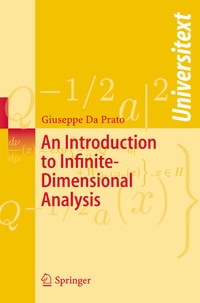
An Introduction to Infinite-Dimensional Analysis
Description

In this revised and extended version of his course notes from a 1-year course at Scuola Normale Superiore, Pisa, the author provides an introduction - for an audience knowing basic functional analysis and measure theory but not necessarily probability theory - to analysis in a separable Hilbert space of infinite dimension.
Starting from the definition of Gaussian measures in Hilbert spaces, concepts such as the Cameron-Martin formula, Brownian motion and Wiener integral are introduced in a simple way. These concepts are then used to illustrate some basic stochastic dynamical systems (including dissipative nonlinearities) and Markov semi-groups, paying special attention to their long-time behavior: ergodicity, invariant measure. Here fundamental results like the theorems of Prokhorov, Von Neumann, Krylov-Bogoliubov and Khas'minski are proved. The last chapter is devoted to gradient systems and their asymptotic behavior.
Reviews / Votes
From the reviews:
"This is an extended version of the author's 'An introduction to infinite-dimensional analysis' published by Scuola Normale Superiore, Pisa . . A well written textbook (even an introductory research monograph), suitable for teaching a graduate course." (Neils Jacob, Zentralblatt MATH, Vol. 1109 (11), 2007)
"The present volume collects together . the notes of the course on infinite-dimensional analysis held by the author at the Scuola Normale Superiore of Pisa in recent years. The book is intended for people who have some knowledge of functional analysis . . It provides an extremely useful tool for those scholars who are interested in learning some basics about Gaussian measures in Hilbert spaces, Brownian motion, Markov transition semigroups . . The book is well written and all arguments are clearly and rigorously presented." (Sandra Cerrai, Mathematical Reviews, Issue 2009 a)
More details
Other editions
Additional editions
Person
GIUSEPPE DA PRATO was born in La Spezia in 1936. Having graduated in Physics in 1960 from the University of Rome, he became full professor of Mathematics in 1968 and taught in Rome and in Trento. Since 1979 he has been Professor of Mathematical Analysis at the Scuola Normale Superiore di Pisa.
The scientific activity of Giuseppe Da Prato concerns infinite-dimensional analysis and partial differential stochastic equations (existence, uniqueness, invariant measures, ergodicity), with applications to optimal stochastic control.
Giuseppe Da Prato is the author of 5 other books, some co-authored with other international specialists, on control theory, stochastic differential equations and infinite dimensional Kolmogorov equations, and of more than 250 papers in international scientific journals.
