

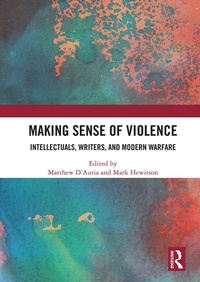
Making Sense of Violence
Intellectuals, Writers, and Modern Warfare
1st Edition
Published on 25. November 2020
210 pages
978-1-000-16985-0 (ISBN)
Description

This book looks at the representations of modern war by analysing texts and examining the ways in which authors relate to the atrocious horrors of war.
Rejecting the assumption that violence is simply a denial of reason or, at best, a pathological form of collective sadism, this book considers it 'a cultural act' that needs to be understood as underpinned by a series of shared and accepted norms and values stemming from a society at a given moment of its history and shaped by its language. Traditional vocabulary and language seem inadequate to describe soldiers' experience of modern warfare. The problem for writers is to depict and render intelligible a dramatically unprecedented reality through recourse to something familiar. For some historians and literary critics, the absurdity of the First World War has shaped our ironic and disenchanted reading of the entire twentieth century. Yet these ways of coping with the urge to communicate inexpressible feelings and emotions in most cases are not sufficient to overcome the incoherence of the sentiments felt and the events witnessed.
The contributors attempt to address the questions and issues that are posed by the highly ambiguous views, texts, and representations examined in this volume.
This book was originally published as a special issue of the journal European Review of History: Revue Europeenne d'Histoire.
Rejecting the assumption that violence is simply a denial of reason or, at best, a pathological form of collective sadism, this book considers it 'a cultural act' that needs to be understood as underpinned by a series of shared and accepted norms and values stemming from a society at a given moment of its history and shaped by its language. Traditional vocabulary and language seem inadequate to describe soldiers' experience of modern warfare. The problem for writers is to depict and render intelligible a dramatically unprecedented reality through recourse to something familiar. For some historians and literary critics, the absurdity of the First World War has shaped our ironic and disenchanted reading of the entire twentieth century. Yet these ways of coping with the urge to communicate inexpressible feelings and emotions in most cases are not sufficient to overcome the incoherence of the sentiments felt and the events witnessed.
The contributors attempt to address the questions and issues that are posed by the highly ambiguous views, texts, and representations examined in this volume.
This book was originally published as a special issue of the journal European Review of History: Revue Europeenne d'Histoire.
More details
Edition
1. Auflage
Language
English
Place of publication
London
United Kingdom
Publishing group
Taylor & Francis Ltd
Target group
College/higher education
Product notice
Reflowable
ISBN-13
978-1-000-16985-0 (9781000169850)
Copyright in bibliographic data and cover images is held by Nielsen Book Services Limited or by the publishers or by their respective licensors: all rights reserved.
Schweitzer Classification
Other editions
Additional editions
Book
01/2024
1st Edition
Routledge
€63.00
Shipment within 15-20 days
Book
07/2020
1st Edition
Routledge
€208.20
Shipment within 15-20 days
Persons
Matthew D'Auria is an intellectual historian working at the University of East Anglia, UK. His main research interest lies in the relationship between images of the nation and discourses about Europe in the modern age.
Mark Hewitson is a Professor of German History and Politics at University College London, UK. His research interests lie principally in the intellectual, cultural, and political history of nineteenth- and twentieth-century Germany and Europe.
Mark Hewitson is a Professor of German History and Politics at University College London, UK. His research interests lie principally in the intellectual, cultural, and political history of nineteenth- and twentieth-century Germany and Europe.
Content
Introduction: Making sense of modern warfare Violence
1. Memory in warfare: history as a destituent narrative
2. Progress, decline and redemption: understanding war and imagining Europe, 1870s-1890s
3. Culture, resistance and violence: guarding the Habsburg Ostgrenze with Montenegro in 1914
4. Sender, those who have not returned: Carlo Salsa and his 'Trenches'
5. A war of words: the cultural meanings of the First World War in Britain and Germany
6. The Tannenberg myth in history and literature, 1914-1945
7. Resistance politics of non-violence: Jean Paulhan's 'Fautrier the Enraged' (1943)
8. The experience and the idea of war in the writings of Simone Weil and Marguerite Duras
9. Violence and resistance: Joyce Lussu's minority revolution in trans-lation
1. Memory in warfare: history as a destituent narrative
2. Progress, decline and redemption: understanding war and imagining Europe, 1870s-1890s
3. Culture, resistance and violence: guarding the Habsburg Ostgrenze with Montenegro in 1914
4. Sender, those who have not returned: Carlo Salsa and his 'Trenches'
5. A war of words: the cultural meanings of the First World War in Britain and Germany
6. The Tannenberg myth in history and literature, 1914-1945
7. Resistance politics of non-violence: Jean Paulhan's 'Fautrier the Enraged' (1943)
8. The experience and the idea of war in the writings of Simone Weil and Marguerite Duras
9. Violence and resistance: Joyce Lussu's minority revolution in trans-lation
