

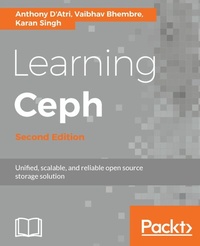
Learning Ceph
Unifed, scalable, and reliable open source storage solution
2nd Edition
Published on 8. July 2025
340 pages
978-1-78712-291-8 (ISBN)
Description

No detailed description available for "Learning Ceph".
All prices
More details
Edition
2nd Revised edition
Language
English
Place of publication
Birmingham
United Kingdom
Target group
Professional and scholarly
US School Grade: College Graduate Student
Edition type
Revised edition
File size
2,01 MB
ISBN-13
978-1-78712-291-8 (9781787122918)
Copyright in bibliographic data and cover images is held by Nielsen Book Services Limited or by the publishers or by their respective licensors: all rights reserved.
Schweitzer Classification
Other editions
Additional editions
Anthony D'Atri | Vaibhav Bhembre | Karan Singh
Learning Ceph -
Unifed, scalable, and reliable open source storage solution
Book
10/2017
2nd Edition
Packt Publishing
€63.40
Shipment within 3-4 weeks
Person
Singh Karan :
Karan is an IT expert and passionate tech enthusiast living with his beautiful wife Monika in Finland. He holds Honours degree in Bachelor of Computer Science and a Master degree in System Engineering from BITS, Pilani. Apart from this, he is a certified professional for technologies like OpenStack, NetApp and Oracle Solaris. Karan is currently working as a System Specialist of Storage and Cloud Platform for CSC - IT Center for Science Ltd. focusing all his energies on providing IaaS cloud solutions based on OpenStack and Ceph and building economic multi-petabyte storage system using Ceph. Karan possesses a rich skill set and working experience of a variety of cloud technologies. He devotes a part of his time to R&D and learning technologies. He is also the author of the very first book on Ceph titled Learning Ceph, published in 2014. Karan possesses extensive system administration skills and has excellent working experience on a variety of Unix environments, backup, enterprise storage systems, and cloud platforms. When not working on Ceph and OpenStack, Karan can be found working with Configuration management, containers and devops related tools. He loves writing about technologies and is an avid blogger. You can reach him on Twitter. Bhembre Vaibhav :
Vaibhav Bhembre is a systems programmer working currently as a technical lead for cloud storage products at DigitalOcean. He holds a bachelor's degree in computer engineering from the University of Mumbai and a master's degree in computer science from the State University of New York in Buffalo. Before joining DigitalOcean, Vaibhav wore multiple hats and lead the backend engineering and reliability engineering teams at Sailthru Inc. From helping to scale dynamically generated campaign sends to over million users at a time, to architecting a cloud-scale compute and storage platform, Vaibhav has years of experience writing software across all layers of the stack. During his time as a student, Vaibhav co-published a novel graph algorithm that optimally computed closeness and betweenness in an incrementally updating social network. He also made changes to a highly available distributed file-system built on top of iRODs data management framework as his master's project. This system, that was actively used across more than 10+ educational institutions live, was his foray into large-scale distributed storage and his transition into using Ceph professionally was only natural.D'Atri Anthony :
Anthony D'Atri's career in system administration spans from laptops to vector supercomputers. He has brought his passion for fleet management and server components to bear on a holistic yet, detailed approach to deployment and operations. His experience with architecture, operation, and troubleshooting of NetApp, ZFS, SVM, and other storage systems dovetailed neatly into Ceph. Anthony worked for three years at Cisco using Ceph as a petabyte-scale object and block backend to multiple OpenStack clouds. Now helping deliver awesome storage to droplet customers of DigitalOcean, Anthony aims to help the growing community build success with Ceph.
Karan is an IT expert and passionate tech enthusiast living with his beautiful wife Monika in Finland. He holds Honours degree in Bachelor of Computer Science and a Master degree in System Engineering from BITS, Pilani. Apart from this, he is a certified professional for technologies like OpenStack, NetApp and Oracle Solaris. Karan is currently working as a System Specialist of Storage and Cloud Platform for CSC - IT Center for Science Ltd. focusing all his energies on providing IaaS cloud solutions based on OpenStack and Ceph and building economic multi-petabyte storage system using Ceph. Karan possesses a rich skill set and working experience of a variety of cloud technologies. He devotes a part of his time to R&D and learning technologies. He is also the author of the very first book on Ceph titled Learning Ceph, published in 2014. Karan possesses extensive system administration skills and has excellent working experience on a variety of Unix environments, backup, enterprise storage systems, and cloud platforms. When not working on Ceph and OpenStack, Karan can be found working with Configuration management, containers and devops related tools. He loves writing about technologies and is an avid blogger. You can reach him on Twitter. Bhembre Vaibhav :
Vaibhav Bhembre is a systems programmer working currently as a technical lead for cloud storage products at DigitalOcean. He holds a bachelor's degree in computer engineering from the University of Mumbai and a master's degree in computer science from the State University of New York in Buffalo. Before joining DigitalOcean, Vaibhav wore multiple hats and lead the backend engineering and reliability engineering teams at Sailthru Inc. From helping to scale dynamically generated campaign sends to over million users at a time, to architecting a cloud-scale compute and storage platform, Vaibhav has years of experience writing software across all layers of the stack. During his time as a student, Vaibhav co-published a novel graph algorithm that optimally computed closeness and betweenness in an incrementally updating social network. He also made changes to a highly available distributed file-system built on top of iRODs data management framework as his master's project. This system, that was actively used across more than 10+ educational institutions live, was his foray into large-scale distributed storage and his transition into using Ceph professionally was only natural.D'Atri Anthony :
Anthony D'Atri's career in system administration spans from laptops to vector supercomputers. He has brought his passion for fleet management and server components to bear on a holistic yet, detailed approach to deployment and operations. His experience with architecture, operation, and troubleshooting of NetApp, ZFS, SVM, and other storage systems dovetailed neatly into Ceph. Anthony worked for three years at Cisco using Ceph as a petabyte-scale object and block backend to multiple OpenStack clouds. Now helping deliver awesome storage to droplet customers of DigitalOcean, Anthony aims to help the growing community build success with Ceph.
Content
- Intro
- Copyright
- Credits
- About the Authors
- About the Reviewer
- www.PacktPub.com
- Customer Feedback
- Table of Contents
- Preface
- Chapter 1: Introducing Ceph Storage
- The history and evolution of Ceph
- Ceph releases
- New since the first edition
- The future of storage
- Ceph as the cloud storage solution
- Ceph is software-defined
- Ceph is a unified storage solution
- The next-generation architecture
- RAID: the end of an era
- Ceph Block Storage
- Ceph compared to other storage solutions
- GPFS
- iRODS
- HDFS
- Lustre
- Gluster
- Ceph
- Summary
- Chapter 2: Ceph Components and Services
- Introduction
- Core components
- Reliable Autonomic Distributed Object Store (RADOS)
- MONs
- Object Storage Daemons (OSDs)
- Ceph manager
- RADOS GateWay (RGW)
- Admin host
- CephFS MetaData server (MDS)
- The community
- Core services
- RADOS Block Device (RBD)
- RADOS Gateway (RGW)
- CephFS
- Librados
- Summary
- Chapter 3: Hardware and Network Selection
- Introduction
- Hardware selection criteria
- Corporate procurement policies
- Power requirements-amps, volts, and outlets
- Compatibility with management infrastructure
- Compatibility with physical infrastructure
- Configuring options for one-stop shopping
- Memory
- RAM capacity and speed
- Storage drives
- Storage drive capacity
- Storage drive form factor
- Storage drive durability and speed
- Storage drive type
- Number of storage drive bays per chassis
- Controllers
- Storage HBA / controller type
- Networking options
- Network versus serial versus KVM management
- Adapter slots
- Processors
- CPU socket count
- CPU model
- Emerging technologies
- Summary
- Chapter 4: Planning Your Deployment
- Layout decisions
- Convergence: Wisdom or Hype?
- Planning Ceph component servers
- Rack strategy
- Server naming
- Architectural decisions
- Pool decisions
- Replication
- Erasure Coding
- Placement Group calculations
- OSD decisions
- Back end: FileStore or BlueStore?
- OSD device strategy
- Journals
- Filesystem
- Encryption
- Operating system decisions
- Kernel and operating system
- Ceph packages
- Operating system deployment
- Time synchronization
- Packages
- Networking decisions
- Summary
- Chapter 5: Deploying a Virtual Sandbox Cluster
- Installing prerequisites for our Sandbox environment
- Bootstrapping our Ceph cluster
- Deploying our Ceph cluster
- Scaling our Ceph cluster
- Summary
- Chapter 6: Operations and Maintenance
- Topology
- The 40,000 foot view
- Drilling down
- OSD dump
- OSD list
- OSD find
- CRUSH dump
- Pools
- Monitors
- CephFS
- Configuration
- Cluster naming and configuration
- The Ceph configuration file
- Admin sockets
- Injection
- Configuration management
- Scrubs
- Logs
- MON logs
- OSD logs
- Debug levels
- Common tasks
- Installation
- Ceph-deploy
- Flags
- Service management
- Systemd: the wave (tsunami?) of the future
- Upstart
- sysvinit
- Component failures
- Expansion
- Balancing
- Upgrades
- Working with remote hands
- Summary
- Chapter 7: Monitoring Ceph
- Monitoring Ceph clusters
- Ceph cluster health
- Watching cluster events
- Utilizing your cluster
- OSD variance and fillage
- Cluster status
- Cluster authentication
- Monitoring Ceph MONs
- MON status
- MON quorum status
- Monitoring Ceph OSDs
- OSD tree lookup
- OSD statistics
- OSD CRUSH map
- Monitoring Ceph placement groups
- PG states
- Monitoring Ceph MDS
- Open source dashboards and tools
- Kraken
- Ceph-dash
- Decapod
- Rook
- Calamari
- Ceph-mgr
- Prometheus and Grafana
- Summary
- Chapter 8: Ceph Architecture: Under the Hood
- Objects
- Accessing objects
- Placement groups
- Setting PGs on pools
- PG peering
- PG Up and Acting sets
- PG states
- CRUSH
- The CRUSH Hierarchy
- CRUSH Lookup
- Backfill, Recovery, and Rebalancing
- Customizing CRUSH
- Ceph pools
- Pool operations
- Creating and listing pools
- Ceph data flow
- Erasure coding
- Summary
- Chapter 9: Storage Provisioning with Ceph
- Client Services
- Ceph Block Device (RADOS Block Device)
- Creating and Provisioning RADOS Block Devices
- Resizing RADOS Block Devices
- RADOS Block Device Snapshots
- RADOS Block Device Clones
- The Ceph Filesystem (CephFS)
- CephFS with Kernel Driver
- CephFS with the FUSE Driver
- Ceph Object Storage (RADOS Gateway)
- Configuration for the RGW Service
- Performing S3 Object Operations Using s3cmd
- Enabling the Swift API
- Performing Object Operations using the Swift API
- Summary
- Chapter 10: Integrating Ceph with OpenStack
- Introduction to OpenStack
- Nova
- Glance
- Cinder
- Swift
- Ganesha / Manila
- Horizon
- Keystone
- The Best Choice for OpenStack storage
- Integrating Ceph and OpenStack
- Guest Operating System Presentation
- Virtual OpenStack Deployment
- Summary
- Chapter 11: Performance and Stability Tuning
- Ceph performance overview
- Kernel settings
- pid_max
- kernel.threads-max, vm.max_map_count
- XFS filesystem settings
- Virtual memory settings
- Network settings
- Jumbo frames
- TCP and network core
- iptables and nf_conntrack
- Ceph settings
- max_open_files
- Recovery
- OSD and FileStore settings
- MON settings
- Client settings
- Benchmarking
- RADOS bench
- CBT
- FIO
- Fill volume, then random 1M writes for 96 hours, no read verification:
- Fill volume, then small block writes for 96 hours, no read verification:
- Fill volume, then 4k random writes for 96 hours, occasional read verification:
- Summary
- Index

