

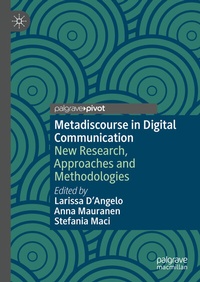
Metadiscourse in Digital Communication
Description

In this book, a solid and emerging group of international researchers contributes to the theory of metadiscourse and to our understanding of the role metadiscourse and related 'meta' phenomena may play in digital forms of communication. Providing examples of new research methods and approaches, the authors investigate progressively hybridized academic and non-academic genres that have migrated from analogue to digital format. The book offers valuable insights on how digital communication has changed today's communication environments and provides examples of research methods needed to capture that change. This volume will be appreciated by scholars and graduate students interested in linguistics, corpus linguistics and metadiscourse.
Reviews / Votes
"Various chapters as well as the Introduction offer a view of what metadiscourse is and what direction metadiscourse should take, thus providing this encompassing perspective to novice scholars in the field, but also offering a critical view to more knowledgeable readers. Moreover, the book may be of great interest to digital discourse analysts and researchers . . the volume reads as a versatile, promising window into what metadiscourse might offer to digital discourse analysis." (Rosa Lorés, ESP Today, Vol. 11 (2), 2023)More details
Other editions
Additional editions
Persons
Larissa D'Angelo is Associate Professor of English Language at the University of Bergamo, Italy. She is an active member of CERLIS (Research Centre on Specialized Languages) and her main research interests deal with biometric analyses, multimodality, audiovisual translation, corpus linguistics and metadiscourse.
Anna Mauranen
is Professor and Research Director at the University of Helsinki, Finland. Her research and publications include those on ELF, academic discourses, corpus linguistics, translation studies, and theoretical modelling of speech. She is co-editor of
Applied Linguistics
and formerly founding co-editor of the
Journal of English as a Lingua Franca
.
Stefania Maci
is Full Professor of English Language, pro Vice-Chancellor of Education, Director of CERLIS at the University of Bergamo and serves on the Board of AIA (Associazione Italiana di Anglistica). Her research is focused on the study of the English language in academic and professional contexts, with particular regard to the analysis of tourism and medical discourses.
Content
Chapter 1 Metadiscourse in Digital Communication: A short introduction.- Chapter 2 "Gonna write about it on my blog too" Metadiscourse in research blog discussions.- Chapter 3 Reflections on reflexivity in digital communication: Toward a third wave of metadiscourse studies.- Chapter 4 Metadiscourse in Academic Research Articles vs. Blogs: Paul Krugman as a Case Study.- Chapter 5 This Has Changed: 'Out-of-the-Box' metadiscourse in Scientific Graphical Abstracts.- Chapter 6 Lemons and watermelons: Visual advertising and conceptual blending.- Chapter 7 Metadiscourse In Social Media: A Reflexive Framework.
