

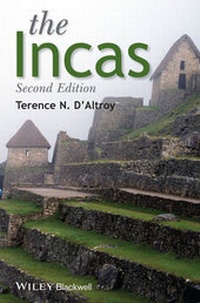
The Incas
Description

Reviews / Votes
"This new edition of Terence D'Altroy's The Incas is themost complete and authoritative account to date of this last, greatempire of Pre-Columbian South America. It will stand for sometime to come as the go-to book to consult for everything you everwanted to know about the Incas -- and what's more, it's anengaging, enlightening and exciting read!" - Gary Urton,Harvard University "D'Altroy's expanded second editionincorporates the latest Inca scholarship along with additionaltopics of interest. It is a masterful work by a leadingexpert, accessible to students and professionals alike."- Katharina Schreiber, University of California, SantaBarbara "A comprehensive overview of the Inca Empire. Thereis no other book that even comes close to matching TerenceD'Altory's scholarship and knowledge." -Brian Bauer, University of Illinois - ChicagoMore details
Other editions

Person
Content
Preface to the Second Edition
A second edition—why bother? Anyone who has seen books go through multiple editions has good reason to raise an eyebrow when a new one appears, so the reader may feel that some justification is in order. I can distill out my rationale for writing this book to three major points. The first is that we know far more about the Incas today than we did a dozen years ago when I was finishing the first edition. Both the documentary and archaeological databases that inform our understanding have grown significantly. On the written side, no great new chronicles have appeared, but archival work by historians has brought many important new documents to light. Archaeologists have also been vigorously conducting field studies throughout the entire Inca domain, sometimes at elevations that defy human existence. Work by scholars in the Cuzco heartland has been especially valuable, because it has vastly enriched our discussions of the Incas' rise to local power, and thus the origins of the empire itself. Scores of projects in the provinces are also enlightening us as to how the Incas put their rule into practice and how their subjects reacted in the face of Cuzco's imposed dominion. Overall, hundreds of new studies have been conducted or published in the last decade, more than enough to draw from to update our account of the Inca realm.
A second reason for a revised edition is that researchers today are asking different kinds of questions, and are using new methods to answer them, which is a sign of a vibrant research community. In the process, they often turn a critical eye to ideas that were broadly accepted in the past. They can also draw on theoretical premises that challenge our understanding of the nature of humanity, its self-perception or self-presentation, and the past. Some of the new answers are forcing us to revisit issues about the Incas' own notions about existence, time, causality, and power. They also invite us to rethink the relationships between the information contained in written sources or archaeological remains, or that never took a substantial material form (speech, for example). In the process, Andean research has increasingly become a laboratory for thinking about humanity's past in general.
In thinking about such topics, I have become increasingly convinced that the available documents and material remains do not provide two windows into precisely the same kinds of knowledge. Instead, they are partial complements, affording overlapping insights into different parts of the Inca world. That idea, which will pop up at various places in this book, leads us to ask questions about how the Incas classified things in their world and how they thought those things interacted. To provide one example, we know that the Incas apparently made almost no physical representations of their rulers or their actions that we can recognize today. They created no statues of them, no grand friezes, murals, or portraits, except for some illustrations sequestered in the main temple in Cuzco. Why not? Was there something about rendering things human in a material form that was dangerous, blasphemous, or even impossible? We know that many other pre-modern societies mastered representation of humans and their endeavors, including some Andean predecessors, such as the Moche. So why not the Incas?
Third, my own interests in the Incas have shifted over time. Most importantly, I have become drawn to the intellectual history that paralleled the physical and organizational projects that created the empire. As we will see in the text to follow, prehispanic Andean societies enjoyed a vibrant intellectual life, including the invention of an array of philosophical notions justifying the Incas' right to rule. It is a tremendous challenge to identify and make sense of those ideas, but if we can make some headway, we will be in a better position to understand how the Incas saw the world and what options lay before them during their run of power.
A note is also in order on a few of the sources cited in this edition of the book. Since the first version appeared, several important early texts have appeared in reliable English translation. The most significant are Sarmiento's (2007) chronicle of 1572, which was an official version of Inca history written for Viceroy Toledo to meet crown interests, and the hospice priest Molina's (2011) exposition on Inca religion. Another key document is the treatise of the neo-Inca ruler, Titu Kusi Yupanki (Titu Cusi 2005), presented to the same viceroy in 1570. That document was intended as an Inca counter-chronicle of the Colonial era, written in the hopes of legitimizing Inca rule and thus allowing the kings to retain status and resources as co-equals with the Spanish crown. I have chosen to cite those publications where possible in preference to the best regarded Spanish texts, because this book has been written for an English-speaking audience.
I warn readers away from some other translations, notably the appallingly inexact works of Sir Clements Markham, which are still reprinted or cited today. Readers of von Hagen and de Onis's edited translation of Cieza's work (Cieza 1959) also need to be aware that the translation, while rendered reliably, conflates two separate books into one running text without systematic acknowledgment of the sources of the passages. For the quotations in the present book in which another translator is not explicitly cited, the translation is mine. Readers may also note that the names of the some of the early Spanish authors have been updated to conform to current understandings of their names. For example, Betanzos is now cited as Diez de Betanzos, Sancho de la Hoz is Sancho, and Polo de Ondegardo is now Polo Ondegardo (see Pillsbury 2008).
It is also worth emphasizing that the other sources cited in this text are largely in English, not because they are the most important available, but because I anticipate that many people reading the book will not be conversant in Spanish and other languages. The writings and insights of Spanish-language authors have been especially valuable to my own understanding, but my goal in the References is primarily to cite works that would be accessible to English-only readers, while giving proper credit to the sources of ideas and information. I have drawn on several times as many works as are listed in the current References in preparing the text, and will cite literature weighted toward the appropriate language in any future translation.
For this edition, I also draw more extensively from the often brilliant studies by modern ethnographers who have been working among both Quechua and Aymara speakers. In the first edition, I resisted using much ethnography for reasons that seem a little less persuasive to me now. One concern was that any discussion of today's Andean peoples treats societies that have been tinged by half a millennium of Christian and Spanish cultural influences, not to mention modern transportation and communication technologies. No matter how deep the traditions, modern peasant communities are in many ways a world apart from their ancestral kin. Recognizing the elements that provide sound insights into prehispanic societies is therefore fraught with all sorts of problems. Not least of those is any researcher's (perhaps unconscious) bias in the choice of the features that can be used as trustworthy analogies for pre-European social order, belief, and practice. It is sometimes easy to decide that an anomalous feature seen in today's communities has to be a post-contact introduction because of an idealized, relatively static notion we often have of life in the past or because of a particular stance we want to defend.
The converse, of course, is assuming that something described in the early Colonial era was not a new introduction. The practices of people forming social groups around an occupation, for example, or bartering or using money, or constantly re-sorting membership in kin groups or the hierarchies among them, or strategically moving about the social landscape and declaring a new history to justify it, are well represented in modern traditional communities. In contrast, they only occasionally figure in discussions of prehistory. A second reason for de-emphasizing studies of societies more than a few decades removed from independent Andean life is the sheer weight of the history and ethnography that has been produced. Its comprehensive inclusion in this work would make it unmanageable for my purposes. That said, so many kinds of insights can be found into prehistory from contemporary peoples that I thought it wise to expand judiciously on my use of ethnography in this edition. My apologies to those for whom this has just made the text a little more unwieldy.
I would like to repeat my thanks to the vast number of people whose hard work and generosity has made this book possible. Among them are many who I recognized in the first edition (see below), and who continued to provide comments, publications, and insight. It is hard to single out particular scholars whose work has made a major difference in my own thinking, but Gary Urton's and Frank Salomon's studies of the khipu knot-records have been a revelation; their work, of course, has been complemented by that of many other scholars. Similarly, the surveys and extensive publications by Brian Bauer, Alan Covey, Steven Kosiba, and others have rewritten the history of the heartland. The work of Peruvian scholars specializing in the archaeology of the Cuzco region has been vital to my understanding; among them are Arminda Gibaja, the late Alfredo Valencia Zegarra, and Ernesto...
