

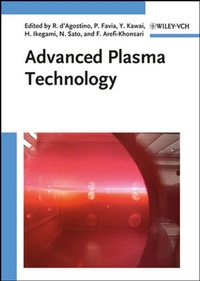
Advanced Plasma Technology
1st Edition
Published on 8. September 2008
XXII, 457 pages
978-3-527-62219-1 (ISBN)
Description

A panel of internationally renowned scientists discuss the latest results in plasma technology. This volume has been compiled with both a didactic approach and an overview of the newest achievements for industrial applications. It is divided into two main sections. One is focused on fundamental technology, including plasma production and control, high-pressure discharges, modeling and simulation, diagnostics, dust control, and etching. The section on application technology covers polymer treatments, silicon solar cell, coating and spray, biomaterials, sterilization and waste treatment, plasma propulsion, plasma display panels, and anti-corrosion coatings. The result is an indispensable work for physicists, chemists and engineers involved in the field of plasma technology.
More details
Other editions
Additional editions
R. D'Agostino
Advanced Plasma Technology
Software
04/2008
Wiley-VCH
€346.96
No shipping information available
Riccardo D'Agostino | Pietro Favia | Yoshinobu Kawai
Advanced Plasma Technology
Book
12/2007
1st Edition
Wiley-VCH
€249.00
Article exhausted; check different version
Persons
Professor Riccardo d'Agostino is director of the Department of Chemistry at the University of Bari, Italy. His research is focused on low pressure plasma processes and diagnostics for the modification of materials. During is career, he authored 180 scientific papers and edited four books and three international proceedings. His memberships include the managing committee of Plasma Science Technique Division of IUVSTA and, as chairman, the IUPAC Committee on "Plasma Chemistry" (1989-1991). He served as co-editor of the journal Plasmas and Polymers (until 2003) and chaired numerous international conferences.
Professor Pietro Favia is Associate Professor of Chemistry and Chemistry of Materials at the Department of Chemistry, University of Bari, Italy. During his career he focused on low pressure plasma processes, plasma diagnostics and surface characterization techniques. He authored about 100 papers, acted as editor of two books and served in many organizing and scientific committees of renowned international conferences on Plasma Chemistry.
Professors Favia and d'Agostino are the two editors in chief of the journal Plasma Processes and Polymers (PPP).
The co-editors, Professors Farzaneh Arefi-Konsari, Yoshinobu Kawai, Noriyoshi Sato, Hideo Ikegami, are also experienced plasma researchers. They are responsible for sub-areas within the monograph, on which they have concentrated in their respective careers.
Professor Pietro Favia is Associate Professor of Chemistry and Chemistry of Materials at the Department of Chemistry, University of Bari, Italy. During his career he focused on low pressure plasma processes, plasma diagnostics and surface characterization techniques. He authored about 100 papers, acted as editor of two books and served in many organizing and scientific committees of renowned international conferences on Plasma Chemistry.
Professors Favia and d'Agostino are the two editors in chief of the journal Plasma Processes and Polymers (PPP).
The co-editors, Professors Farzaneh Arefi-Konsari, Yoshinobu Kawai, Noriyoshi Sato, Hideo Ikegami, are also experienced plasma researchers. They are responsible for sub-areas within the monograph, on which they have concentrated in their respective careers.
Content
Basic Approaches to Plasma Production and Control
N. Sato
Plasma Sources and Reactor Configurations
P. Colpo
Simulations for Low-Temperature Plasma Applications
J. K. Lee
Modeling and diagnostics of He discharges for treatment of polymers
D. Mataras
3-D Modelling of Thermal Plasmas (RF and Transferred Arc) for the Design of Sources and Industrial Processes
E. Ghedini
RF Plasma Sources for Semiconductor processing
F. F. Chen
Advanced Plasma Diagnostics for Thin Film Deposition
R. Engeln
Plasma Processing of Polymers by a Low-Frequency Discharge with Asymmetrical Configuration of Electrodes
F. Arefi-Khonsari and M. Tatoulian
Fundamentals on plasma deposition of fluorocarbon films
A. Milella
Plasma CVD processes for thin film Si solar cells
A. Matsuda
VHF Plasma Production for Solar Cells
Y. Kawai
Growth Control of Clusters in Reactive Plasmas and Its Application to High-stability a-Si Film Deposition
Y. Watanabe
Micro- and Nano-Structuring in Plasma-Processes for Biomaterials: Micro- and Nano-Features as Powerful Tools to Address Selective Biological Responses
E. Sardella
Chemical Immobilization of Biomolecules on Plasma Modified Substrates for Biomedical Applications
L. C. Lopez
In Vitro Methods to Assess the Biocompatibility of Plasma Modified Surfaces
M. Nardulli
Cold gas plasma in biology and medicine
E. Stoffels
Mechanisms of Sterilization and Decontamination of Surfaces by Low Pressure Plasma
F. Rossi
Application to Atmospheric Pressure Glow Plasma
M. Kogoma
Hydrocarbon and fluorocarbon thin films deposition in atmospheric pressure glow dielectric barrier discharges
F. Fanelli
Remark on Production of Atmospheric Pressure Non-Thermal Plasmas for Modern Application
R. Itatani
Present status and Future of Color Plasma Display
T. Shinoda
Characteristics of PDP Plasmas
H. Ikegami
Recent progress in plasma spray processing
T. Yoshida
Electrohydraulic Discharge Direct Plasma Water Treatment Processes
J.-S. Chang
Development and Physics Issues of an Advanced Space Propulsion
M. Inutake
N. Sato
Plasma Sources and Reactor Configurations
P. Colpo
Simulations for Low-Temperature Plasma Applications
J. K. Lee
Modeling and diagnostics of He discharges for treatment of polymers
D. Mataras
3-D Modelling of Thermal Plasmas (RF and Transferred Arc) for the Design of Sources and Industrial Processes
E. Ghedini
RF Plasma Sources for Semiconductor processing
F. F. Chen
Advanced Plasma Diagnostics for Thin Film Deposition
R. Engeln
Plasma Processing of Polymers by a Low-Frequency Discharge with Asymmetrical Configuration of Electrodes
F. Arefi-Khonsari and M. Tatoulian
Fundamentals on plasma deposition of fluorocarbon films
A. Milella
Plasma CVD processes for thin film Si solar cells
A. Matsuda
VHF Plasma Production for Solar Cells
Y. Kawai
Growth Control of Clusters in Reactive Plasmas and Its Application to High-stability a-Si Film Deposition
Y. Watanabe
Micro- and Nano-Structuring in Plasma-Processes for Biomaterials: Micro- and Nano-Features as Powerful Tools to Address Selective Biological Responses
E. Sardella
Chemical Immobilization of Biomolecules on Plasma Modified Substrates for Biomedical Applications
L. C. Lopez
In Vitro Methods to Assess the Biocompatibility of Plasma Modified Surfaces
M. Nardulli
Cold gas plasma in biology and medicine
E. Stoffels
Mechanisms of Sterilization and Decontamination of Surfaces by Low Pressure Plasma
F. Rossi
Application to Atmospheric Pressure Glow Plasma
M. Kogoma
Hydrocarbon and fluorocarbon thin films deposition in atmospheric pressure glow dielectric barrier discharges
F. Fanelli
Remark on Production of Atmospheric Pressure Non-Thermal Plasmas for Modern Application
R. Itatani
Present status and Future of Color Plasma Display
T. Shinoda
Characteristics of PDP Plasmas
H. Ikegami
Recent progress in plasma spray processing
T. Yoshida
Electrohydraulic Discharge Direct Plasma Water Treatment Processes
J.-S. Chang
Development and Physics Issues of an Advanced Space Propulsion
M. Inutake
