

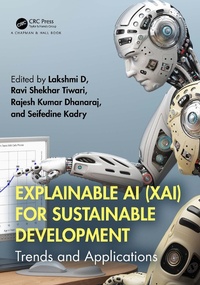
Explainable AI (XAI) for Sustainable Development
Trends and Applications
1st Edition
Published on 26. June 2024
334 pages
978-1-040-03887-1 (ISBN)
Description

This book presents innovative research works to automate, innovate, design, and deploy AI fo real-world applications. It discusses AI applications in major cutting-edge technologies and details about deployment solutions for different applications for sustainable development. The application of Blockchain techniques illustrates the ways of optimisation algorithms in this book. The challenges associated with AI deployment are also discussed in detail, and edge computing with machine learning solutions is explained. This book provides multi-domain applications of AI to the readers to help find innovative methods towards the business, sustainability, and customer outreach paradigms in the AI domain.
* Focuses on virtual machine placement and migration techniques for cloud data centres
* Presents the role of machine learning and meta-heuristic approaches for optimisation in cloud computing services
* Includes application of placement techniques for quality of service, performance, and reliability improvement
* Explores data centre resource management, load balancing and orchestration using machine learning techniques
* Analyses dynamic and scalable resource scheduling with a focus on resource management
The reference work is for postgraduate students, professionals, and academic researchers in computer science and information technology.
* Focuses on virtual machine placement and migration techniques for cloud data centres
* Presents the role of machine learning and meta-heuristic approaches for optimisation in cloud computing services
* Includes application of placement techniques for quality of service, performance, and reliability improvement
* Explores data centre resource management, load balancing and orchestration using machine learning techniques
* Analyses dynamic and scalable resource scheduling with a focus on resource management
The reference work is for postgraduate students, professionals, and academic researchers in computer science and information technology.
More details
Edition
1. Auflage
Language
English
Place of publication
London
United Kingdom
Publishing group
Taylor & Francis Ltd
Target group
Professional and scholarly
Product notice
Reflowable
Illustrations
22 Tables, black and white; 110 Line drawings, black and white; 22 Halftones, black and white; 132 Illustrations, black and white
ISBN-13
978-1-040-03887-1 (9781040038871)
Copyright in bibliographic data and cover images is held by Nielsen Book Services Limited or by the publishers or by their respective licensors: all rights reserved.
Schweitzer Classification
Other editions
Additional editions
Lakshmi D | Ravi Shekhar Tiwari | Rajesh Kumar Dhanaraj
Explainable AI (XAI) for Sustainable Development
Trends and Applications
Book
05/2026
1st Edition
Chapman & Hall/CRC
€64.50
Shipment within 10-20 days
Lakshmi D | Ravi Shekhar Tiwari | Rajesh Kumar Dhanaraj
Explainable AI (XAI) for Sustainable Development
Trends and Applications
Book
06/2024
1st Edition
Chapman & Hall/CRC
€205.10
Shipment within 10-20 days
Persons
Dr. Lakshmi D is presently designated as a Senior Associate Professor in the School of Computing Science and Engineering (SCSE) and Assistant Director, at the Centre for Innovation in Teaching & Learning (CITL) at VIT Bhopal. She has 26 years of teaching experience. She has addressed innumerable guest lectures, acted as a session chair, and was invited as a keynote speaker at several international conferences. She has conducted FDPs that cover approximately ~1,00,000 plus faculty members including JNTU, TEQIP, SERB, SWAYAM, DST, AICTE, MHRD, ATAL, ISTE, Madhya Pradesh Government-sponsored, and self-financed workshops across India as well as Misami University, Philipines on various topics. She has 20 international conference presentations, and 32 international journal papers inclusive of SCOPUS & SCI (cumulative impact factor 45). A total of 20 SCOPUS-indexed book chapters. A total of 24 patents are in various states and 18 patents have been granted at both national and international levels. She was appointed as an external examiner for several Ph.D candidates at reputed universities. She is also guiding research scholars. She has won two Best Paper awards at international conferences, one at the IEEE conference and another one at EAMMIS 2021 (First European, Asian, Middle Eastern North African Conference on Management & Information Systems). She received two best teacher awards in the year 2022 on the eve of Teacher's Day. She published a book on "Theory of Computation" in 2003, "Leading Education in the Age of Disruption" in 2021, and "Smart Cities: Disruptive Technologies Driving the Force", in 2023. She acted as a SPOC to both KAVACH and the Smart India Hackathon in the last three editions. She has created 15 hours of the high-quality online course "Python Essentials" at VITyarthi Online Learning Platform. She has 5 SCOPUS Indexed book edits with three CRS Press, Taylor, and Francis, three IGI Global, and two IEEE Rivers.
Mr. Ravi Shekhar Tiwari is a Researcher, Innovator, and an Engineer. He has written more than 0.5 billion lines of code that are adding value to people's lives. He has 4+ years of industry experience working as an Artificial Intelligence Engineer, Penetration Tester, and MFDI Engineer in Multinational IT companies as well as start-ups. He also holds a position as a reviewer and editor in reputed journals and as an author in technical magazines with Indian Patents, SCI research papers SCOPUS research papers, Book Chapters SCOPUS indexed, and as an Editor in Book Series titled 'Futuristic Trend in Artificial Intelligence' and 'Futuristic Trend in IoT''. He has won awards as a Researcher and contribution to Student Development. Ravi Shekhar Tiwari's research domain includes Time Series Analysis, Protein Structure Prediction and Generation, Federated Learning, the Internet of Things, Microcontrollers, Gait Analysis, AI and Healthcare, XAI, Cloud Computing, Computer Vision, Parallel and Distributed Computing in the cloud. Currently, he is pursuing his Master in Technology in Mahindra University with a Specialization in Artificial Intelligence and Data Science with Teaching Assistant. As a responsible member, he always tries to enhance and uplift society by teaching students remotely. He has been invited as a guest speaker at 2 international conferences. He is also a teacher and mentor without the border where he teaches students to overcome difficulties and pursue their interests as their careers. He also writes poems and short inspirational stories in periodicals.
Dr Rajesh Kumar Dhanaraj is a distinguished Professor at Symbiosis International (Deemed University) in Pune, India. His academic and research achievements have earned him a place among the top 2% of scientists globally, a recognition bestowed upon him by Elsevier and Stanford University. He has authored and edited over 50 books on various cutting-edge technologies and holds 21 patents. Furthermore, he has contributed over 100 articles and papers to esteemed refereed journals and international conferences, in addition to providing chapters for several influential books. Dr. Dhanaraj has earned the distinction of being a Senior Member of the Institute of Electrical and Electronics Engineers (IEEE). He is also a member of the Computer Science Teacher Association (CSTA) and the International Association of Engineers (IAENG). Dr. Dhanaraj's commitment to academic excellence extends to his role as an Associate Editor and Guest Editor for renowned journals, including Elsevier Computers and Electrical Engineering, Human-centric Computing and Information Sciences, Emerald - International Journal of Pervasive Computing and Communications, and Hindawi - Mobile Information Systems. His expertise has earned him a position as an Expert Advisory Panel Member of Texas Instruments Inc., USA.
Prof. Kadry has a bachelor's degree in 1999 from Lebanese University, an MS degree in 2002 from Reims University (France) and EPFL (Lausanne), Ph.D. in 2007 from Blaise Pascal University (France), an HDR degree in 2017 from Rouen University (France). His research currently focuses on Data Science, medical image recognition using AI, education using technology, and applied mathematics. He is an IET Fellow and IETE Fellow, member of European Academy of Sciences and Arts. He is a full professor of data science at Noroff University College, Norway.
Mr. Ravi Shekhar Tiwari is a Researcher, Innovator, and an Engineer. He has written more than 0.5 billion lines of code that are adding value to people's lives. He has 4+ years of industry experience working as an Artificial Intelligence Engineer, Penetration Tester, and MFDI Engineer in Multinational IT companies as well as start-ups. He also holds a position as a reviewer and editor in reputed journals and as an author in technical magazines with Indian Patents, SCI research papers SCOPUS research papers, Book Chapters SCOPUS indexed, and as an Editor in Book Series titled 'Futuristic Trend in Artificial Intelligence' and 'Futuristic Trend in IoT''. He has won awards as a Researcher and contribution to Student Development. Ravi Shekhar Tiwari's research domain includes Time Series Analysis, Protein Structure Prediction and Generation, Federated Learning, the Internet of Things, Microcontrollers, Gait Analysis, AI and Healthcare, XAI, Cloud Computing, Computer Vision, Parallel and Distributed Computing in the cloud. Currently, he is pursuing his Master in Technology in Mahindra University with a Specialization in Artificial Intelligence and Data Science with Teaching Assistant. As a responsible member, he always tries to enhance and uplift society by teaching students remotely. He has been invited as a guest speaker at 2 international conferences. He is also a teacher and mentor without the border where he teaches students to overcome difficulties and pursue their interests as their careers. He also writes poems and short inspirational stories in periodicals.
Dr Rajesh Kumar Dhanaraj is a distinguished Professor at Symbiosis International (Deemed University) in Pune, India. His academic and research achievements have earned him a place among the top 2% of scientists globally, a recognition bestowed upon him by Elsevier and Stanford University. He has authored and edited over 50 books on various cutting-edge technologies and holds 21 patents. Furthermore, he has contributed over 100 articles and papers to esteemed refereed journals and international conferences, in addition to providing chapters for several influential books. Dr. Dhanaraj has earned the distinction of being a Senior Member of the Institute of Electrical and Electronics Engineers (IEEE). He is also a member of the Computer Science Teacher Association (CSTA) and the International Association of Engineers (IAENG). Dr. Dhanaraj's commitment to academic excellence extends to his role as an Associate Editor and Guest Editor for renowned journals, including Elsevier Computers and Electrical Engineering, Human-centric Computing and Information Sciences, Emerald - International Journal of Pervasive Computing and Communications, and Hindawi - Mobile Information Systems. His expertise has earned him a position as an Expert Advisory Panel Member of Texas Instruments Inc., USA.
Prof. Kadry has a bachelor's degree in 1999 from Lebanese University, an MS degree in 2002 from Reims University (France) and EPFL (Lausanne), Ph.D. in 2007 from Blaise Pascal University (France), an HDR degree in 2017 from Rouen University (France). His research currently focuses on Data Science, medical image recognition using AI, education using technology, and applied mathematics. He is an IET Fellow and IETE Fellow, member of European Academy of Sciences and Arts. He is a full professor of data science at Noroff University College, Norway.
Content
1. Sustainable AI: Environmental Implications, Challenges, and Opportunities 2. Artificial Intelligence of Things (AIOT) in Agriculture 4.0 3. EXAI for Computational Sustainability - Models, Services in Smart City and Challenges 4. Impact of Artificial Intelligence and Emotional Intelligence in Autonomous Operation and MSME Entrepreneurs' Performance in the Waste Management Industry 5. Artificial Intelligence Governance and Comprehensibility in Renewable 6. Exploring EEG Characteristics and Machine Learning Classifiers for Accurate Detection of Eye-Blink Mistakes 7. Machine Learning Advancements in Polymer Material Creation: Successful Prediction of Glass Transition Temperature 8. Smart Greenhouse Management System Using AIoT for Sustainable Agriculture 9. Cardiac Images using CardioSegNet: A Deep Learning Approach 10. Artificial Intelligence-Based Techniques for Early Detection of Chiari Malformation 11. AI-Driven Restoration: Enhancing Biodiversity Conservation and Ecosystem Resilience 12. Improvised DenseNet and Faster RCNN for Assisting Agriculture 4.0 13. Libraries for Explainable Artificial Intelligence (EXAI): Python 14. Trends and Advancements of Artificial Intelligence & Explainable Artificial Intelligence in Drug Discovery 15. An In-Depth Analysis of the Potential of AIoT to Improve Agricultural Productivity and Long-Term Sustainability 16. Text-Report Generation from Chest X-Rays using Image Captioning17. The Role of AIoT in Reshaping the Farming Sector 18. Unleashing the Power of XAI (Explainable Artificial Intelligence): Empowering Decision-making and overcoming challenges in Smart Healthcare Automation
