

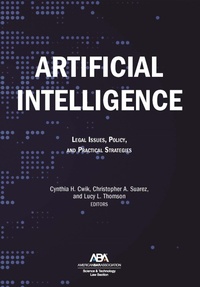
Artificial Intelligence
Description

Artificial Intelligence (AI) is transforming our world at a breakneck pace, including the practice of law. The recent rapid development of generative AI, which produces new outputs based on the data it has been trained on and prompts from users, has been heralded as a revolutionary intellectual and technological development. AI has the potential to improve many aspects of the practice of law, including increasing the speed at which many tasks can be done, boosting productivity, and reducing the amount of time spent on routine tasks. In addition, AI can help to solve one of the most pressing problems facing our legal system ? the large number of people who are not able to afford a lawyer and must try to navigate the legal system on their own.
There also are significant challenges with the use of AI in the legal profession, including AI's yet undetermined accuracy in drafting legal documents; its potential to undermine confidentiality, privacy and security; the capacity to introduce and perpetuate bias; and its impact on the structure of law firms. Additional concerns include the impact of AI on intellectual property rights; how law schools can best prepare students for this new AI-enabled future; and whether advances in AI will meaningfully reduce the number of attorneys that are needed to serve their clients. Governments and private organizations are grappling with how to develop laws, regulations and rules that will govern the use and functionality of AI systems.
In order to address these issues, this book contains reflections and chapters by a group of more than 40 preeminent AI and legal experts from in-house legal departments; private practice; non-profits; academia; government, and the judiciary. The book covers a wide range of important topics concerning AI and the law, and provides practical advice to attorneys on how to navigate these complex and rapidly evolving issues. The topics include:
A primer on key AI concepts
- Overarching legal issues, including AI governance and ethics
- AI and law practice management, including the use of digital assistants, AI use cases for lawyers, and paths to the responsible use of AI by lawyers
- AI and the courts and how AI can be used to close the justice gap
- Intellectual property issues, as well as issues at the intersection of AI and the Internet of Things (IoT)
- The impact of AI on employment law and the workplace
- Specific types of AI risks, including cybersecurity, privacy, and national security
- AI and the law from the perspective of practitioners in Europe
- The long-term future of AI.
