

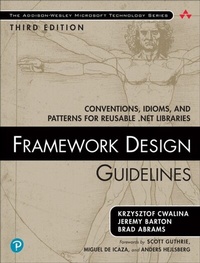
Framework Design Guidelines
Conventions, Idioms, and Patterns for Reusable .NET Libraries
3rd Edition
Published on 10. March 2021
624 pages
978-0-13-589632-7 (ISBN)
Description

Master Today's Best Practices for Building Reusable .NET Frameworks, Libraries, and Components
".NET Core [contains] advances important to cloud application developers: performance, resource utilization, container support, and others. This third edition of Framework Design Guidelines adds guidelines related to changes that the .NET team adopted during transition from the world of client-server application to the world of the Cloud."
-From the Foreword by Scott Guthrie Framework Design Guidelines has long been the definitive guide to best practices for developing components and component libraries in Microsoft .NET. Now, this third edition has been fully revised to reflect game-changing API design innovations introduced by Microsoft through eight recent updates to C#, eleven updates to .NET Framework, and the emergence and evolution of .NET Core.
Three leading .NET architects share the same guidance Microsoft teams are using to evolve .NET, so you can design well-performing components that feel like natural extensions to the platform. Building on the book's proven explanatory style, the authors and expert annotators offer insider guidance on new .NET and C# concepts, including major advances in asynchronous programming and lightweight memory access. Throughout, they clarify and refresh existing content, helping you take full advantage of best practices based on C# 8, .NET Framework 4.8, and .NET Core.
Discover which practices should always, generally, rarely, or never be used-including practices that are no longer recommended
Learn the general philosophy and fundamental principles of modern framework design
Explore common framework design patterns with up-to-date C# examples
Apply best practices for naming, types, extensibility, and exceptions
Learn how to design libraries that scale in the cloud
Master new async programming techniques utilizing Task and ValueTask
Make the most of the Memory and Span types for lightweight memory access
This guide is an indispensable resource for everyone who builds reusable .NET-based frameworks, libraries, or components at any scale: large system frameworks, medium-size reusable layers of large distributed systems, extensions to system frameworks, or even small shared components.
Register your book for convenient access to downloads, updates, and/or corrections as they become available. See inside book for details.
".NET Core [contains] advances important to cloud application developers: performance, resource utilization, container support, and others. This third edition of Framework Design Guidelines adds guidelines related to changes that the .NET team adopted during transition from the world of client-server application to the world of the Cloud."
-From the Foreword by Scott Guthrie Framework Design Guidelines has long been the definitive guide to best practices for developing components and component libraries in Microsoft .NET. Now, this third edition has been fully revised to reflect game-changing API design innovations introduced by Microsoft through eight recent updates to C#, eleven updates to .NET Framework, and the emergence and evolution of .NET Core.
Three leading .NET architects share the same guidance Microsoft teams are using to evolve .NET, so you can design well-performing components that feel like natural extensions to the platform. Building on the book's proven explanatory style, the authors and expert annotators offer insider guidance on new .NET and C# concepts, including major advances in asynchronous programming and lightweight memory access. Throughout, they clarify and refresh existing content, helping you take full advantage of best practices based on C# 8, .NET Framework 4.8, and .NET Core.
Discover which practices should always, generally, rarely, or never be used-including practices that are no longer recommended
Learn the general philosophy and fundamental principles of modern framework design
Explore common framework design patterns with up-to-date C# examples
Apply best practices for naming, types, extensibility, and exceptions
Learn how to design libraries that scale in the cloud
Master new async programming techniques utilizing Task and ValueTask
Make the most of the Memory and Span types for lightweight memory access
This guide is an indispensable resource for everyone who builds reusable .NET-based frameworks, libraries, or components at any scale: large system frameworks, medium-size reusable layers of large distributed systems, extensions to system frameworks, or even small shared components.
Register your book for convenient access to downloads, updates, and/or corrections as they become available. See inside book for details.
All prices
More details
Series
Edition
3rd edition
Language
English
Place of publication
Boston
United States
Publishing group
Pearson Education (US)
Target group
Professional and scholarly
File size
30,38 MB
ISBN-13
978-0-13-589632-7 (9780135896327)
Copyright in bibliographic data and cover images is held by Nielsen Book Services Limited or by the publishers or by their respective licensors: all rights reserved.
Schweitzer Classification
Other editions
Additional editions
Krzysztof Cwalina | Jeremy Barton | Brad Abrams
Framework Design Guidelines
Conventions, Idioms, and Patterns for Reusable .NET Libraries
Book
08/2020
3rd Edition
Addison Wesley
€60.50
Shipment within 15-20 days
Persons
Krzysztof Cwalina is a Principal Architect at Microsoft. He was a founding member of the .NET Framework team, and throughout his career has designed many .NET Framework, .NET Core, and other APIs. He is currently working on Azure SDK APIs. Krzysztof graduated with BS and MS in computer science from the University of Iowa.
Jeremy Barton is a Principal Software Engineer at Microsoft. The majority of his career in computer software has been on the design and development of shared libraries. Since 2005 his primary programming language is C#, and he joined the .NET Base Class Libraries team in 2015 and is primarily responsible for .NET Cryptography. Jeremy graduated from Rose-Hulman Institute of Technology with a BS in Computer Science and Discrete Mathematics. Since graduation, he has gotten a cat, married, and a pilot's license.
Brad Abrams was a founding member of the Common Language Runtime and .NET Framework teams at Microsoft Corporation. He has been designing parts of the .NET Framework since 1998 and is currently a Group Program Manager at Google. Brad started his framework design career building the Base Class Library (BCL) that ships as a core part of the .NET Framework. Brad was also the lead editor on the Common Language Specification (CLS), the .NET Framework Design Guidelines, and the libraries in the ECMA/ISO CLI Standard. Brad has authored and coauthored multiple publications, including Programming in the .NET Environment and .NET Framework Standard Library Annotated Reference, Volumes 1 and 2. Brad graduated from North Carolina State University with a BS in computer science. You can find his most recent musings on his blog at http://blogs.msdn.com/BradA.
Jeremy Barton is a Principal Software Engineer at Microsoft. The majority of his career in computer software has been on the design and development of shared libraries. Since 2005 his primary programming language is C#, and he joined the .NET Base Class Libraries team in 2015 and is primarily responsible for .NET Cryptography. Jeremy graduated from Rose-Hulman Institute of Technology with a BS in Computer Science and Discrete Mathematics. Since graduation, he has gotten a cat, married, and a pilot's license.
Brad Abrams was a founding member of the Common Language Runtime and .NET Framework teams at Microsoft Corporation. He has been designing parts of the .NET Framework since 1998 and is currently a Group Program Manager at Google. Brad started his framework design career building the Base Class Library (BCL) that ships as a core part of the .NET Framework. Brad was also the lead editor on the Common Language Specification (CLS), the .NET Framework Design Guidelines, and the libraries in the ECMA/ISO CLI Standard. Brad has authored and coauthored multiple publications, including Programming in the .NET Environment and .NET Framework Standard Library Annotated Reference, Volumes 1 and 2. Brad graduated from North Carolina State University with a BS in computer science. You can find his most recent musings on his blog at http://blogs.msdn.com/BradA.
Content
Figures xvii
Tables xix
Foreword to the Third Edition xxi
Foreword to the Second Edition xxiii
Foreword to the First Edition xxv
Preface xxvii
Acknowledgments xxxiii
About the Authors xxxv
About the Annotators xxxvii
Chapter 1: Introduction 1
1.1 Qualities of a Well-Designed Framework 3
Chapter 2: Framework Design Fundamentals 9
2.1 Progressive Frameworks 12
2.2 Fundamental Principles of Framework Design 15
Chapter 3: Naming Guidelines 41
3.1 Capitalization Conventions 42
3.2 General Naming Conventions 52
3.3 Names of Assemblies, DLLs, and Packages 61
3.4 Names of Namespaces 63
3.5 Names of Classes, Structs, and Interfaces 67
3.6 Names of Type Members 74
3.7 Naming Parameters 79
3.8 Naming Resources 81
Chapter 4: Type Design Guidelines 83
4.1 Types and Namespaces 85
4.2 Choosing Between Class and Struct 89
4.3 Choosing Between Class and Interface 92
4.4 Abstract Class Design 100
4.5 Static Class Design 102
4.6 Interface Design 104
4.7 Struct Design 106
4.8 Enum Design 111
4.9 Nested Types 124
4.10 Types and Assembly Metadata 127
4.11 Strongly Typed Strings 129
Chapter 5: Member Design 135
5.1 General Member Design Guidelines 135
5.2 Property Design 158
5.3 Constructor Design 165
5.4 Event Design 175
5.5 Field Design 180
5.6 Extension Methods 184
5.7 Operator Overloads 192
5.8 Parameter Design 202
5.9 Using Tuples in Member Signatures 220
Chapter 6: Designing for Extensibility 227
6.1 Extensibility Mechanisms 227
6.2 Base Classes 242
6.3 Sealing 244
Chapter 7: Exceptions 249
7.1 Exception Throwing 254
7.2 Choosing the Right Type of Exception to Throw 260
7.3 Using Standard Exception Types 273
7.4 Designing Custom Exceptions 279
7.5 Exceptions and Performance 281
Chapter 8: Usage Guidelines 287
8.1 Arrays 287
8.2 Attributes 291
8.3 Collections 294
8.4 DateTime and DateTimeOffset 306
8.5 ICloneable 308
8.6 IComparable and IEquatable 309
8.7 IDisposable 311
8.8 Nullable 311
8.9 Object 312
8.10 Serialization 319
8.11 Uri 321
8.12 System.Xml Usage 323
8.13 Equality Operators 324
Chapter 9: Common Design Patterns 329
9.1 Aggregate Components 329
9.2 The Async Patterns 339
9.3 Dependency Properties 365
9.4 Dispose Pattern 372
9.5 Factories 394
9.6 LINQ Support 400
9.7 Optional Feature Pattern 408
9.8 Covariance and Contravariance 412
9.9 Template Method 423
9.10 Timeouts 426
9.11 XAML Readable Types 427
9.12 Operating on Buffers 430
9.13 And in the End... 464
Appendix A: C# Coding Style Conventions 465
A.1 General Style Conventions 466
A.2 Naming Conventions 480
A.3 Comments 482
A.4 File Organization 483
Appendix B: Obsolete Guidance 487
Appendix C: Sample API Specification 523
Appendix D: Breaking Changes 529
D.1 Modifying Assemblies 530
D.2 Adding Namespaces 531
D.3 Modifying Namespaces 532
D.4 Moving Types 532
D.5 Removing Types 533
D.6 Modifying Types 534
D.7 Adding Members 539
D.8 Moving Members 541
D.9 Removing Members 542
D.10 Overloading Members 544
D.11 Changing Member Signatures 545
D.12 Changing Behavior 553
D.13 A Final Note 556
Glossary 557
Index 563
Tables xix
Foreword to the Third Edition xxi
Foreword to the Second Edition xxiii
Foreword to the First Edition xxv
Preface xxvii
Acknowledgments xxxiii
About the Authors xxxv
About the Annotators xxxvii
Chapter 1: Introduction 1
1.1 Qualities of a Well-Designed Framework 3
Chapter 2: Framework Design Fundamentals 9
2.1 Progressive Frameworks 12
2.2 Fundamental Principles of Framework Design 15
Chapter 3: Naming Guidelines 41
3.1 Capitalization Conventions 42
3.2 General Naming Conventions 52
3.3 Names of Assemblies, DLLs, and Packages 61
3.4 Names of Namespaces 63
3.5 Names of Classes, Structs, and Interfaces 67
3.6 Names of Type Members 74
3.7 Naming Parameters 79
3.8 Naming Resources 81
Chapter 4: Type Design Guidelines 83
4.1 Types and Namespaces 85
4.2 Choosing Between Class and Struct 89
4.3 Choosing Between Class and Interface 92
4.4 Abstract Class Design 100
4.5 Static Class Design 102
4.6 Interface Design 104
4.7 Struct Design 106
4.8 Enum Design 111
4.9 Nested Types 124
4.10 Types and Assembly Metadata 127
4.11 Strongly Typed Strings 129
Chapter 5: Member Design 135
5.1 General Member Design Guidelines 135
5.2 Property Design 158
5.3 Constructor Design 165
5.4 Event Design 175
5.5 Field Design 180
5.6 Extension Methods 184
5.7 Operator Overloads 192
5.8 Parameter Design 202
5.9 Using Tuples in Member Signatures 220
Chapter 6: Designing for Extensibility 227
6.1 Extensibility Mechanisms 227
6.2 Base Classes 242
6.3 Sealing 244
Chapter 7: Exceptions 249
7.1 Exception Throwing 254
7.2 Choosing the Right Type of Exception to Throw 260
7.3 Using Standard Exception Types 273
7.4 Designing Custom Exceptions 279
7.5 Exceptions and Performance 281
Chapter 8: Usage Guidelines 287
8.1 Arrays 287
8.2 Attributes 291
8.3 Collections 294
8.4 DateTime and DateTimeOffset 306
8.5 ICloneable 308
8.6 IComparable and IEquatable 309
8.7 IDisposable 311
8.8 Nullable 311
8.9 Object 312
8.10 Serialization 319
8.11 Uri 321
8.12 System.Xml Usage 323
8.13 Equality Operators 324
Chapter 9: Common Design Patterns 329
9.1 Aggregate Components 329
9.2 The Async Patterns 339
9.3 Dependency Properties 365
9.4 Dispose Pattern 372
9.5 Factories 394
9.6 LINQ Support 400
9.7 Optional Feature Pattern 408
9.8 Covariance and Contravariance 412
9.9 Template Method 423
9.10 Timeouts 426
9.11 XAML Readable Types 427
9.12 Operating on Buffers 430
9.13 And in the End... 464
Appendix A: C# Coding Style Conventions 465
A.1 General Style Conventions 466
A.2 Naming Conventions 480
A.3 Comments 482
A.4 File Organization 483
Appendix B: Obsolete Guidance 487
Appendix C: Sample API Specification 523
Appendix D: Breaking Changes 529
D.1 Modifying Assemblies 530
D.2 Adding Namespaces 531
D.3 Modifying Namespaces 532
D.4 Moving Types 532
D.5 Removing Types 533
D.6 Modifying Types 534
D.7 Adding Members 539
D.8 Moving Members 541
D.9 Removing Members 542
D.10 Overloading Members 544
D.11 Changing Member Signatures 545
D.12 Changing Behavior 553
D.13 A Final Note 556
Glossary 557
Index 563
