

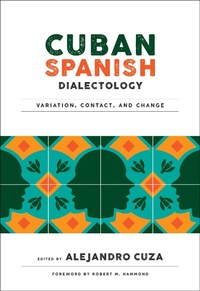
Cuban Spanish Dialectology
Description

This volume addresses the lacuna in Cuban Spanish linguistics with a collection of articles from a range of theoretical perspectives and linguistic areas, including phonological and phonetic variation, morphosyntactic approaches, sociolinguistic perspectives, and heritage language acquisition. Given increasing interest in Cuban Spanish among graduate students and faculty, it is a highly relevant contribution to Hispanic linguistics and Cuban Spanish dialectology in particular
More details
Other editions
Additional editions
Person
Alejandro Cuza is full professor of Spanish and linguistics at Purdue University. His primary areas of research include second and heritage language acquisition, child bilingual development, Spanish morphosyntax and semantics, bilingualism/multilingualism, Cuban Spanish.
Content
Illustrations
Foreword
Robert Hammond
Acknowledgments
Introduction
Alejandro Cuza
Part I: Phonological and Phonetic Variation
1. Miami Cuban Vowels
Brandon M. A. Rogers and Scott M. Alvord
2. The Phonetic Output of Word-Internal, Post-nuclear /l/ and // Weakening in Havana Cuban Spanish
Kristin Carlson
3. Code-Switching in Miami Cuban Spanish: A Preliminary Study of Suprasegmental Effects
Ann M. Aly
Part II: Morphosyntactic Variation
4. Continuity and Change in Spanish among Cubans in New York: A Study of Subject Placement with Finite Verbs
Daniel Erker, Eduardo Ho-Fernández, Ricardo Otheguy, and Naomi Shin
5. The Variation of Subject Pronouns over Time in Cuban Spanish
Gabriela G. Alfaraz
6. Cuban Spanish: Is it a Null Subject Parameter Dialect?
Luis A. Ortiz-López, Ashlee Dauphinais, and Héctor Aponte Alequín
7. Recomplementation as an Unexplored Locus of Dialectal Variation: The Status of Reduplicative Que in Cuban Spanish
Joshua Frank and Almeida Jacqueline Toribio
8. The Sociolinguistic Profile of Ser and Estar in Cuban Spanish: An Analysis of Oral Speech
Manuel Díaz-Campos, Iraida Galarza, and Gibran Delgado-Díaz
Part III: Lexical Variation
9. The Social Diffusion of English-Based Lexical Innovations in Miami Cuban Spanish
Andrew Lynch
10. Cuban Spanish versus Peninsular Spanish: A Quantitative Lexical Approach
Pascual Cantos-Gómez
11. Lexical Influences and Perceptions of Cuban Spanish in Miami
Antoni Fernández Parera
Part IV: Heritage Language Acquisition
12. Pronominal Subject Expression with Inanimate Reference in Heritage Speakers of Cuban Spanish
Alejandro Cuza and José Camacho
13. Dative Experiencer Predicates in Child Heritage Speakers of Cuban Spanish
Diego Pascual y Cabo and Inmaculada Gómez-Soler
14. Examining Code-Switching Performance Theories: Copula Choice in Spanish among Cuban Heritage Speakers
Ana de Prada Pérez and Andrea Hernández
List of Contributors
Index
