

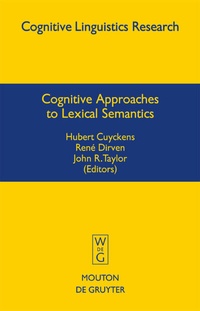
Cognitive Approaches to Lexical Semantics
Description

This collected volume presents radically new directions which are emerging in cognitive lexical semantics research. A number of papers re-ignite the polysemy vs. monosemy debate, and testify to the fact that polysemy is no longer simply taken for granted, but is currently a much more contested issue than it was in the 1980s and 1990s. Other papers offer fresh perspectives on the prototype structure of lexical categories, while generally accepted notions about the radial network structure of categories are questioned in papers on the development of word meaning in child language acquisition and in diachrony. Additional topics include the interaction of lexical and constructional meaning, and the relationship between word meanings and the contexts in which the words are encountered.
This book is of interest to semanticists and cognitive linguists, as well as to scholars working in the broader field of cognitive science.
More details
Other editions
Additional editions
Persons
Content
John Taylor, Hubert Cuyckens and Rene Dirven
Meaning potentials and context: Some consequences for the analysis of variation in meaning
Jens Allwood
Towards a pragmatic model of cognitive onomasiology
Stefan Grondelars and Dirk Geeraerts
Monosemy versus polysemy
Theo A.J.M. Janssen
The grammaticalization of alltsa and saledes: Two Swedish conjuncts revisited
Hanna Lehti-Eklund
Word meaning, sentence meaning, and syntactic meaning
Laura A. Michaelis
Metonymic sense shift: Its origins in hearers' abductive construal of usage in context
Kurt Queller
Growth of a lexical network: Nine English prepositions in acquisition
Sally Rice
Image schemas and category coherence: The case of the Portuguese verb deixar
Augusto Soares da Silva
The Nawatl verb kisa: A case study in polysemy
David Tuggy
A diachronic perspective on prototypicality: The case of Nominal Adjectives in Japanese
Satoshi Uehara
Containment, support, and linguistic relativity
Claude Vandeloise
The Dutch hedges echt and gewoon: Markers of prototypicality?
Christof Vanden Eynde
Polysemy or generality? Mu.
Jordan Zlatev
